
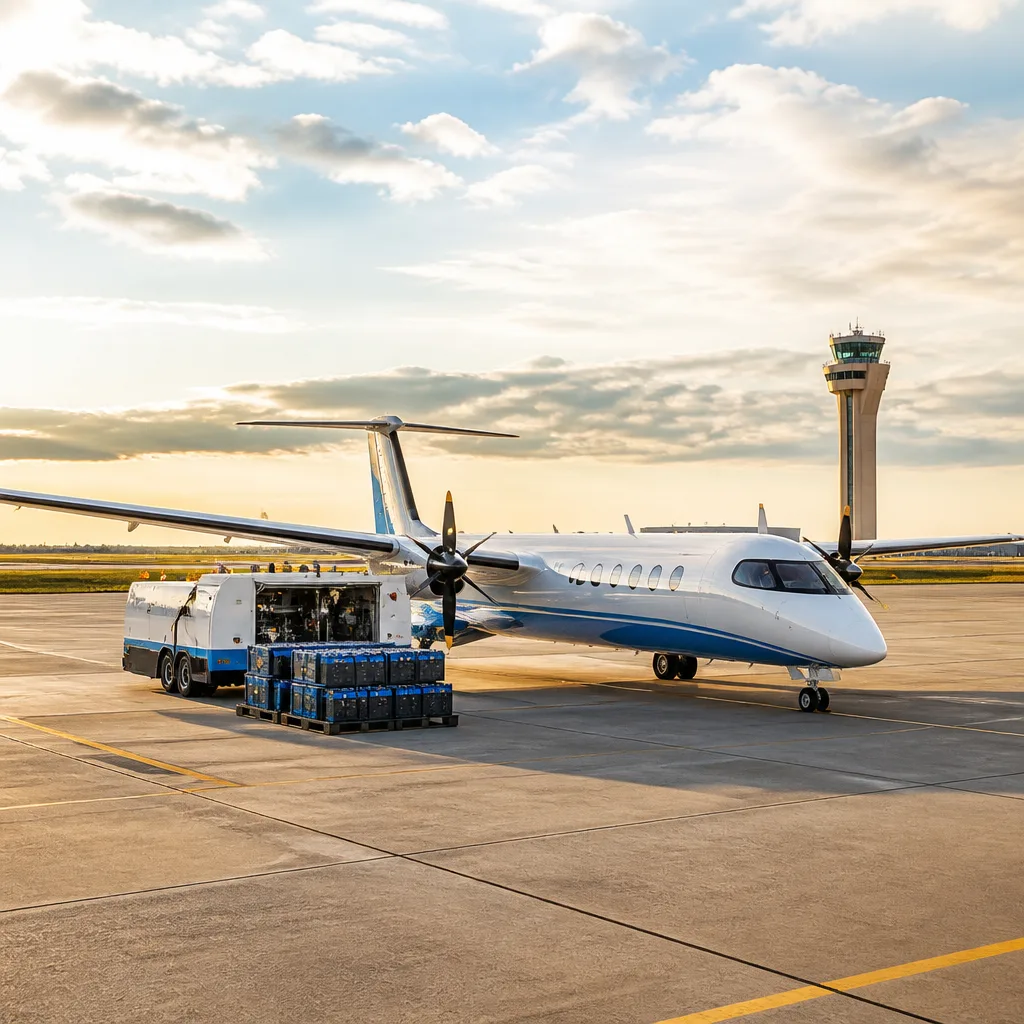
The largest fully battery-powered aeroplane ever built successfully completed its first test flight this month, a milestone for electric aviation that highlights both progress in battery and propulsion technology and the long run of development still ahead before commercial services begin.
What happened
Heart Aerospace’s X1 demonstrator, a battery-only prototype weighing more than an empty school bus, lifted off from a regional airport in upstate New York and remained airborne for 27 minutes. The craft reached about 1,100 feet and was piloted by a single crew member; it carried no passengers. With a wingspan of roughly 106 feet and a length near 76 feet, the X1 is the largest aircraft powered solely by batteries to have flown.
Why it matters
The test is an important technical proof point for an industry that has for years aimed to cut aviation emissions by electrifying short-haul and regional flights. Heart Aerospace has positioned the X1 as a demonstrator for a commercial hybrid-electric model, the ES-30, which the company is developing with an eye to entering service in the early 2030s.
Interest in Heart’s larger programme has already come from major carriers. The ES-30 has drawn non-binding attention from airlines including United, Air Canada and JSX, attracted by the potential for lower maintenance costs and reduced exposure to jet fuel price swings. However, the X1 flight itself is an early stage milestone: demonstrations of range, payload, safety and certification remain necessary before airlines can place operational aircraft into service.
"With the first flight of X1, Heart Aerospace has demonstrated electric flight at the scale of a commercial airliner," Heart’s founder and chief executive said in a statement.
Technical snapshot
- Aircraft type: Battery-electric demonstrator (X1)
- Seats (design target): 30 for the related ES-30 hybrid model
- Wingspan: 106 feet
- Length: 76 feet
- Empty weight (approx): over 25,000 lb
- Test flight duration: 27 minutes
- Maximum altitude reached: 1,100 feet
| Feature | X1 demonstrator |
|---|---|
| Propulsion | Battery-electric |
| Test flight time | 27 minutes |
| Crew | Single pilot |
Context and constraints
Electric propulsion promises lower direct emissions on the flights it can operate, but battery energy density remains the limiting factor for range and payload. The X1’s successful short flight demonstrates that large, airliner-scale structures can be flown using batteries, but a series of further demonstrations — including sustained cruise at higher altitudes, operations with passengers and full certification testing — are required before this technology can be deployed on scheduled routes.
Heart Aerospace relocated its headquarters to Los Angeles in April 2025 from Gothenburg, Sweden, as it accelerated development of the ES-30. The company frames the ES-30 as a hybrid-electric regional airliner, combining electric propulsion with conventional power for longer sectors or backup, a configuration many in the industry consider a pragmatic intermediate step while battery chemistry improves.
Airlines’ early engagement reflects commercial curiosity about lifecyle costs and fuel-price exposure, but interest does not equate to firm orders or regulatory approval. Certification regimes for novel propulsion systems are still evolving and will demand rigorous demonstration of safety, redundancy and operational reliability.
The flight of the X1 is therefore both a technical achievement and a reminder of the gap between demonstrator flights and everyday passenger services. It signals that components of the electric aircraft puzzle — large airframes, battery integration, and electric propulsion — can work together at scale, while highlighting that batteries will need further advances before they can carry passengers on routine regional services.
For the industry, the path ahead will involve continued tests, tighter collaborations with regulators and airlines, and sustained investment in battery supply chains and manufacturing capacity. The X1’s flight is a visible step on that journey.









