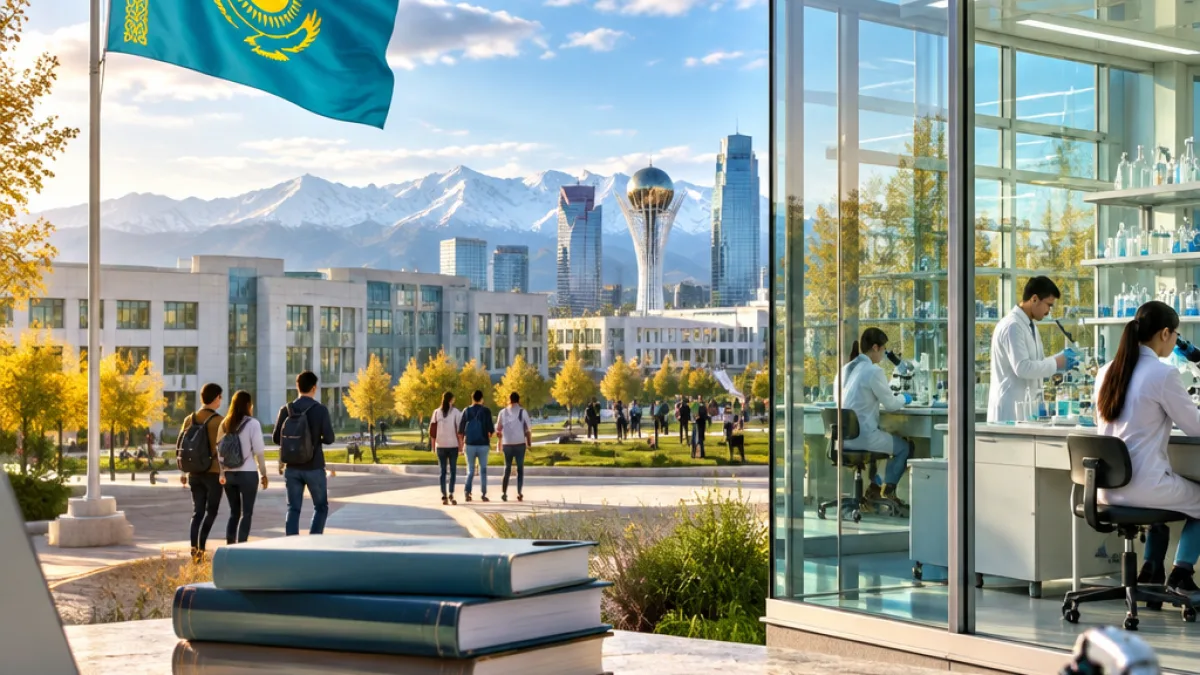
Kazakhstan’s president has identified human capital, education, science and innovation as strategic priorities, presenting them as central to the country’s long-term programme of national renewal.
Speaking at the Third Forum of Strategic Partners on 19 November, Kassym-Jomart Tokayev said Kazakhstan had chosen to develop the capabilities and knowledge that would support its future. His remarks were reported by the Qazinform News Agency, citing the Akorda press service.
A stated direction for national policy
The president described the decision as part of a wider effort to build what he called a “Just Kazakhstan”, where citizens would have equal opportunities and where honest work and responsibility would be valued. Within that framework, education and the development of people’s skills were placed alongside science and innovation as areas of state activity.
“Development of human capital, education, science and innovation has been defined as a strategic area of state activity.”
The statement does not set out a new funding package, timetable or specific changes for schools, colleges or universities. It does, however, establish the government’s declared priorities in a speech focused on the country’s future direction. For pupils, students, teachers and families, the practical significance will depend on how those priorities are translated into policy and institutions.
Education linked to wider national renewal
Tokayev presented the education agenda as part of a broader transformation rather than as an isolated sectoral measure. He said Kazakhstan was pursuing deep renewal as a creative and innovation-oriented nation, linking the development of human capital with the country’s capacity to respond to change.
The president also referred to the nationwide Taza Qazaqstan, or “Clean Kazakhstan”, initiative. According to his remarks, the programme had helped foster a new civic ethic and contributed to changes in public attitudes and behaviour. Its inclusion in the address placed civic responsibility and public conduct alongside education, science and innovation in the account of Kazakhstan’s national development.
- Human capital was identified as a strategic area of state activity.
- Education and science were presented as key elements of the country’s renewal.
- Innovation was linked to Kazakhstan’s ambition to be a creative and forward-looking nation.
- Equal opportunity and responsibility were cited as principles of the proposed “Just Kazakhstan”.
Constitutional and civic principles
In his address, Tokayev connected the government’s priorities with constitutional and civic principles. He recalled the adoption of the Constitution through a nationwide referendum, saying it reflected the aspirations of the people and the country’s vision for the future.
He said Kazakhstan’s sovereignty and independence, territorial integrity, and the lawful rights and freedoms of citizens had been established as fundamental state values. He also pointed to adherence to the principles of Law and Order, stronger national unity and improved public welfare as enduring priorities.
| Area | Position outlined at the forum |
|---|---|
| Human capital | Identified as a strategic area of state activity |
| Education and science | Placed at the centre of national development |
| Innovation | Linked to Kazakhstan’s creative and renewal-focused direction |
| Civic life | Connected with responsibility, unity and public welfare |
International cooperation in the background
The forum also provided an international dimension to the discussion. Tokayev stressed the role of international scientific cooperation in reducing global tensions, according to the account of his remarks. That emphasis places collaboration between researchers and institutions within the same strategic picture as domestic education and innovation.
For the education sector, the address sets out a broad political ambition rather than detailed implementation measures. The source material does not specify changes to curriculum, teacher training, admissions, research grants or student support. Nor does it give figures for investment or identify individual programmes for schools and universities.
The significance of the announcement therefore rests on the prominence given to education and related fields at the highest level of government. Kazakhstan has formally described the growth of human capital, alongside education, science and innovation, as a strategic state responsibility. The next test will be how that declaration is reflected in the decisions that shape learning, research and opportunity across the country.