
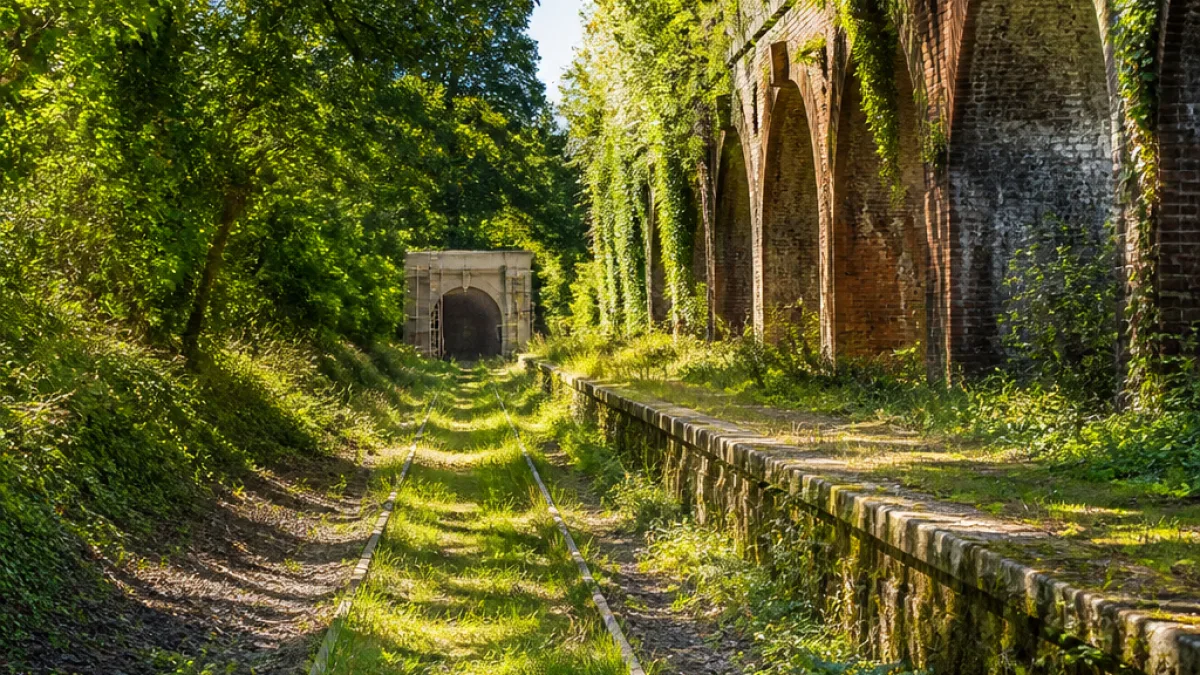
Crouch End is widely admired for its independent shops, community arts and village atmosphere. What many residents and visitors pass every day without noticing is that the neighbourhood’s quiet, green spine was once a busy railway. The line that last carried passengers in 1954 has since been reclaimed by nature to become the Parkland Walk, the capital’s longest urban nature reserve.
From Victorian branch line to interrupted modernisation
The track through Crouch End opened in 1867 under the Great Northern Railway, providing steam services between Alexandra Palace and Finsbury Park. In the 1930s, a comprehensive London Passenger Transport Board programme sought to convert that branch into an extension of the Northern line, bringing electric Tube services to neighbourhoods that still lack an Underground station.
Preparatory works were already underway. Platforms at Crouch End were raised and rebuilt in concrete and brick to accommodate trains of both mainline and Underground stock. Electrification works began on parts of the line. But the scheme was interrupted in 1939 by the outbreak of the Second World War and never resumed.
Maps, decline and closure
Even into the 1950s, Tube maps continued to show the branch as being "under construction", signalling a project that had stalled but not yet been altogether abandoned. In 1953 officials concluded that passenger numbers did not justify completing the electrification and modernisation. The decline in viable services followed and the line closed to passengers in 1954.
Rewilding the route
Tracks were lifted and platform buildings removed over subsequent years. Around three decades after the last passenger train left, the disused corridor was transformed into the Parkland Walk — a continuous green pathway stretching roughly 3.5 kilometres between Alexandra Palace and Finsbury Park. Today it is celebrated as London’s longest linear nature reserve, a wildlife corridor threaded through an otherwise built-up part of the city.
The walk is punctuated by reminders of its past and civic art from more recent decades — most notably the Spriggan sculpture, installed in the 1990s and now a familiar landmark for families and dog-walkers using the path.
What the lost line tells us about planning and priorities
The aborted extension holds lessons about how wartime disruption and post-war resource decisions can permanently alter urban development. Had the Northern line branch been completed, travel patterns and local commerce in Crouch End, Highgate and Muswell Hill might look very different today. Instead, the absence of a Tube station has helped preserve a low-rise, community-focused character that residents often cite as part of the area’s appeal.
- Key dates: 1867 – branch opens; 1930s – Northern line extension planned and partial work begun; 1939 – works halted by war; 1953 – decision not to electrify; 1954 – passenger services end.
- Current use: Parkland Walk, London’s longest linear nature reserve, linking Alexandra Palace and Finsbury Park.
- Notable feature: The Spriggan sculpture, a local landmark since the 1990s.
Timeline
| Year | Event |
|---|---|
| 1867 | Branch line opened by Great Northern Railway |
| 1930s | London Passenger Transport Board proposes Northern line extension; platform works begin |
| 1939 | Work halted due to Second World War |
| 1953 | Decision taken not to proceed with electrification |
| 1954 | Last passenger service runs; line closed to passengers |
| c.1980s | Corridor formally repurposed as Parkland Walk (approximate reclamation period) |
Practical note for readers
For local residents and visitors the Parkland Walk is more than a piece of transport archaeology: it is a daily amenity that supports biodiversity and outdoor recreation. Entrances and access points are spread along the route between Alexandra Palace and Finsbury Park, and the path is widely used by walkers, runners and cyclists. The line's conversion into green space demonstrates how infrastructure decisions can yield unintended civic benefits decades later.
The story of Crouch End’s lost train line is a reminder that the urban landscape is constantly being remade — sometimes by grand engineering plans, at other times by quiet reclamation where nature and communities take over spaces that modern planners once intended for steel and signals.
Reporting from north London.















