
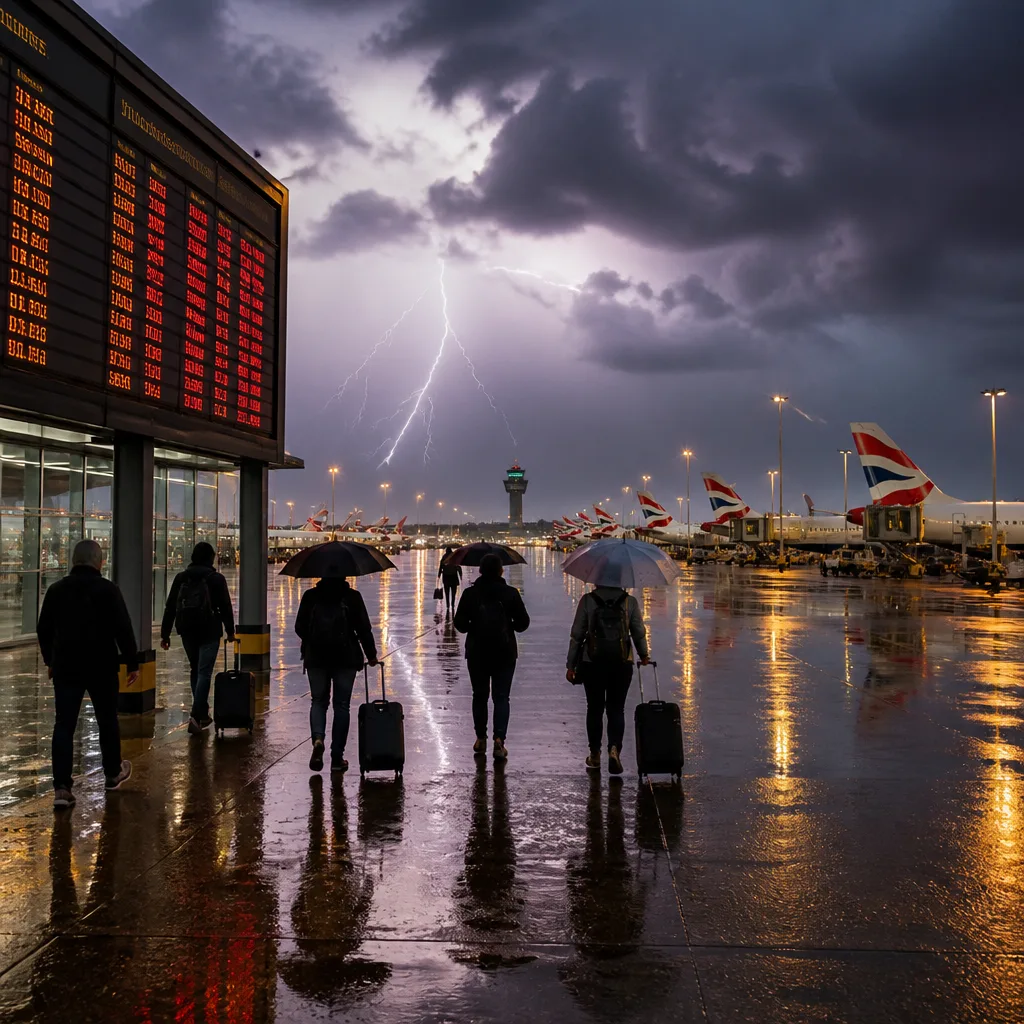
Severe summer thunderstorms around London in late June forced air traffic controllers to reroute aircraft and left travellers facing widespread delays and cancellations, industry figures say — a disruption they warn may become more frequent as the climate warms.
Chaos at peak travel time
On a busy Saturday at the start of the holiday season, thunderstorms over the south of England and northern Europe caused significant congestion in the airspace serving London’s airports. In total, around 900 flights to and from Heathrow and Gatwick were delayed — some by as much as 11 hours — with dozens more cancelled. Passengers arriving into the UK also experienced long holds and uncertainty at other European airports.
The immediate consequences were stark: lengthy waits for travellers, frustrated families and additional costs for airlines and airports managing disrupted schedules and passenger care. Industry voices say the June episode should serve as a warning rather than a one-off.
Industry concern over growing unpredictability
Tim Atkinson, an airline risk consultant and former pilot, warned that the high density of traffic over the UK and northern Europe makes the region especially vulnerable. He said the area could face situations in which multiple London airports are affected at once, causing sudden loss of real-time operations with little notice.
"What we're seeing now is very rapid climate change. We're going from the kind of weather activity which takes out an airport, and which the system kind of copes with… to a situation where, with very little predictability, it would be possible to lose all of the London airports from real-time operation quite swiftly and with little notice"
Such an eventuality, he added, would amplify disruption both in the air and on the ground and raise costs across the aviation sector.
Consequences and preparations
Aircraft are dependent on cleared airspace and steady flows of arrivals and departures. When major storm cells force rerouting, sequencing and spacing of flights change, causing knock-on delays that can ripple across days. For passengers this means missed connections, hotel costs and crowded airports; for airlines and airports it means schedule recovery challenges and higher operating expenses.
Industry sources emphasise that the timing of the June storms was particularly unlucky, but that the pattern of intense, less-predictable weather is consistent with expectations for a warming climate. The risk is not confined to England: similar disturbances across northern Europe contributed to the regional congestion.
- Immediate impact: Around 900 flights delayed; some delays up to 11 hours; dozens cancelled.
- System vulnerability: Dense air traffic over UK and northern Europe increases risk of simultaneous disruption across multiple airports.
- Longer-term risk: Experts warn of increasing frequency and unpredictability of severe weather linked to climate change.
| Metric | Reported figure |
|---|---|
| Flights delayed at Heathrow and Gatwick | ~900 |
| Maximum reported delay | 11 hours |
| Flights cancelled | Dozens |
Policymakers and airport operators will need to weigh how to build greater resilience into the system. Options include enhanced weather forecasting and earlier contingency planning, investment in flexible slot management, and coordination across European airspace authorities to reduce the risk of simultaneous disruption.
For travellers, the episode underlines the value of planning for the unexpected during summer travel peaks — including insurance, flexible tickets where possible, and allowing extra time for connections. For the aviation industry, the lesson is towards anticipating not only isolated incidents but potentially more frequent, simultaneous events across a highly interconnected airspace as the climate changes.
The June events were a reminder that even routine travel days can be swiftly upended by extreme weather. With experts pointing to a trend of more volatile conditions, the cost and complexity of keeping Britain’s skies moving could increase substantially unless the system adapts.















