
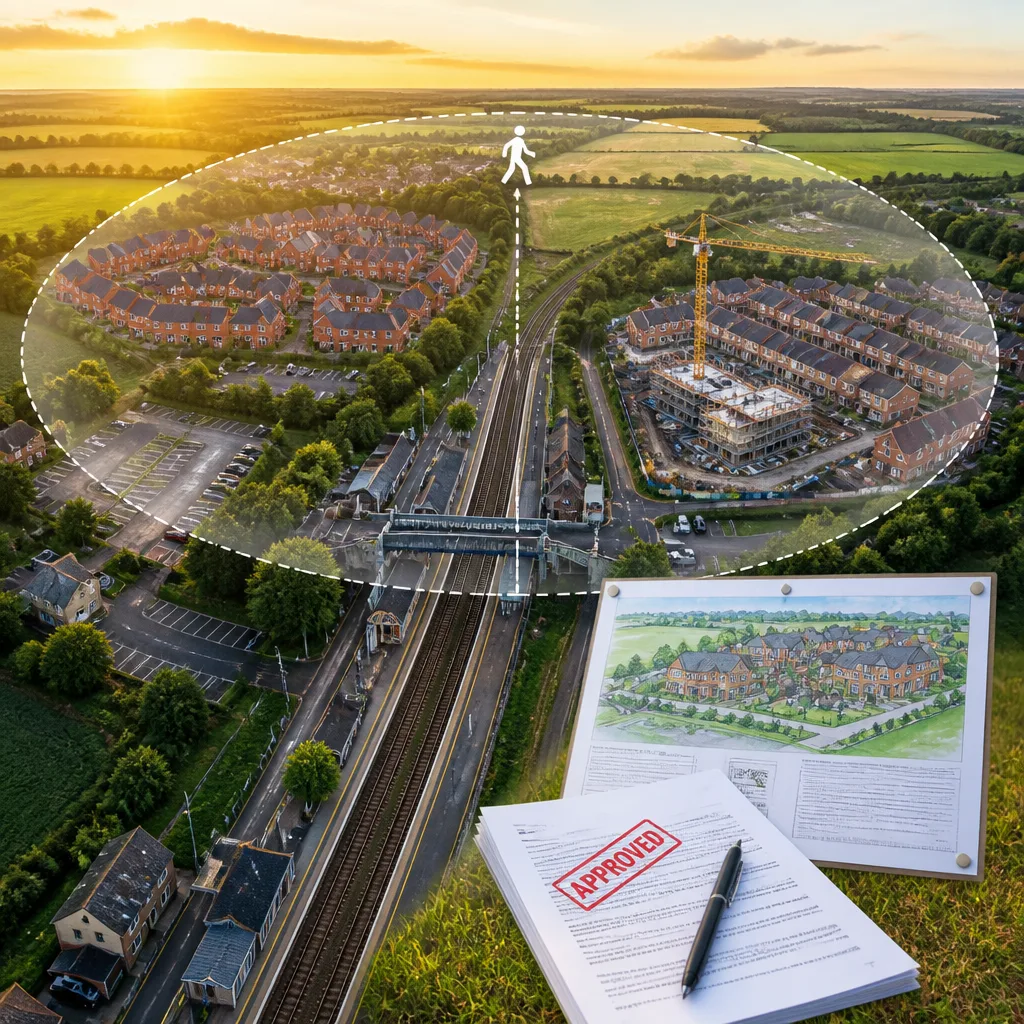
The UK government has introduced a new presumption in favour of housebuilding within a short walk of rail stations in England, part of revised planning guidance designed to accelerate delivery of its national housing pledge.
Under changes to the National Planning Policy Framework, developments located within a ten-minute walk of a railway station will be treated favourably, with ministers establishing a “default yes” for housing in those locations. The move is intended to unlock thousands of new homes and to concentrate growth where public transport access is strongest.
Policy aims and context
Government ministers are framing the change as a tool to help reach the target of building 1.5 million new homes by 2029. Officials acknowledge the scale of the task: two years into the current five-year parliament the government is around a quarter of the way towards that target.
Detail released this morning sets a minimum performance expectation for transport access in qualifying areas. One reported criterion is that nearby rail stations should be able to operate at least four trains per hour into a large urban centre — a measure intended to ensure developments are genuinely well connected.
Green belt and controversy
The policy change has prompted immediate questions about the fate of the green belt. The housing minister confirmed that the new presumption can apply to sites outside existing settlements, including green belt locations, where the station is well connected.
“For well-connected stations outside of settlements, including the greenbelt, that default policy applies,” the housing minister told Sky News.
He argued that the shortage of deliverable brownfield land in many areas means the government must consider alternative sites, including lower-quality green belt land, in exceptional circumstances. He added that a sequential approach will be used to identify the least harmful land first.
Reaction and implications
Campaigners who prioritise green belt protection have warned of a possible backlash. Local residents, planning groups and conservation organisations are likely to contest developments on green belt land, particularly where schemes are large or seen as eroding the purpose of the protected zone. Councils will be placed under pressure to reconcile local plans with the central presumption favouring housing near stations.
Political parties and commentators are expected to frame the change differently. Supporters will point to quicker delivery and better use of public transport; critics will argue that it weakens longstanding protections and risks ill-considered development.
- What qualifies: Sites within a ten-minute walk of a rail station, with minimum rail frequency thresholds reported as part of the criteria.
- Objective: Help achieve a national target of 1.5m homes by 2029.
- Timing: Measures form part of an updated National Planning Policy Framework published by ministers.
Practical effects on planning decisions
The change operates at the policy level of the planning framework rather than directly amending local plan rules, but it will influence decisions by local planning authorities and developers. Where the presumption applies, applications for housing may receive more favourable treatment than previously, shifting the balance in marginal cases.
The guidance also sets expectations for minimum housing delivery in station-adjacent areas. How councils apply the sequential approach to site selection — prioritising previously developed or lower-quality land before considering prime green belt — will be crucial in determining the policy’s environmental and social impact.
| Policy element | Reported detail |
|---|---|
| Distance from station | Within a ten-minute walk |
| Rail frequency | Minimum of four trains per hour into a major urban area (reported) |
| National target | 1.5 million homes by 2029 |
The government will now face the task of translating broad policy intent into workable local arrangements. Developers, local authorities and campaign groups will be watching closely to see which sites are prioritised and how the balance between housing delivery and environmental protection is struck.












