
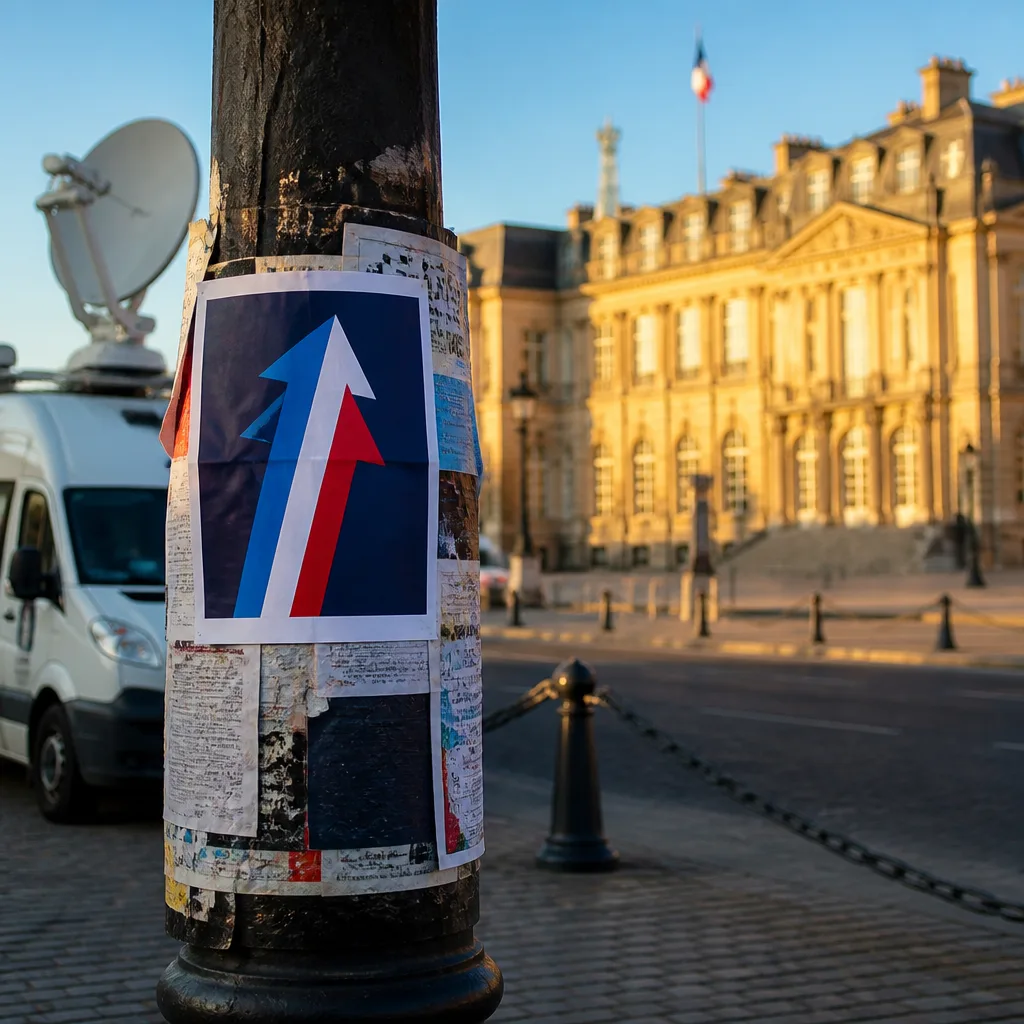
Raphaël Glucksmann has formally entered the contest for France's presidency, telling TF1 he intends to "lift up France" as he joins a crowded field of left, centrist and far-right candidates vying for the Élysée next year.
Announcement and immediate fallout
Glucksmann, a 46-year-old Member of the European Parliament and leader of the centre-left party Place Publique, confirmed his decision on Sunday on TF1. He said the move was not taken lightly given current national circumstances and voiced alarm at developments he described as making everyone feel "a knot in the stomach".
His candidacy is expected to trigger a declaration from his partner, Léa Salamé, a prominent newsreader at France 2, that she will step aside from her role to avoid any perceived conflict of interest in the campaign, according to the reporting.
Where he sits in a crowded contest
Glucksmann will compete in a race that includes multiple figures on the left and centre, as well as the well-known far-right leader Marine Le Pen, who is widely viewed as a serious contender. President Emmanuel Macron is ineligible to run for a third term under the constitution.
Polling gives Glucksmann a level of public support estimated at about 10–12%, a score the report characterised as respectable but likely short of what would be needed to reach a second-round run-off.
"Yes, I am a candidate in the presidential election," Glucksmann said on TF1, adding his aim was to "lift up France."
Background and political positioning
Described in the coverage as outside "classical political" circles, Glucksmann has a background that includes humanitarian work in Rwanda and a spell advising Mikheil Saakashvili, the former Georgian president and outspoken opponent of Moscow. Saakashvili is now imprisoned in Georgia.
His appeal among younger voters has been noted in commentary, sometimes referred to as "Glucksmania". Nevertheless, analysts in the reporting suggest that the fragmentation of the left and centrist vote could constrain any single candidate's ability to challenge the far right.
Party manoeuvres and the left's strategy
To blunt vote-splitting on the left, Place Publique and the Socialist Party have plans to hold a primary in October to select a unified candidate. Glucksmann, however, has made clear he will not be part of a traditional political establishment, signalling potential friction over any negotiated candidacy.
- Candidate: Raphaël Glucksmann, 46, MEP and Place Publique leader
- Poll standing: around 10–12% (as reported)
- Timing: Presidential election scheduled for next year; primary planned by some left parties in October
| Element | Detail |
|---|---|
| Glucksmann's role | MEP; leader of Place Publique |
| Public support (reported) | 10–12% |
| Planned left primary | October (Socialists and Place Publique) |
Consequences and context
Glucksmann's entry increases pressure on left and centrist forces to co-ordinate ahead of the first round of voting. With a multiplicity of candidates including the far-left leader Jean-Luc Mélenchon, the Greens' Marine Tondelier and potential bids from the Socialist leadership and even a contemplated run by former president François Hollande, the first round could reflect a deeply fragmented electorate.
If current polling holds, the left risks failing to consolidate behind a single contender strong enough to beat the far-right in the initial rounds, a dynamic that could favour Marine Le Pen should she maintain or improve her position.
Glucksmann's emphasis on being outside conventional party networks, his humanitarian and advisory background, and his resonance with younger voters will shape both his message and the tactical calculations of rival campaigns as the calendar moves towards an October primary and the election next year.
For now, his declaration makes him an active participant in what is shaping up to be one of the most contested presidential contests in recent French history.












