
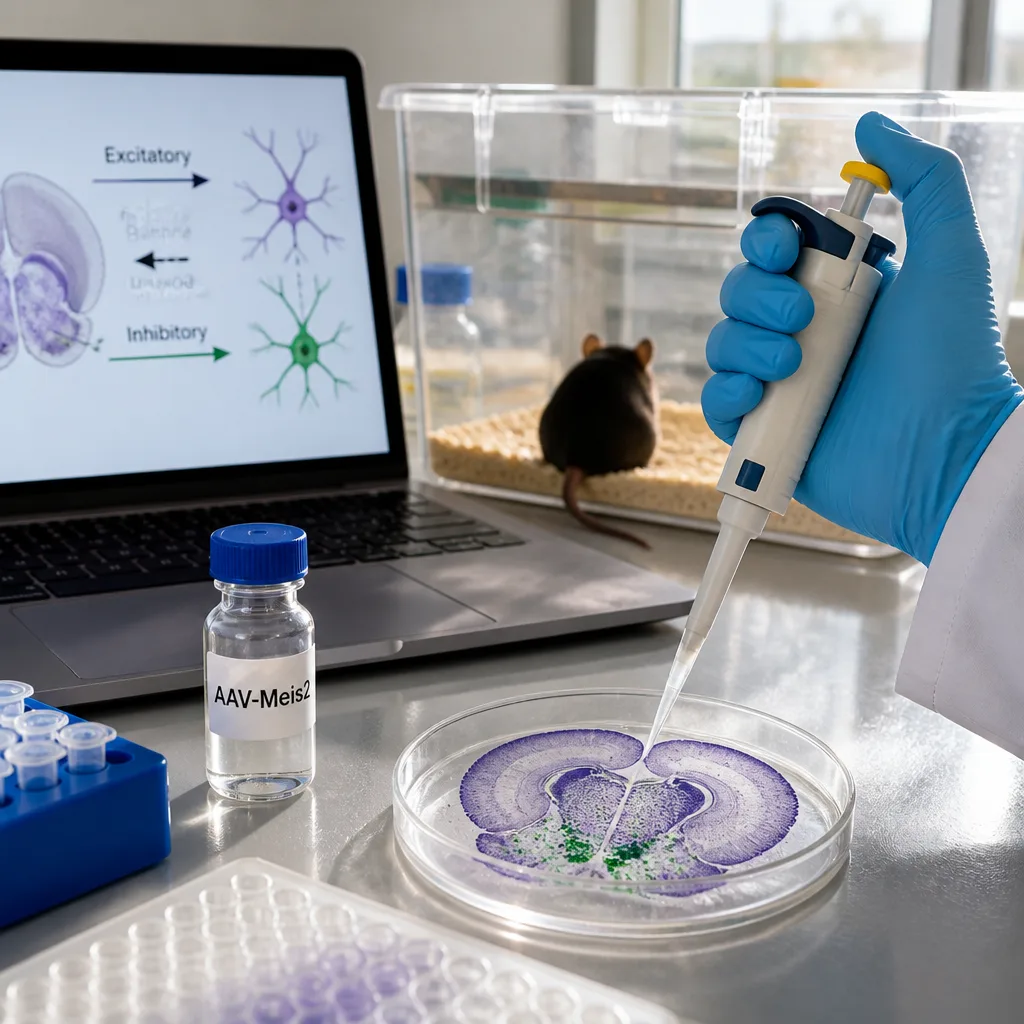
Researchers have shown in preclinical experiments that increasing expression of the gene Meis2 in a specific class of inhibitory neurons can reverse several brain network deficits linked to neurodevelopmental disorders (NDDs), including improvements in memory and a reduction in seizures.
Targeting parvalbumin neurons to restore plasticity
A team led by investigators at Mass General Brigham screened genes that regulate the plasticity of parvalbumin inhibitory neurons, cells that modulate the balance between excitation and inhibition in cortical circuits. They identified Meis2 as a candidate because it is expressed at low levels in these neurons under baseline conditions but increases in response to experience. Using gene therapy to raise Meis2 levels in an established mouse model of NDD, the researchers report a restoration of experience‑dependent plasticity.
The intervention reportedly rebalanced cortical excitation and inhibition, improved measures of spatial and social memory, lowered seizure frequency and corrected abnormal patterns of brain network activity that are important for cognition.
“Cognitive impairment and seizures are hallmarks of neurodevelopmental disorders and represent a large, unmet clinical need,” said Amar Sahay, senior author and researcher at Mass General Brigham. “We show in proof‑of‑concept studies that targeting one candidate gene could be sufficient to reverse developmental deficits, even in adulthood.”
What the study shows — and what it does not
The work is preclinical and performed in mouse models used widely to study NDDs such as autism spectrum disorder and epilepsy. The results indicate functional recovery across a set of measures rather than a single biomarker: cellular plasticity, behavioural memory tests and seizure occurrence were all reported to improve after Meis2 up‑regulation in parvalbumin neurons.
Key points reported by the team include:
- Gene identification: a screen for genes affecting parvalbumin neuron plasticity highlighted Meis2.
- Expression change: Meis2 is normally low in these cells but increases with experience.
- Therapeutic effect: boosting Meis2 restored plasticity, improved memory measures and reduced seizure frequency in the mouse model.
| Aspect | Reported result |
|---|---|
| Neuronal plasticity | Restored in parvalbumin neurons |
| Memory | Improved spatial and social memory |
| Seizures | Reduced frequency |
| Network activity | Abnormalities corrected |
Crucially, the study is a proof‑of‑concept demonstration that manipulating a single gene in a defined neuronal population can have wide‑ranging effects on circuit function. The authors caution that the path from mechanism identification to a human therapy is long and complex.
Implications and next steps
If the findings translate beyond the specific mouse models used, they open a route to treatments that target circuit function rather than attempting to correct many diverse genetic risk factors directly. For families affected by disorders that combine cognitive impairment and seizures, an approach that restores inhibitory neuron plasticity could be transformative. But translation will require substantial additional work: safety and delivery in larger brains, durability of effect, off‑target consequences and whether the same mechanism operates across genetically and clinically diverse human NDDs.
The research also underlines a broader strategy in neurotherapeutics: identify nodal points in circuit physiology that integrate multiple risk pathways, and target those nodes to produce broader functional recovery. Here, parvalbumin inhibitory neurons and the regulation of Meis2 represent such a node in the mouse models studied.
Publication details: the preclinical results are described in a paper in Nature. The study was led by co‑first authors Yu‑Tzu Shih and Jason Alipio and senior author Amar Sahay of Mass General Brigham and the Broad Institute.
As always with early laboratory work, cautious optimism is warranted. The next stages will determine whether the promise seen in mice can be developed into safe and effective interventions for people.









