
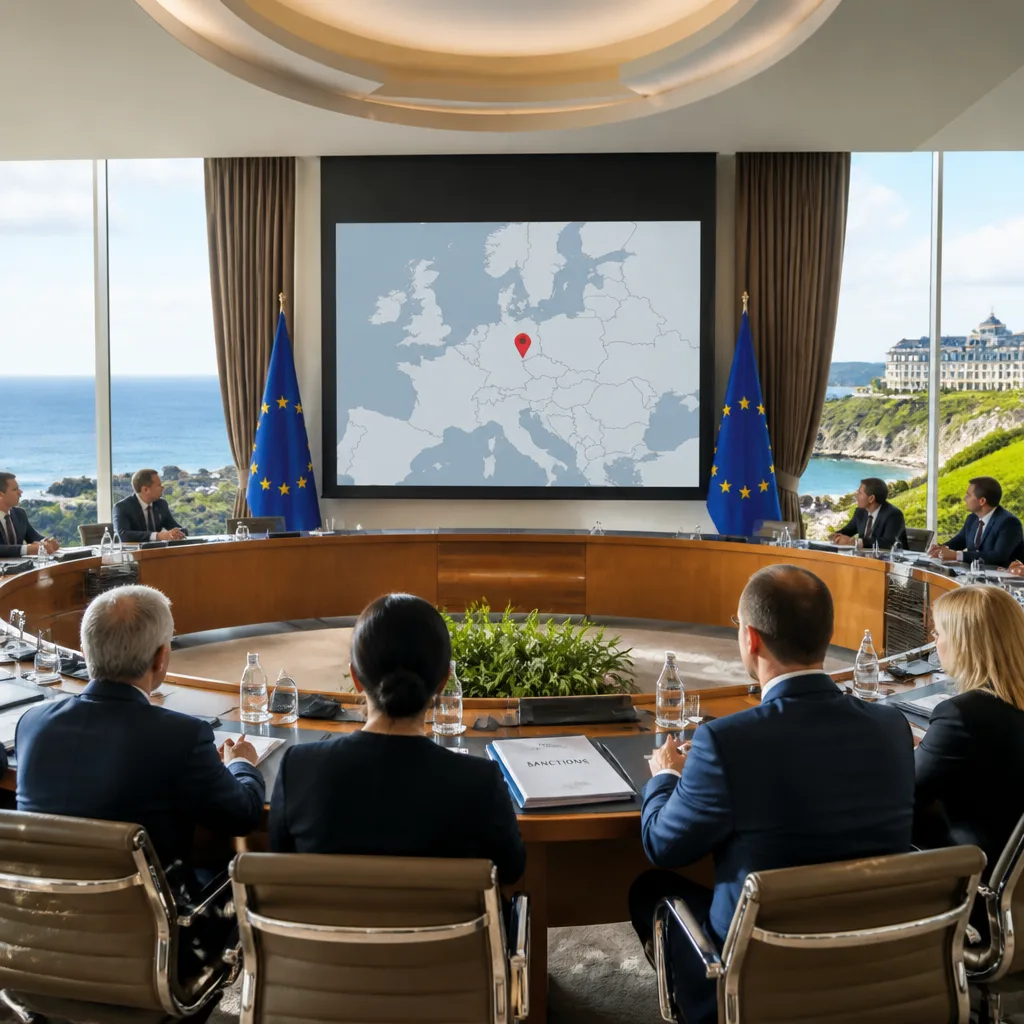
European Union foreign ministers gathered on Ireland’s east coast on Wednesday to consider how the bloc should respond after Germany accused Russia of attempting a bombing at Leipzig/Halle airport. Leaders issued united public statements condemning the incident, but ministers left the meeting without announcing a comprehensive new package of measures.
Diplomatic actions taken so far
Berlin has already taken direct action: a Russian consulate in Bonn was closed and a Russian cultural centre in the German capital was shuttered. France summoned the Russian ambassador to Paris. Those steps reflect a wider push by several member states for harder responses to what national leaders describe as a dangerous escalation.
“The question is what can we do about this,” said Kaja Kallas, the EU’s chief diplomat, signalling the urgency felt in capitals.
At the Wicklow meeting, ministers discussed a range of possible responses, from additional sanctions to tighter restrictions on Russian diplomatic activities in the EU. Poland’s foreign minister Radosław Sikorski urged measures aimed at making life more difficult for Russian operatives in Europe, describing the overall situation as part of a broader campaign of hostility.
Sanctions and security measures under consideration
Officials said there is momentum around expanding listings linked to the Russian military and defence industry. One figure cited at the meeting was some 1,600 existing listings of people and entities tied to Russia’s military complex that could be built on. However, ministers stopped short of approving a fresh, unified sanctions package at this session.
- Germany closed a consulate in Bonn and a cultural centre in Berlin.
- France summoned the Russian ambassador.
- Calls from several eastern and central European states for expulsions of diplomats and tighter visa rules.
Irish foreign minister Helen McEntee described the episode as more than a typical “hybrid” threat, warning ministers that the scale of the activity required careful attention. Andrii Sybiha, Ukraine’s foreign minister, who attended the meeting, said Kyiv would propose a targeted package aimed at responding to the incident.
Divisions over escalation and the limits of joint action
Despite common rhetoric from European capitals and from Brussels, ministers faced practical differences over how far to go. Some member states favour a rapid imposition of fresh sanctions, including travel bans and asset freezes for individuals tied to the operation. Others suggested that measures should be calibrated to the evidence and to the wider diplomatic relationship with Moscow.
EU leaders had already issued co-ordinated messages backing Germany, including public statements from Commission President Ursula von der Leyen and French President Emmanuel Macron. Yet officials acknowledged that moving from declarations to legally binding steps requires unanimity on certain files and time to prepare targeted measures.
Next steps and consequences
Ministers agreed to continue work in capitals and at EU level to assess the available evidence and to draw up options that could be adopted in the coming weeks. Central and eastern European states, long sceptical of Moscow, are pressing for quicker, more intrusive responses, such as expulsions of diplomats and restrictions on consulate activity.
| Item | Action reported |
|---|---|
| Consulate in Bonn | Closed by Germany |
| Cultural centre in Berlin | Closed by Germany |
| Existing Russia-related listings | 1,600 names/entities cited |
Officials said further decisions will depend on the outcome of ongoing investigations and on diplomatic assessment of the best means to deter similar operations. For now, ministers returned to their capitals under public pressure to convert a show of unity into concrete tools that can be deployed if further evidence points to a state-backed operation.
The meeting underlined a dilemma for the EU: maintain a disciplined, evidence-based approach that can secure consensus among member states, or risk fragmentation by some governments acting unilaterally in search of faster punishments.












