
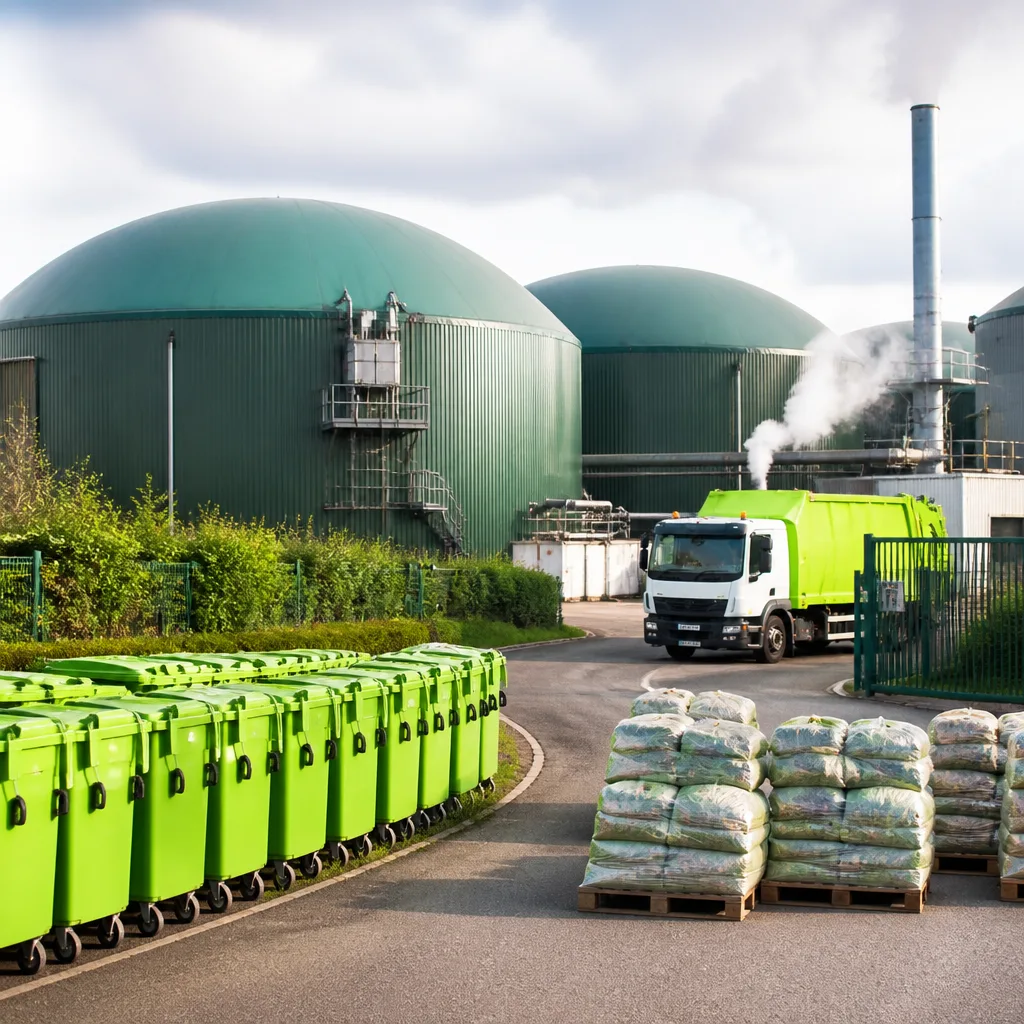
England’s move to require separate household food waste collections has shifted the debate from bins to plants. The government’s change, introduced under the Simpler Recycling reforms in March 2026, will divert greater volumes of organic material from residual waste. Industry operators say the policy is welcome but that collection is only the start: the country must build capacity and align investment and policy if it is to convert food waste into useful energy and nutrient-rich fertiliser.
Policy delivers material — but what next?
Jonathon Wroe, managing director at Severn Trent Green Power, sets out the central challenge. The company currently recycles around 500,000 tonnes of food waste a year and estimates that the Simpler Recycling change will divert roughly 44,000 tonnes previously destined for landfill to its nearest facilities. Those figures underline two facts: the new rules will increase feedstock for anaerobic digestion (AD) operators, and the additional tonnages are material enough to require joined-up planning.
AD processes unavoidable food waste without oxygen to produce biogas for electricity and heat, or upgraded biomethane for the gas grid. It also yields digestate, which can be used as an agricultural fertiliser. Supporters argue AD therefore tackles at least three problems: it captures energy, avoids methane from landfill, and returns nutrients to farmland — reducing reliance on imported fertiliser.
Capacity, investment and coherence
But Wroe and other industry figures warn that collection alone will not ensure those benefits are realised. Three interlinked gaps must be addressed, they say:
- Infrastructure capacity — more AD plants or upgraded facilities are required to handle increased volumes;
- Investment — private and public capital will be needed to build and connect facilities to grids and storage;
- Policy coherence — regulatory clarity on uses for biogas, biomethane and digestate, and market support, will determine whether outputs are put to strategic use.
The wider context matters. Preventing food waste remains the priority, and edible surplus should be redistributed where possible. But even the strongest prevention regimes will leave peels, bones, spoiled products and manufacturing residues that require treatment. AD is presented by proponents as a route that retains nutrient value while producing energy, unlike incineration which recovers energy but destroys nutrients, or landfill which releases methane.
Numbers and outcomes
The immediate numerical impact for operators such as Severn Trent Green Power is modest in scale but politically significant. To set the figures out:
| Metric | Figure |
|---|---|
| Food waste recycled annually (Severn Trent Green Power) | 500,000 tonnes |
| Additional food waste diverted since March 2026 | 44,000 tonnes |
Those diverted tonnes must be treated somewhere. If facilities do not exist within economically viable transport distances, local authorities may struggle with increased costs and delay. If treated, the biogas and digestate will need markets and networks — for example, injection into the gas grid as biomethane or use on farms as a substitute for mineral fertiliser.
Choices for government and councils
The policy choices facing ministers and waste collection authorities are concrete. They include whether to underwrite or incentivise new AD capacity, to streamline planning and grid connection for renewable gas projects, and to create quality standards and markets for digestate so it can be used safely and effectively in agriculture.
Without action on those fronts, the gains from separate food waste collections risk being limited. Collected material could be routed to less desirable outcomes, such as incineration, or incur higher transport and treatment costs that fall on councils and taxpayers.
The politics is straightforward: Simpler Recycling increases volumes; converting those volumes into energy, gas or fertiliser requires work. Industry representatives see opportunity but warn that realising it depends on capital, coherent regulation and the right market signals.












