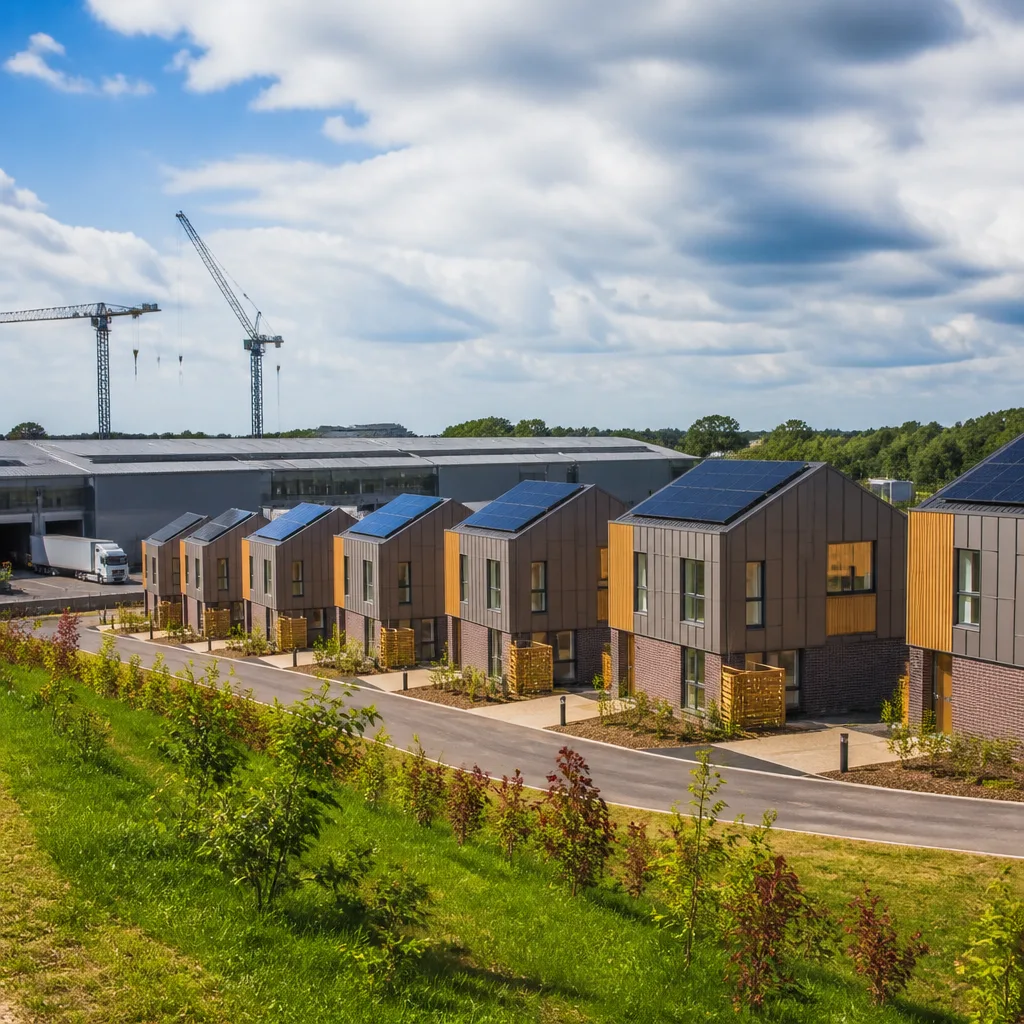
Eco Buildings Group PLC has presented its Rolling Hills development as tangible proof that its off-site building approach can deliver finished homes that meet quality and flexibility requirements, while signalling plans to move from demonstrator projects towards commercially scaled factory production.
From demonstration to scale
In a recent company discussion, chief executive Dr Etrur Albani described Rolling Hills as a showcase for the firm's construction technology and said the business has developed a second-generation production line intended to support larger manufacturing sites and international expansion.
The company argues its approach departs from traditional modular systems used in the sector and is designed to be applied at higher volumes through purpose-built factories. That strategy is aimed at unlocking the cost, speed and quality benefits that industrialised construction promises — but the firm acknowledges there are significant steps between a proof-of-concept development and full commercial roll-out.
How Eco Buildings positions its technology
- Quality and versatility: Rolling Hills is presented as evidence that the system can produce homes to acceptable standards while offering design adaptability.
- Manufacturing evolution: The second-generation production line is claimed to enable a transition from small-scale to larger-scale manufacturing operations.
- Export potential: Management is targeting international markets as part of the next growth phase.
The company identifies its method as distinct from established modular construction techniques, positioning itself among firms pursuing modern methods of construction (MMC) to help address housing shortages.
Implications for the housing and construction sectors
If Eco Buildings can translate the Rolling Hills demonstration into efficient, larger factories, it would follow a familiar industrial pathway: prove the product at small scale, refine production methods, then invest in capacity to lower unit costs. The firm says the new production line is the intermediate step designed to reduce technical and logistical risk before committing to full-scale plants.
For policymakers and housing providers, the potential upside of successful industrialised housing is clear: faster delivery times, more predictable quality control and the possibility of repeatable off-site manufacturing that would relieve pressure on traditional on-site labour and skills shortages. Yet the shift requires capital, supply-chain readiness, planning permissions for factory sites and secure orders or contracts to underpin sustained production — practical challenges not solved by a single demonstration project.
| Area | Eco Buildings' claim |
|---|---|
| Proof point | Rolling Hills development demonstrates system quality and flexibility |
| Production | Second-generation production line designed to support larger manufacturing |
| Market focus | Move towards commercial-scale operations and international expansion |
Management notes the company’s technology could be suited for both housing and larger volume projects, but details such as factory locations, capacity targets, delivery timetables and customer commitments were not provided in the briefing available to investors. Those specifics will be central to assessing whether the business can make the leap from bespoke demonstration to dependable mass production.
What to watch next
Investors and sector observers will be looking for several concrete signals as Eco Buildings attempts to scale up:
- agreements or pilot contracts with housing providers or local authorities;
- clarity on factory investment plans, including size, location and expected throughput;
- evidence that the second-generation line reduces unit costs and shortens build cycles compared with the first line;
- progress on supply-chain partnerships to secure materials at scale.
Industrialised construction technologies are gaining attention across the UK and internationally as governments and developers search for ways to boost housing supply. Eco Buildings’ Rolling Hills project offers an early-stage example of that trend. Whether it becomes a prototype for a larger manufacturing business will depend on the company’s ability to convert the technical demonstration into repeatable, cost-effective production backed by orders.