
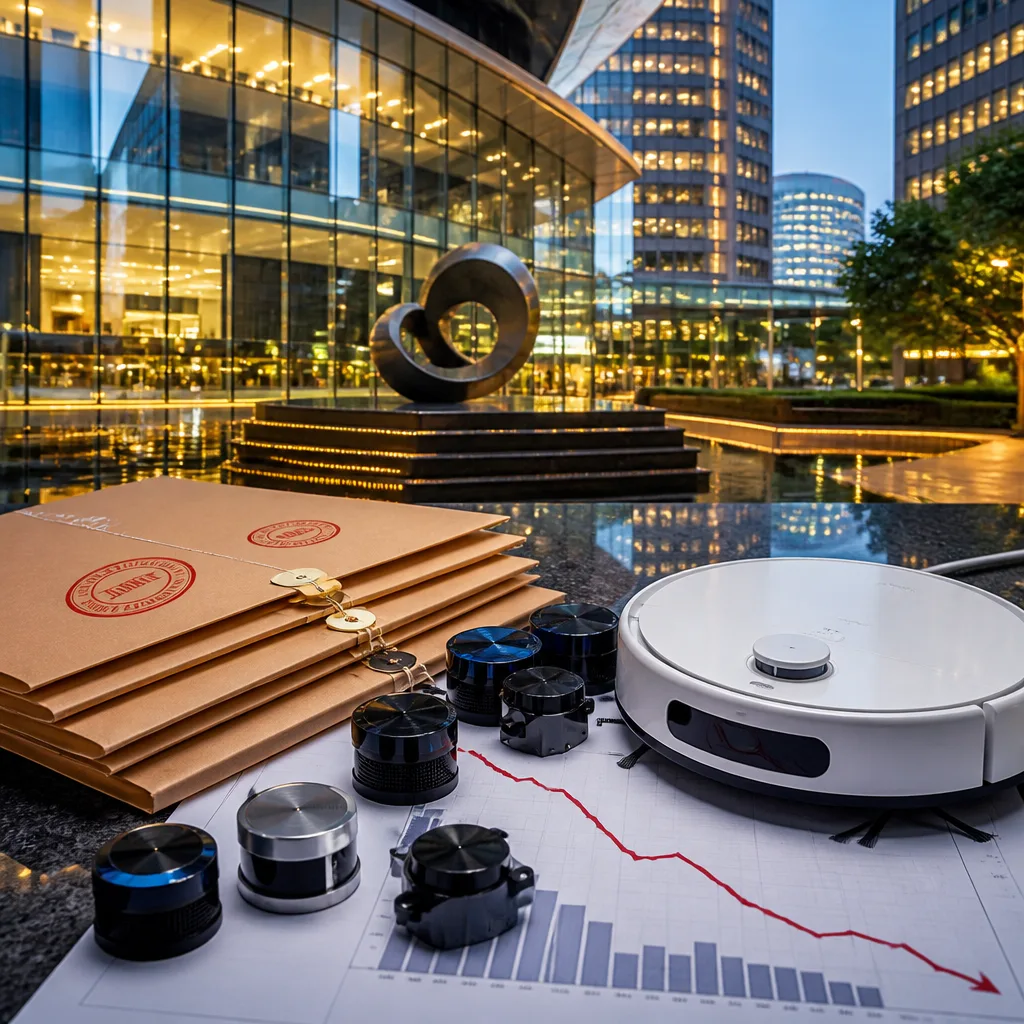
Shenzhen Huanchuang Technology, a Chinese maker of LiDAR and other spatial-perception components for robotic vacuums and intelligent robots, has passed its listing hearing for the Main Board of the Hong Kong Stock Exchange, according to the company’s recent post-hearing filing.
Growth in revenue, but not in margin
The company reported rapid top-line expansion between 2023 and 2025, with operating revenue rising from ¥332 million to ¥614 million. However, profitability has been limited: net results moved from a small loss in 2023 to a loss in 2024 before registering a wafer-thin profit of ¥2.201 million in 2025 — a net margin of about 0.4%.
| Year | Operating revenue (¥) | Net profit (¥) |
|---|---|---|
| 2023 | 332,000,000 | -883,000 |
| 2024 | 433,000,000 | -31,000,000 |
| 2025 | 614,000,000 | 2,201,000 |
The numbers show a compound annual growth rate in revenue of 35.9% over the three-year period, but they also highlight how revenue gains have not translated into meaningful margin expansion to date.
Market backdrop: demand rising, prices falling
Huanchuang operates in an expanding sector. Independent data cited by the company indicate the global market for spatial-perception solutions for intelligent robots grew from ¥118 billion in 2020 to ¥260 billion in 2024, with forecasts pointing to significant further growth by 2030. Robot vacuums are the largest end market; in 2024 about 70% of units were fitted with LiDAR sensors.
Yet favourable demand trends have coincided with intense price competition at the device level. In 2026, global shipments of robot vacuums reached roughly 7.885 million units, up 21.5% year-on-year, according to IDC data quoted in the filing. That volume growth has not prevented an industry-wide decline in average selling prices as major brands and new entrants press down on costs.
- High volume growth has been accompanied by falling average prices for complete machines.
- Competition from large consumer electronics players is squeezing suppliers’ margins.
- Huanchuang’s profit margin in 2025 was about 0.4%, despite strong revenue growth.
Supplier dynamics and strategic pressure
Huanchuang is an upstream component supplier rather than a finished-goods manufacturer. That position concentrates exposure to the pricing and margin pressure coming from OEMs and white‑label producers. The filing notes competition from prominent, deep-pocketed entrants into the robot vacuum space, which has already begun to affect the supply chain.
For a specialist supplier, two strategic tasks stand out from the public information: defend or extend technological differentiation to avoid pure price competition, and broaden customer relationships so that revenue growth is matched by more resilient margins. The filing does not alter these challenges — it simply underlines them.
What the listing would mean
Passing the listing hearing is a regulatory milestone. If the company proceeds to list, it would gain access to public capital markets that could be used to invest in R&D, expand production capacity or pursue acquisitions. But listing will not change market realities: component suppliers must still navigate aggressive pricing, rapid product commoditisation and competition from large vertically integrated groups.
Investors will watch three measurable indicators closely should Huanchuang go to market: margin recovery, diversification of end customers, and the company’s ability to convert its research into features that customers are willing to pay a premium for. Without improvement on those fronts, revenue growth alone may prove insufficient to deliver durable returns for shareholders.
The filing lists China International Capital Corporation and Guosen Securities (Hong Kong) as joint sponsors for the proposed listing.









