
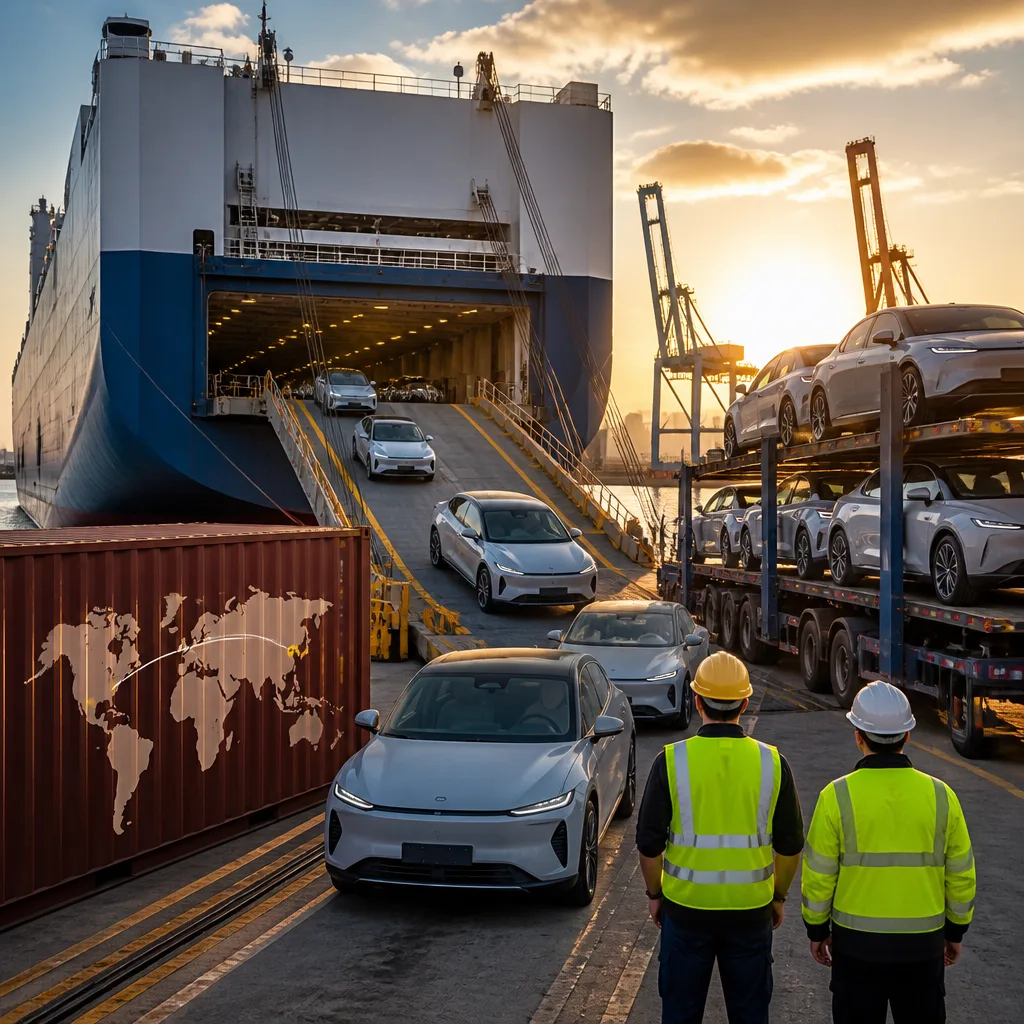
Chinese electric-vehicle manufacturers have accelerated exports amid weakening domestic demand, shipping a monthly record of 540,000 battery electric vehicles in July while selling about 980,000 in China, according to a London-based industry report.
Exports surge as home market softens
Benchmark Mineral Intelligence’s data outline a stark shift in where Chinese makers are finding buyers. The July figures amount to roughly one car exported for every two sold at home — a reversal from last July when exports were about one for every five domestic sales. Analysts and industry figures quoted by Rest of World say the change is structural rather than a short-term response to a bad year.
The move overseas follows a prolonged price war in China, which has compressed margins and left manufacturers looking for growth beyond the home market. Sales inside China fell by 12% in the first seven months of 2026, and the International Energy Agency expects the market to finish the year roughly flat — the first non-growth year this decade.
“The export surge is partially due to overcapacity, but that’s not the only factor,”
Lei Xing, founder of the consultancy AutoXing, told Rest of World that Chinese cars are inexpensive, widely available and equipped with the technology buyers want — a combination that echoes earlier export booms from Japan and Germany.
From exporting cars to localising industry
Industry advisers say the next phase for Chinese firms will not be limited to sending finished vehicles abroad. Bill Russo of the Shanghai-based advisory firm Automobility warned that companies will increasingly consider building factories, supply chains and technology footprints in destination markets to sustain long-term presence.
“We’ve moved from export opportunity to export necessity,” Russo said, reflecting a shift in strategy as manufacturers face slower growth in China and intensifying competition overseas.
Where the vehicles are going
Benchmark’s analysis shows substantial gains in regions outside China, Europe and North America — a category that almost doubled to 1.7 million EV sales in the first seven months of the year. Chinese brands supplied about half of those vehicles, up from a quarter in 2023.
- July exports from China: 540,000 EVs
- Domestic sales in China in July: ~980,000
- Sales outside China, Europe and North America (Jan–Jul): 1.7 million
- Share of those supplied by Chinese brands: 50% (up from 25% in 2023)
The report specifically singles out markets such as Brazil, Thailand and Gulf states as expanding destinations for Chinese models. Observers say low prices, broad availability and competitive technology give Chinese marques an advantage in these markets.
Tesla’s Shanghai plant reflects the trend
Even Tesla’s Shanghai operation appears to be leaning on exports to offset softer domestic demand. Data published by the China Passenger Car Association on 4 August show the plant sold 238,955 cars in China in the first half of 2026 while shipping out 228,994 over the same period.
| Measure | Units |
|---|---|
| July EV exports from China | 540,000 |
| July domestic EV sales in China | 980,000 (approx.) |
| EVs sold outside China, Europe and North America (Jan–Jul) | 1.7 million |
| Tesla Shanghai — sold domestically (H1) | 238,955 |
| Tesla Shanghai — shipped out (H1) | 228,994 |
The broad export push has implications for trade patterns and for countries that will host manufacturing capacity. If localisation follows exports, it could create jobs and investment overseas while also shifting the geography of EV supply chains — a strategic development that governments and incumbents in Europe, the Americas and Asia will watch closely.
Still, analysts caution that part of the export boom reflects Chinese industry overcapacity. That condition, coupled with intense price competition, may limit margins for exporters and encourage moves to localise production to protect profitability and reduce logistics costs.
For now, the figures point to a notable rebalancing: Chinese manufacturers are increasingly reliant on overseas demand to absorb output that the domestic market no longer consumes at the pace seen in recent years. How quickly firms move from exporting finished vehicles to embedding factories, suppliers and software stacks abroad will shape the next phase of the global automotive transition.









