
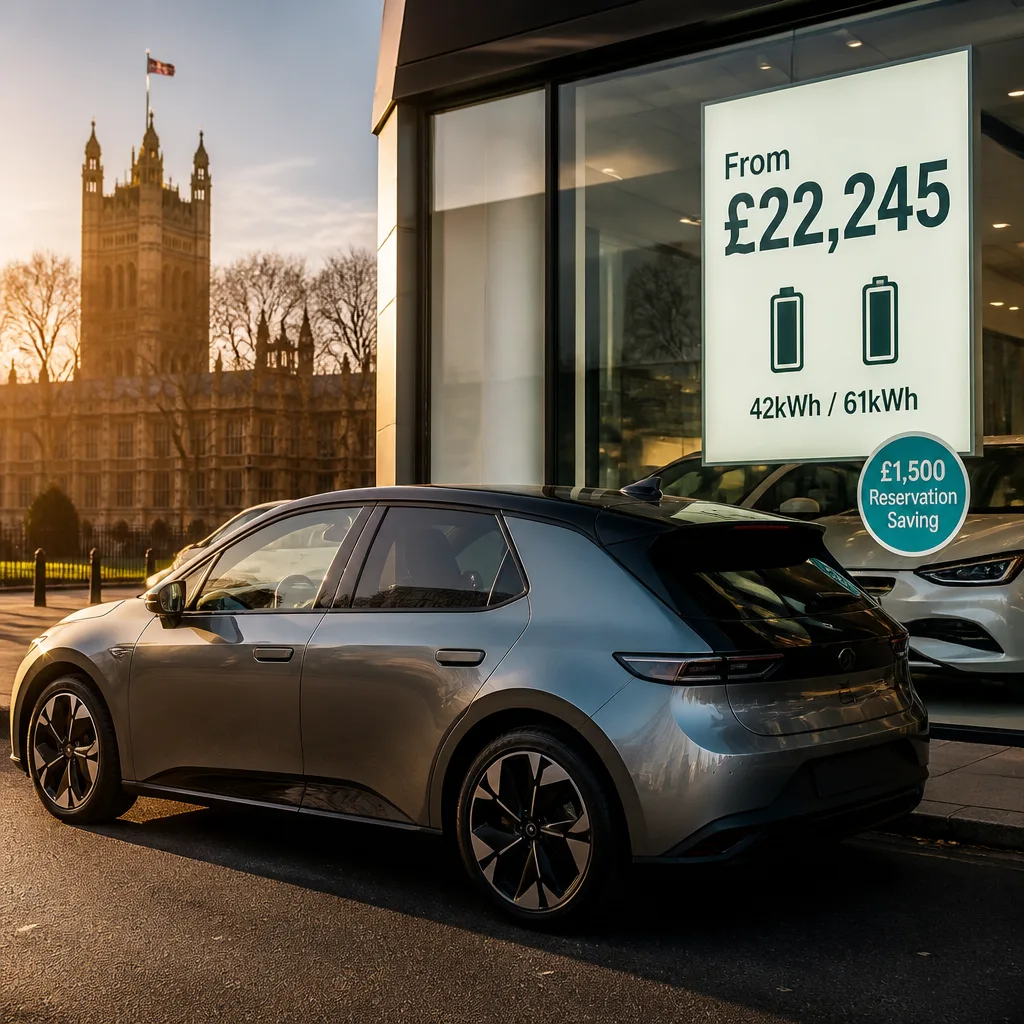
Hyundai has opened UK orders for its IONIQ 3 electric vehicle, offering a choice of 42kWh and 61kWh battery packs and prices starting at £22,245. The manufacturer says the larger 61kWh battery is expected to deliver a range of around 308 miles, although official testing and assessment of that figure are not yet complete.
Pricing, specification and the subsidy backdrop
The entry-level IONIQ 3 Advance with the 42kWh battery is priced at £22,245, with an estimated range of approximately 210 miles. Buyers can opt for the 61kWh battery on the Advance for £24,245; that price includes a £1,500 Hyundai Reservation Saving, which Hyundai has said is being offered in place of the Government’s Electric Car Grant.
Hyundai also revealed two higher trims. The Premium starts at £25,945 and adds features such as 17-inch alloy wheels, battery heating and pre-conditioning, a wireless phone charger, and rain-sensing wipers. The Ultimate model begins at £28,445 and brings 18-inch alloy wheels, heated front seats, a heated steering wheel, Highway Drive Assist, and lumbar support.
| Model / Battery | Price | Stated range |
|---|---|---|
| Advance (42kWh) | £22,245 | ~210 miles |
| Advance (61kWh) | £24,245 (incl. £1,500 reservation saving) | ~308 miles (awaiting testing) |
| Premium | £25,945 | Not specified |
| Ultimate | £28,445 | Not specified |
What this means for buyers and household budgets
The IONIQ 3’s headline price points place it in the competitive mid-market EV segment, where price sensitivity remains high among private buyers. The use of a manufacturer reservation saving to mirror the £1,500 Electric Car Grant — currently not being applied directly at point of sale for this model — is notable. For purchasers paying by cash or finance, a £1,500 reduction is meaningful: it can buy a year or more of petrol for many households or offset part of a typical monthly car finance repayment.
That said, sticker price is only one part of the ownership equation. Driving range, charging costs, insurance and depreciation are major determinants of lifetime cost. Hyundai’s quoted 308 miles for the 61kWh variant, if confirmed by regulators, would be a competitive figure that can reduce range anxiety and lower the proportion of time owners spend charging — effectively improving convenience and potentially cutting running costs.
- Affordability: Starting price of £22,245 aims at buyers looking to trade up from smaller EVs or economical combustion cars.
- Incentive replacement: Hyundai’s £1,500 Reservation Saving substitutes the government grant in practice, but it leaves open questions about longer‑term policy certainty for subsidies.
- Range credibility: The 308‑mile claim for the 61kWh model needs official confirmation to be fully persuasive to buyers whose budgets are tight.
Wider industry and market consequences
For the industry, the IONIQ 3 is another sign that mainstream manufacturers are sharpening their volume EV offers to appeal to cost‑conscious buyers. Competitive pricing can help stimulate demand among customers who base purchase decisions on month‑by‑month affordability rather than headline technical specs.
However, the reliance on manufacturer discounts rather than a stable policy framework for grants could complicate the market. If manufacturers choose to include one‑off reservation savings to replicate past grant levels, it transfers the subsidy burden onto company margins or promotional budgets rather than securing a predictable incentive for consumers. That matters for jobs and investment planning in supply chains: stable demand driven by clear incentives is easier to plan for than growth propped up by temporary discounts.
Hyundai’s early ordering phase will test how many buyers are persuaded by the combination of range and price while the wider market adjusts to the end of conventional grant arrangements. For shoppers, the immediate calculation is simple: does the IONIQ 3 save enough on fuel and running costs, or offer enough convenience, to justify the monthly outlay compared with a cheaper petrol or second‑hand option?
As the model moves through testing and into owner hands, the real measures will be how the advertised range holds up in real‑world conditions and whether the initial price position proves sustainable in a fiercely competitive EV market.














