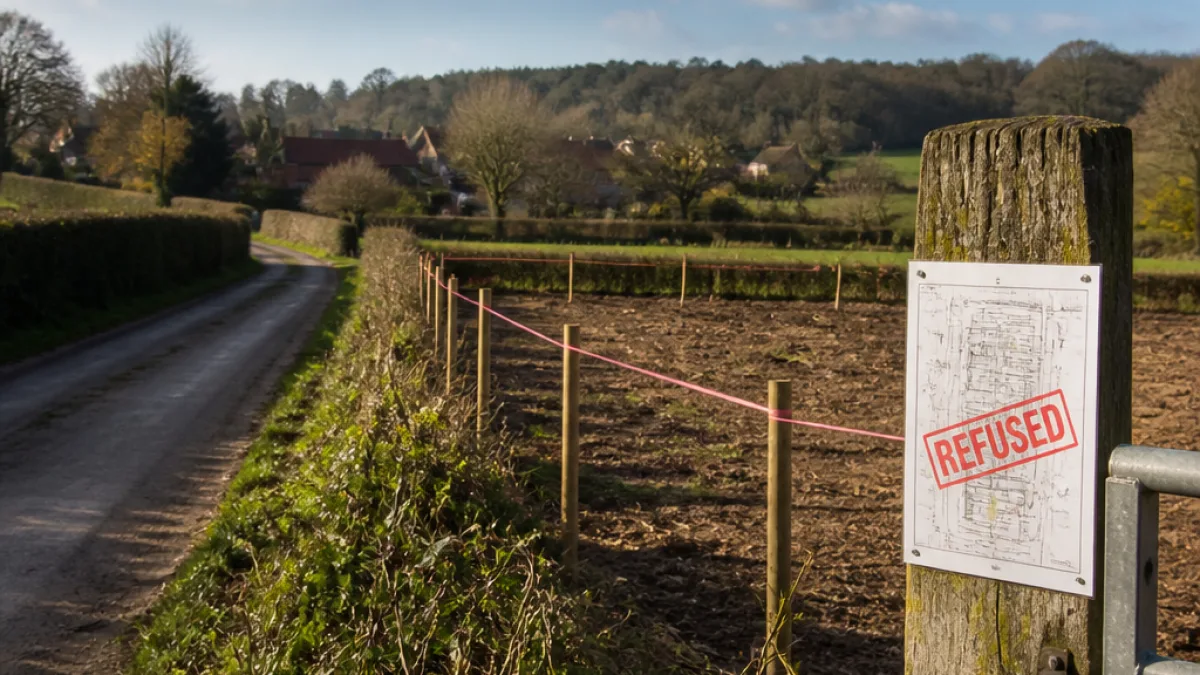
Countryside site at The Folly rejected by council
Chichester District Council has turned down an application to build nine homes at The Folly, Tinwood Lane, Halnaker, concluding the proposal would be harmful to the character and visual amenity of the area.
The scheme, which proposed two two‑bed, three three‑bed and four four‑bed dwellings, was refused by planning officers who said the development would amount to an "urbanising and incongruous form of development" in countryside outside any defined settlement boundary.
"The proposal would result in an urbanising and incongruous form of development which would be harmful to the rural character and visual amenity of the area."
The officer report sets out a number of detailed reasons for refusal. It states the site is located in the "countryside/rest of plan area" and that, by virtue of its location, layout, scale, massing, design and cramped appearance, the proposal would fail to protect or reflect the positive rural characteristics and distinctiveness of the surrounding landscape.
Officers added the development would not make efficient use of land because of the layout and the excessive size of the proposed dwellings. The housing mix was also criticised; the report concluded the scheme failed to deliver an appropriate mix of dwellings and therefore contravened Policy H5 of the Chichester Local Plan.
Local responses split
The application generated a number of responses on the council planning portal. There were eight letters of objection and 15 letters of support, reflecting a divided local view.
- Objections raised concerns about infrastructure, particularly the existing sewage system. One objector said the system in Halnaker was already overloaded following a nearby development and described raw sewage reaching their property.
- Supporters described the scheme as a welcome, aesthetically pleasing addition and noted family connections in the area.
- Concerns about the size and layout of the proposed houses underpinned the council’s policy-based refusal.
| Proposed unit type | Number of units |
|---|---|
| Two-bedroom | 2 |
| Three-bedroom | 3 |
| Four-bedroom | 4 |
Local planning refusals such as this sit at the intersection of housing need and landscape protection — a tension that plays out across the Chichester district. Planners must weigh the government and council ambitions to boost housing supply against statutory and local policies designed to conserve rural character and prevent sprawl beyond settlement boundaries.
For residents of Halnaker, the decision will be welcomed by those who argued the site’s development would be out of keeping with the village’s rural appearance and who fear strain on local services. Conversely, supporters who called for new homes have seen their hopes for additional housing — and potential family ties maintained — frustrated by the planning balance reached by officers.
Where the applicant goes next is not known from the council’s published decision. In many cases, developers either amend schemes to address the reasons for refusal or appeal to the Planning Inspectorate. Any revised application would need to demonstrate a significantly different approach to layout, scale and housing mix, and to satisfy local policy requirements on efficient use of land and countryside protection.
The refusal is a reminder that even relatively small housing schemes are scrutinised for their landscape impact and policy compliance. For Chichester residents watching the evolution of housing in the district, the outcome at Halnaker is likely to feed into wider debates about where and how new homes should be built in rural parts of the city’s hinterland.