
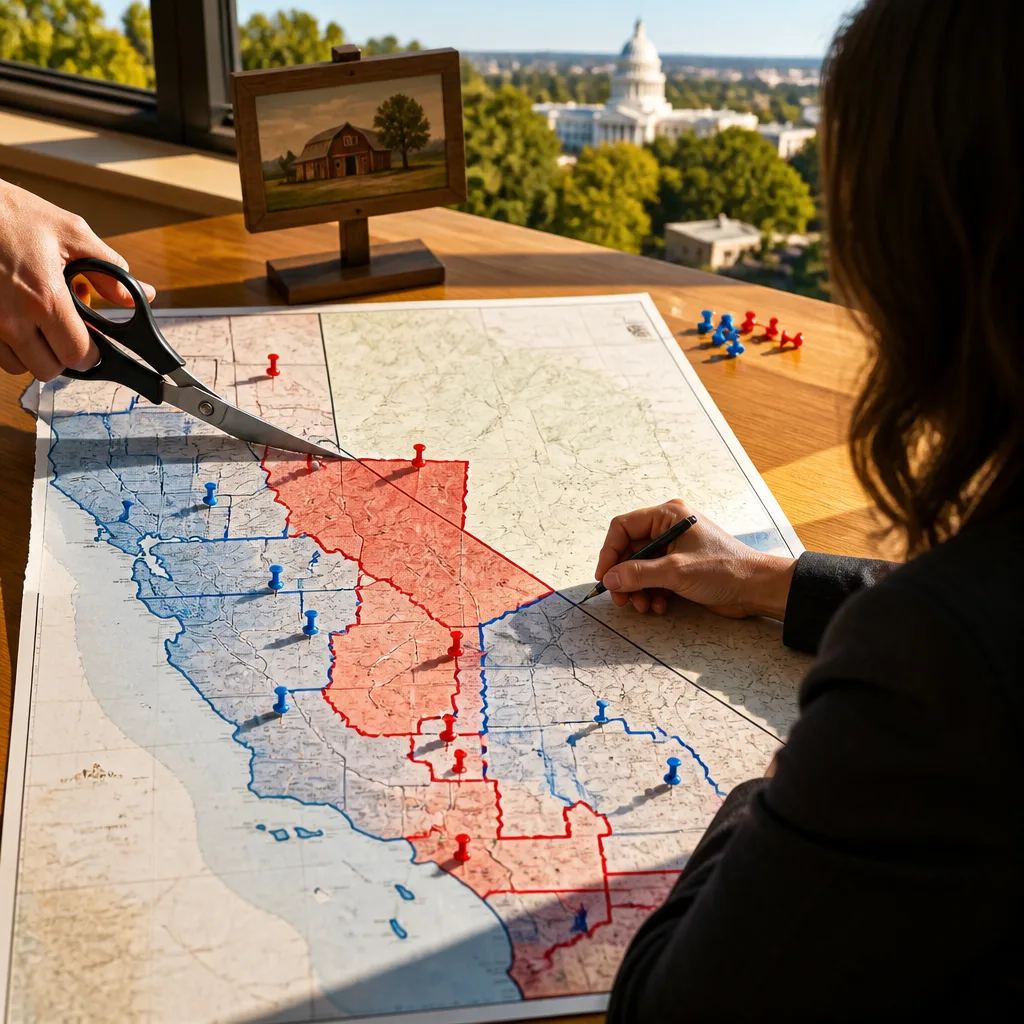
Democratic mapmakers in California have cut a Republican-held congressional district into pieces, a change that will prevent many current constituents from voting for their incumbent, reflecting a national tit-for-tat over redistricting that has intensified ahead of the 2026 midterms and beyond.
Local upheaval after statewide redraw
The Associated Press reported that the seat held by conservative Representative Kevin Kiley was carved up in the latest California redistricting. Voters in parts of his present district, including residents of Lincoln — a former agricultural town on the edge of Sacramento’s exurban sprawl — now find themselves in districts centred on heavily Democratic areas and will no longer be represented by Kiley.
One voter interviewed by the AP said she was dismayed.
"He believes in the same things I do," she said. "It feels sneaky and underhanded."
Retaliation and a national contest over maps
The California changes come amid a broader national struggle over congressional boundaries. The report notes that Republicans initiated a wave of aggressive redrawing after a recent U.S. Supreme Court decision that weakened a key provision of the Voting Rights Act, enabling GOP-led states in the South to redraw districts that had previously elected Black Democrats.
Democrats in several states, the AP said, have responded or pledged to respond in kind, promising to split Republican-leaning districts in states where they hold power. The examples cited include:
- Texas and Tennessee — where Republican redistricting earlier this year altered districts that had elected Black Democrats.
- California — where Democratic mapmakers have dismantled Representative Kevin Kiley’s district.
- Maryland, New York and Illinois — states where Democrats have said they will consider dividing Republican-leaning districts ahead of the 2028 elections.
Political consequences and prospective escalation
AP’s coverage frames the current picture as a competition that began with Republican efforts and may conclude with Democratic counters. The immediate effect is local: voters who supported a particular member of Congress may suddenly find themselves in a differently configured constituency with different political leanings.
Beyond the ballot-box impact, the report underscores a strategic shift: mapmaking is now being used as both offence and defence. Republicans accelerated redistricting following signals from national figures encouraging state-level action. Democrats, where they control legislatures or commissions, are signalling they will reciprocate, potentially entrenching partisan advantage in more jurisdictions.
What the report shows
| Aspect | Detail reported by AP |
|---|---|
| Trigger | Supreme Court decision weakening a Voting Rights Act provision |
| Republican action | Redrew maps in southern states to create more winnable seats |
| Democratic response | Redrew California district and pledged similar moves in Maryland, New York, Illinois |
The outcome is likely to be a patchwork of districts across the country that reflect which party controlled the redrawing process in each state. Voters in competitive or shifting regions can expect disruption to long-standing political relationships with their elected representatives.
For now, the story remains one of strategic escalation. Redistricting has always been a tool of partisan advantage. The AP’s reporting indicates that recent court rulings and explicit political exhortations have sharpened its use, prompting responses that could reshape the congressional map well into the next presidential cycle.
How that will affect the balance of power in the House will depend on the particulars of each state’s maps and subsequent electoral outcomes. What is clear from the reporting is that the competition over boundaries is continuing to unfold state by state, with immediate consequences for voters and potential long-term effects for national politics.












