
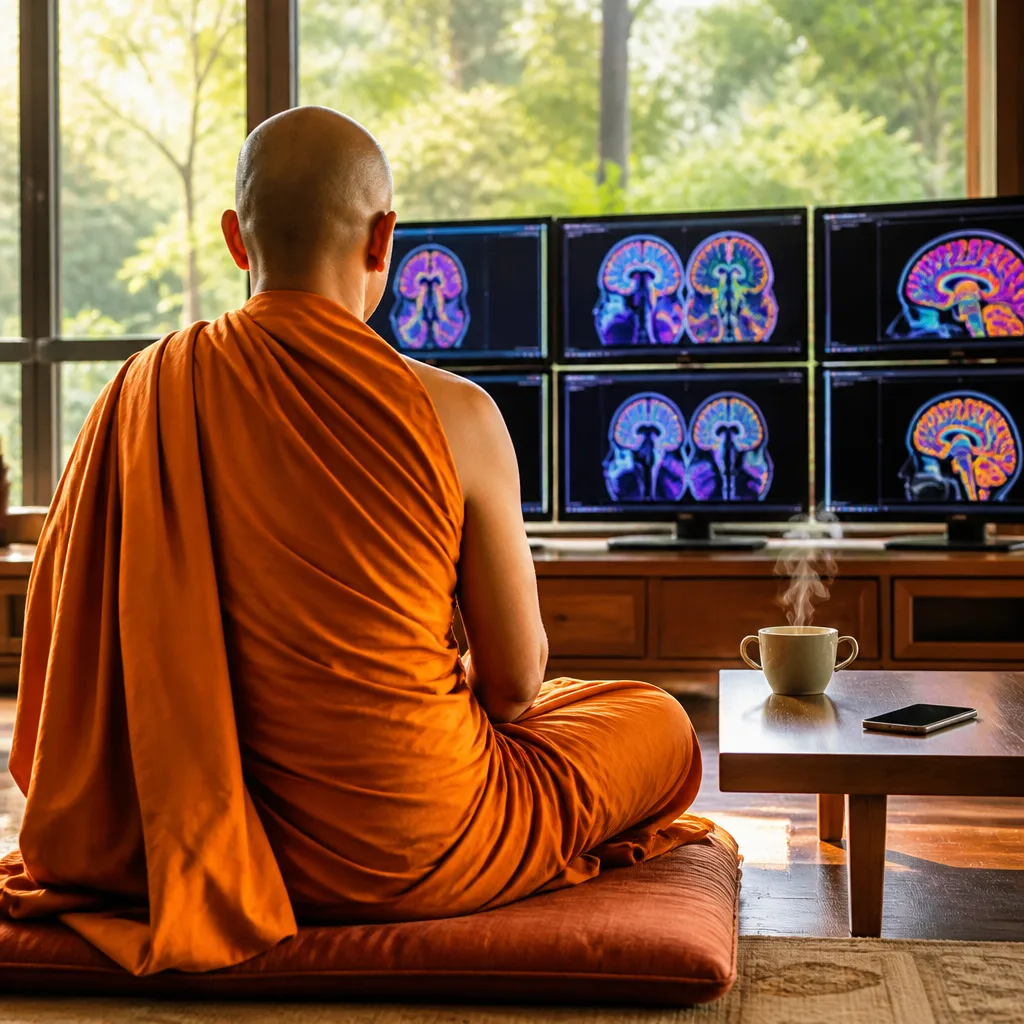
Yongey Mingyur Rinpoche, a Tibetan Buddhist monk whose brain activity has been studied by neuroscientists, is promoting a set of simple practices that he and researchers say are associated with higher levels of positive emotion and resilience.
Scientific signals and everyday habits
In interviews and public engagements, Mingyur has highlighted a combination of introspective practices and behavioural changes that he argues can increase contentment. Researchers who have scanned his brain found unusually strong activity in the left prefrontal cortex, an area commonly linked to positive moods such as enthusiasm and joy; the scans and subsequent reporting suggested his brain activity was “off-the-charts” compared with typical samples. Other tests conducted when he was 41 reportedly showed a brain that “resembled that of a 33-year-old”.
Those findings have captured public attention, but the monk’s message is practical rather than technical: rather than seeking constant external stimulation to avoid uncomfortable feelings, people should learn to sit with those feelings and explore them.
“We try to get away from them, but those feelings are wisdom, in a way. The really important thing is to sit with them, embrace them as a path to explore.”
From extreme example to everyday application
Mingyur cites a dramatic episode from his own life to illustrate his teaching. In 2011 he left his monastery and lived for a time as a wandering yogi; within weeks he suffered severe food poisoning and prolonged exhaustion. He now describes that episode as the moment he gained a deeper appreciation for the Buddhist notion of relinquishing control.
He is explicit, however, that people do not need to replicate such extremes to benefit. Modern life, he says, offers many opportunities for relinquishment and growth if one pays attention to ordinary signals — for example, the restlessness people feel while switching between a streamed show and social media. Citing behavioural research, he notes that flicking between digital videos can increase boredom rather than relieve it, and he suggests switching everything off and turning inwards when these sensations arise.
Practical takeaways for readers
From the material available, several recurring recommendations emerge. They are concise and potentially actionable for readers seeking manageable ways to reduce stress.
- Notice and sit with uncomfortable feelings rather than immediately seeking distraction.
- Reduce reliance on constant digital stimulation — try switching devices off when boredom or restlessness arises.
- Embrace change as an opportunity for growth instead of a threat to be avoided.
These are not presented as panaceas. The evidence cited in reporting includes brain scans of one individual and behavioural studies on social media habits; both point to mechanisms that may help explain why these practices feel beneficial, but they do not constitute broad clinical proof that they will work for everyone.
| Finding | Reported implication |
|---|---|
| Strong activity in left prefrontal cortex | Correlates with positive emotions such as happiness and enthusiasm |
| Behavioural research on social media viewing | Rapidly flicking between videos can increase boredom, not reduce it |
Weighing the evidence
It is important to be cautious in translating single-case neuroscience results into broad guidance. Brain-scan research on individuals can illuminate possible mechanisms but cannot on its own validate interventions for diverse populations. Likewise, behavioural studies that link certain patterns of media use with increased boredom point to associations rather than direct remedies.
Nonetheless, the combination of personal testimony, neuroscientific observation and behavioural science has attracted public interest because it speaks directly to common problems: stress, fragmented attention, and the search for meaning in busy lives. For those struggling with anxiety or depression, clinical pathways remain critical; structured psychological therapies and medical assessment are not supplanted by mindfulness or lifestyle changes.
What Mingyur’s account does offer is a clear, low-cost set of practices that people can try: observing discomfort without immediate reaction, limiting digital distractions, and reframing difficult experiences as potential learning. Those steps are simple to test, and for many they may provide immediate relief — even if the precise neurological mechanisms and long-term effects require more rigorous study.
As debates continue over the mental-health impact of digital life and the best ways to foster resilience, Mingyur’s blend of ancient practice and modern observation will likely remain part of a broader conversation rather than a definitive solution.









