
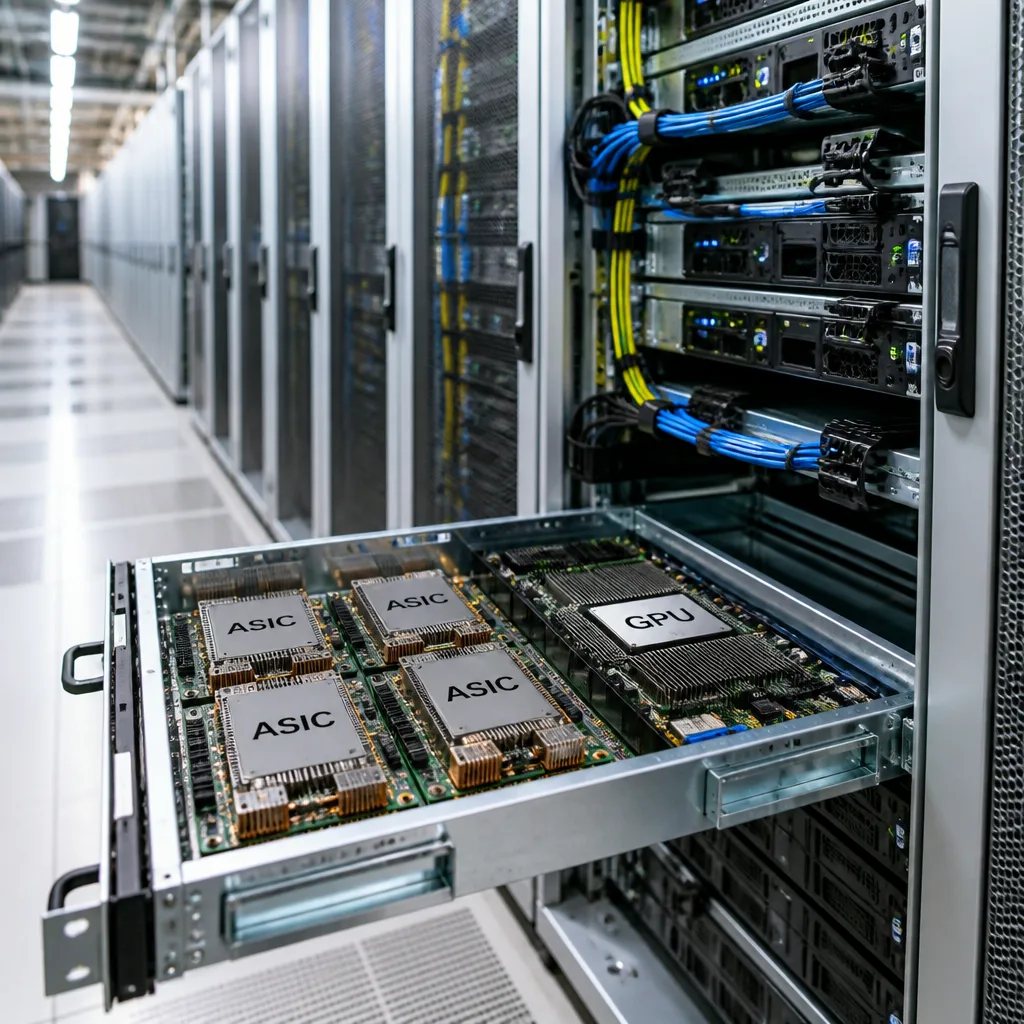
Broadcom and Marvell Technology are positioning themselves at the front of a shift in how large-scale AI computing is delivered, offering application-specific integrated circuits (ASICs) as an alternative to the graphics processing units that currently dominate training and inference.
Why custom chips matter
Most AI training and many inference tasks are today run on GPUs supplied predominantly by Nvidia. GPUs are general-purpose by design and excel when workloads vary. But when a chip spends its life on a single, predictable workload, that flexibility can become wasted silicon. Custom AI chips — ASICs — are engineered around a particular workload and can therefore be tuned for higher efficiency and lower cost.
Both Broadcom and Marvell grew their reputations on data-centre networking equipment and have recently launched bespoke AI chip programmes aimed at a small number of major customers. The immediate market for these chips is clear: cloud hyperscalers and large AI organisations that either run cloud services (for example Alphabet and Amazon) or build vast internal compute fleets (such as OpenAI and Anthropic).
What ASICs bring — and what they don’t
- Efficiency: ASICs can deliver more compute per watt when handling a tightly defined workload.
- Cost performance: By removing general-purpose overheads, bespoke chips can reduce total cost of ownership for specific AI tasks.
- Specialisation trade-offs: They are less flexible than GPUs; if a workload changes, the chip may become less useful.
A simple comparison underlines the trade-offs:
| Attribute | GPUs | ASICs (custom AI chips) |
|---|---|---|
| Flexibility | High | Low |
| Efficiency for single workload | Moderate | High |
| Typical customers | General-purpose compute, research, cloud | Hyperscalers, organisations with predictable AI pipelines |
Customers and market dynamics
The companies most likely to adopt bespoke chips are those that either run the cloud platforms customers rent from or that operate massive internal compute estates for model development. These buyers have two relevant characteristics: scale and predictability. They can afford the engineering, and their workloads are often repetitive enough that an ASIC’s efficiency gains make economic sense.
For Broadcom and Marvell, winning design wins with such customers is the immediate objective. Their existing relationships as networking suppliers give them a foot in the door inside racks and data centres; the technical challenge is to design compute silicon that meets those customers’ exacting performance-per-dollar and performance-per-watt targets.
What this means for the wider market
If custom AI chips do become the norm for large, stable workloads, a few consequences follow:
- Cloud operators and AI firms could reduce their reliance on general-purpose GPU suppliers for a subset of tasks, altering supplier bargaining power.
- Chip design and integration will become a strategic differentiator for companies that can afford bespoke hardware — favouring those with large budgets and in-house deployment expertise.
- Smaller AI users and research groups will likely continue to rely on GPUs because of their versatility.
At the same time, the presence of custom chips does not negate the role of GPUs. The flexibility and ecosystem around existing GPU tooling mean they will remain important for many workloads; ASICs are an optimisation for particular, high-volume use cases.
Broadcom and Marvell are betting the market will split between specialised silicon for high-volume, predictable AI tasks and versatile GPUs for everything else. The next phase to watch is whether those early customers scale purchases and whether the cost advantages of ASICs hold up across real-world deployments.
Implication for readers: if you buy cloud services, run AI workloads, or follow the semiconductor market, expect to see procurement decisions increasingly shaped by the trade-off between flexibility and efficiency — and by how much buyers value lower long-term operating cost over short-term compatibility.









