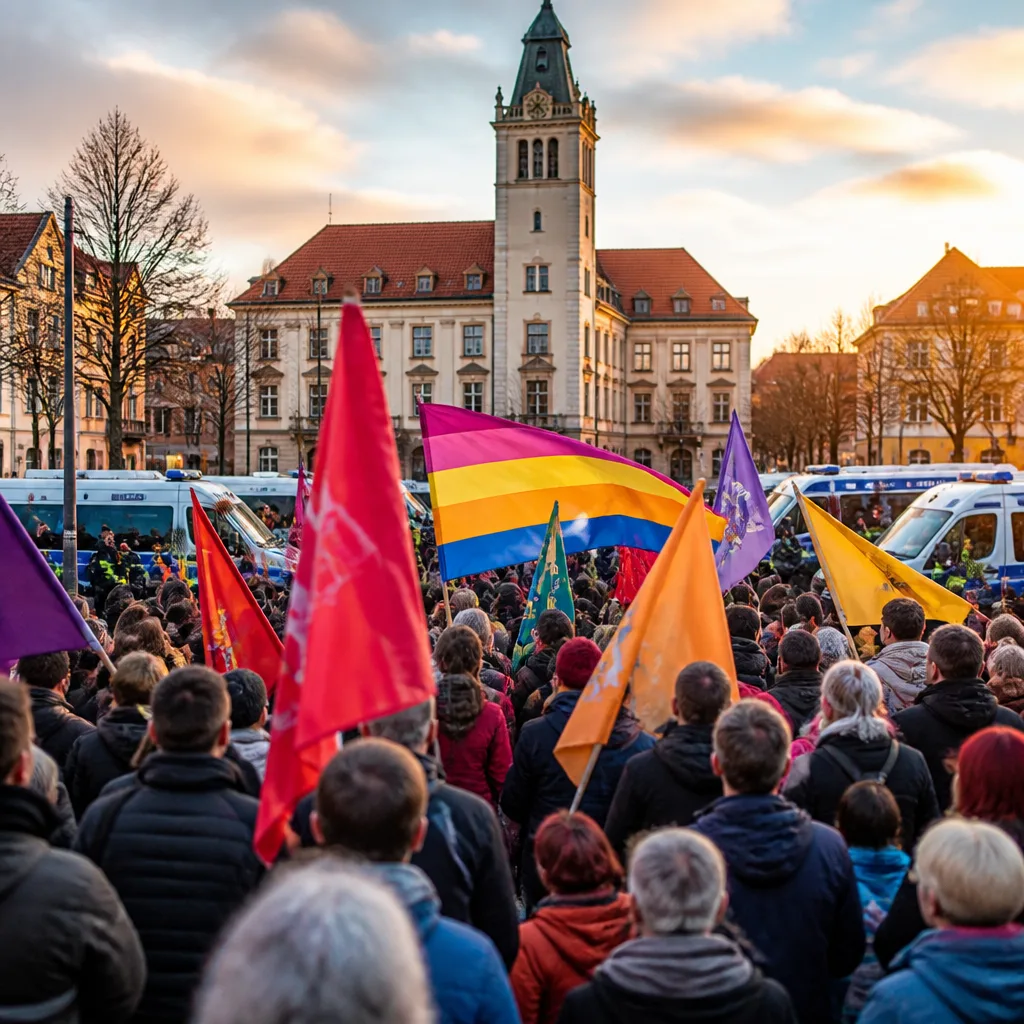
Demonstrations in the eastern German town of Bitterfeld have become a vivid symbol of a strategy intended to keep the far‑right Alternative for Germany (AfD) from power — and of the strain that strategy is now placing on the country’s political fabric.
From protest to paradox
Flags representing almost the full spectrum of Germany’s parties now appear at the weekly Bunt statt braun (colourful instead of brown) protests. Observers in Bitterfeld reported banners from the centre‑right Christian Democrats (CDU), the Greens, the Social Democrats (SPD) and even the hard‑left Die Linke fluttering together. The events were established last year explicitly to counter rallies organised by the AfD.
For many in the town square, the prospect of the AfD gaining office evokes a profound historical anxiety. Yet the policy of an all‑of‑society resistance to the party — a firewall assembled from across the political spectrum — has produced unforeseen effects. What began as a defensive mobilisation is being cast, by critics and some participants, as a movement that both highlights and consolidates the AfD’s profile.
Unusual alliances, familiar danger
The sight of conservatives standing alongside Marxists is rare in German politics. That rarity underlines the depth of the alarm at the AfD’s growth: the town hall square in Bitterfeld now hosts a coalition of political colours united by fear of a common opponent.
- Bunt statt braun demonstrations started last year to contest AfD rallies.
- Participants display flags from parties across the spectrum, from the CDU to Die Linke.
- For many attendees, memories of Germany’s past remain a potent motive for action.
That cross‑party cooperation has tactical logic. Parties that normally oppose one another politically can agree that preventing a far‑right party from entering executive power is essential to preserving democratic norms. But the Bitterfeld experience illustrates an important trade‑off: making the AfD the singular focus of political mobilisation can also consolidate its status as the primary antagonist in the national story, thereby amplifying its visibility.
Consequences for democratic politics
The anti‑AfD firewall highlights two distinct pressures on German democracy. First is the immediate polarisation of political space, where conventional policy debates are displaced by existential contests about who may govern. Second is the risk that a broad‑based campaign to exclude a party may be interpreted by some voters as a denial of representation, potentially lending the excluded party an outsider narrative it can exploit.
In Bitterfeld, participants’ fear of the AfD’s agenda is palpable. That fear unites ideologically diverse actors, but it also narrows the terms of political engagement: elections and demonstrations become measured not by competing policy proposals but by whether a party is tolerated in office. Such a dynamic can harden identities and reduce incentives for cross‑cutting political dialogue.
Those consequences are not unique to Germany. Across Europe, democracies are wrestling with how to respond to parties that challenge liberal norms while still maintaining the integrity of representative politics. The German example shows how well‑intentioned coalitions can produce ambiguous results when they centre solely on exclusion rather than on positive policy alternatives.
What the Bitterfeld scene tells us
The Bitterfeld demonstrations are a reminder that defensive politics can reshape political landscapes in unexpected ways. Broad alliances can communicate seriousness of purpose; they can also entrench the sense that politics is a battle for survival rather than a contest of ideas.
| Element | Observed effect |
|---|---|
| Cross‑party flags | Unusual unity; emphasises existential threat |
| Focus on exclusion | Heightened visibility of the AfD; potential outsider narrative |
As the debate continues, German politics faces a choice about strategy. Parties may persist with an exclusionary firewall, accepting the risks it brings. Alternatively, they may seek to broaden their responses, combining defence of democratic norms with positive policy offers that undercut the grievances the AfD exploits. Which path they choose will shape not only the next elections but the character of political competition in Germany for years to come.