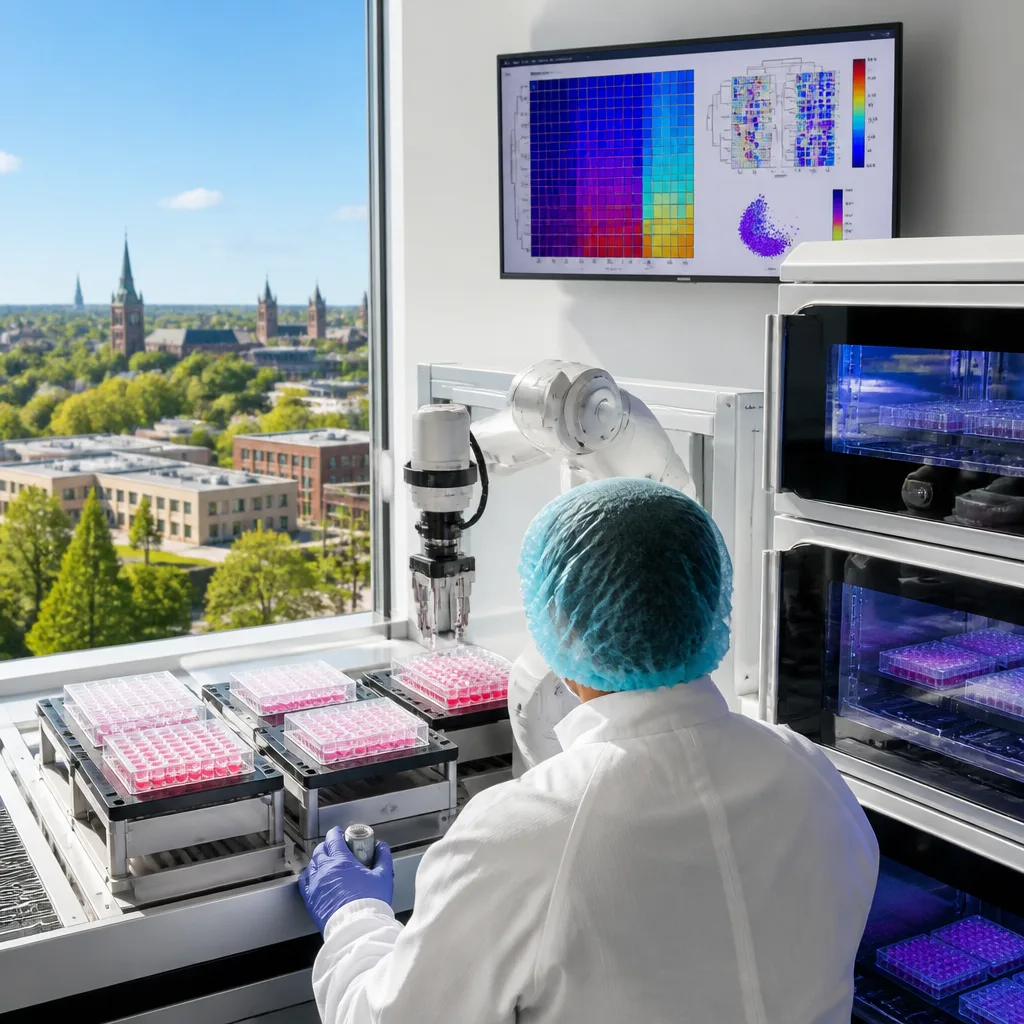
bit.bio, the Cambridge-based synthetic biology firm, has introduced a new screening service called ioScreen and named Sejla Salic-Hainzl as its first Chief Technology Officer. The move packages large-scale CRISPR screening in human induced pluripotent stem cell (iPSC)-derived models into a service that customers can use without building complex in-house infrastructure.
Bringing industrial-scale CRISPR to iPSC-derived cells
ioScreen is designed for pharmaceutical and biotechnology groups running functional genomics programmes — experiments that alter gene activity to probe disease biology and identify drug targets. The service allows customers to run screens in mature, human iPSC-derived cells at scale, either using bit.bio’s own CRISPR-Ready ioCells, integrating other products in the company’s portfolio, or by bringing their own cell models to the platform.
The company says the offering addresses practical hurdles that still prevent many organisations from deploying CRISPR screening widely. Those obstacles include the need for specialised infrastructure and technical expertise, and the sheer numbers of cells required when screening in human iPSC-derived models rather than standard immortalised cell lines.
Leadership scaled to match technical ambition
Sejla Salic-Hainzl takes the newly created CTO role after nearly six years leading research and development at bit.bio Discovery, the company division that has already run large-scale, custom screens for several big pharmaceutical companies. Her promotion reflects a reorganisation of senior technical leadership as bit.bio broadens its commercial offering and moves to make a previously bespoke service more widely available.
- Service: ioScreen — industrial-scale CRISPR screening for human iPSC-derived cells.
- Use cases: functional genomics, target discovery and validation in drug research.
- Access options: CRISPR-Ready ioCells, other bit.bio products, or customer-supplied cell models.
Building on prior work while lowering barriers
The new service formally commercialises work that bit.bio Discovery has already completed for several large pharmaceutical clients. That prior work focused on developing and running extensive customised screens in mature human iPSC-derived cells — a technically demanding approach that aims to give researchers results in models closer to human biology than traditional cell lines.
By offering ioScreen as a managed service, bit.bio is attempting to reduce duplication of effort across the sector. Rather than each organisation investing in the expensive infrastructure and staff expertise needed to run high-throughput CRISPR screens in iPSC-derived systems, customers can access those capabilities externally.
Implications for drug discovery and the UK life sciences scene
Functional genomics is increasingly central to early-stage drug discovery, and demand for human cell models in preclinical research is rising among pharmaceutical, biotechnology and academic groups. Packaging mature iPSC-derived CRISPR screening as a service could accelerate adoption by removing capital and technical barriers.
For the UK life sciences cluster, particularly around Cambridge, the development underlines a broader commercialisation trend: firms that developed bespoke capabilities for large pharma are now productising those services to reach a wider customer base. The appointment of a dedicated CTO signals that bit.bio expects technical scale-up to be a core part of its growth strategy.
| Component | Notes |
|---|---|
| Product | ioScreen — industrial CRISPR screening service |
| Leadership | Sejla Salic-Hainzl, first Chief Technology Officer |
| Target customers | Pharma, biotech, academic organisations using functional genomics |
The practical effect for researchers is straightforward: access to scalable CRISPR screens in more biologically relevant human cell models without the need to replicate costly, time-consuming infrastructure in-house. Whether that translates to faster target discovery or more predictive preclinical results will depend on how organisations integrate externally generated screening data into their pipelines — and on independent benchmarking of results produced by ioScreen in different disease areas.