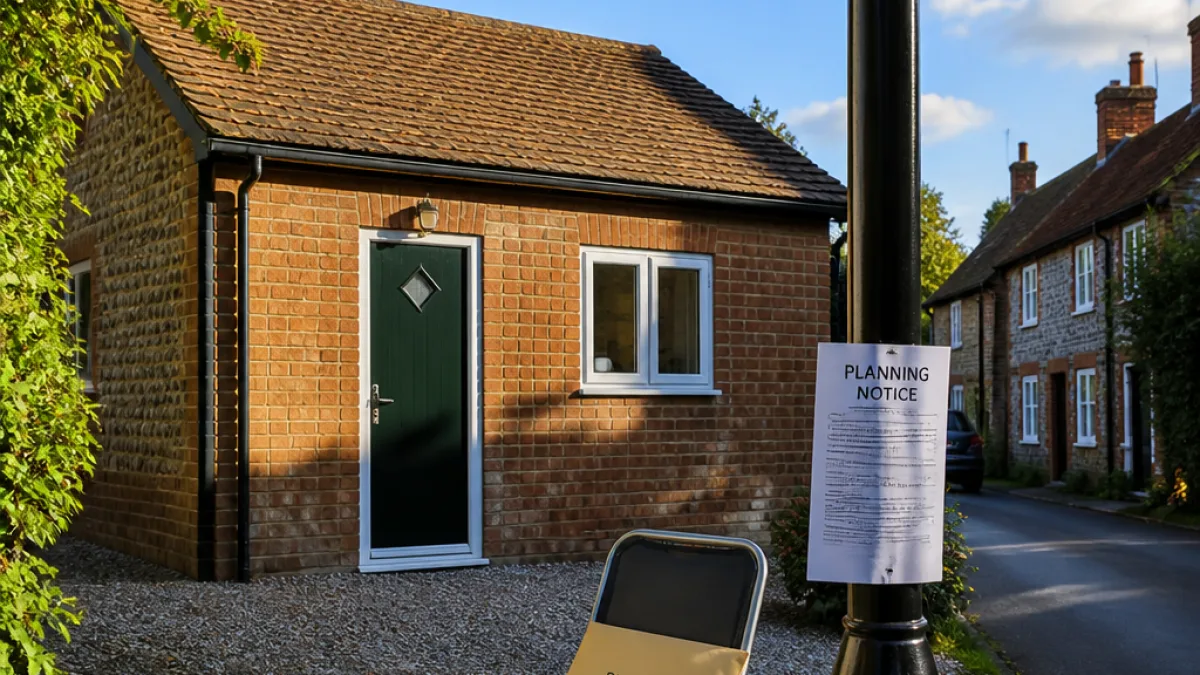
A Buckinghamshire councillor has applied for retrospective planning permission after converting a garage into an independent one-bedroom home on Marston Road, Granborough, in the Aylesbury Vale area. The work has already been completed and is now the subject of a formal planning application that will be considered by councillors rather than officers.
Why the case goes to committee
The proposal must be decided by the central and north Buckinghamshire area planning committee because the applicant, a Conservative member for Quainton, is a serving Buckinghamshire councillor and a member of the same committee. Buckinghamshire Council’s report explains that, under the council’s constitution, such applications are brought before the area planning committee to ensure openness and transparency.
What has been built
Planning documents confirm the single-storey brick structure was formerly used as a garage with three doors across its front. The doors have been removed and replaced with uPVC windows as part of its conversion into a self-contained one-bedroom dwelling. The converted building has been given its own residential curtilage, including use of part of the rear garden, while sharing the existing vehicle access onto Marston Road.
- Type of building: single-storey former garage
- Proposed use: one-bedroom dwelling
- Alterations: three garage doors replaced with uPVC windows; creation of separate curtilage
Planning officers have described the external alterations as relatively minor and judged the size, design and construction of the building suitable for the proposed residential use. They recommend approval of the application subject to six conditions.
"In accordance with the council’s constitution, such planning applications must be determined at the relevant area planning committee to ensure openness and transparency."
Policy and practical considerations
Although the site lies outside Granborough’s settlement boundary, officers concluded the conversion would comply with rural development policies because it reuses an existing building rather than constituting a major reconstruction. The report also states that the dwelling’s retention would not harm the character or appearance of the surrounding countryside.
Highways officers raised no objection, noting that at least four parking spaces can be provided on the existing hardstanding to serve the new home and the main house, Jersey Farm House. That assessment forms part of the planning officer recommendation to grant permission.
| Item | Detail |
|---|---|
| Recommended decision | Approval, subject to 6 conditions |
| Bedrooms | 1 |
| Parking spaces available | At least 4 on existing hardstanding |
Local context and consequences
For residents in the Aylesbury Vale area, this case raises several points about planning practice and the responsibilities of elected members. Retrospective applications are not uncommon, but they attract particular scrutiny when the applicant holds public office and sits on the committee that will determine the application. The council has followed procedure by requiring committee determination, a step designed to preserve public confidence in the decision-making process.
Neighbours and parish councils typically focus on matters such as impact on local character, parking and traffic, and whether a development sets an unwelcome precedent. In rural villages around Aylesbury, residents often emphasise the importance of keeping development proportionate and sensitive to the countryside; officers’ view that the conversion would not harm the area’s character will be a key point in the committee debate.
The committee will also consider whether the building’s prior use and its scale make the conversion acceptable in planning terms. If permission is refused, the council could require the building to be returned to its former use or seek other remedies. If approved, the dwelling will remain and the councillor will be able to occupy or let the unit in line with planning conditions.
The application is scheduled to be heard at the central and north Buckinghamshire area planning committee because of the need to manage potential conflicts of interest. That meeting will be watched by local campaigners and residents attentive to how planning rules are applied to public figures.
The case highlights how decisions about small-scale development can have outsized local significance when they involve elected representatives, and it underlines the role of area committees in maintaining transparency and public trust in local planning.