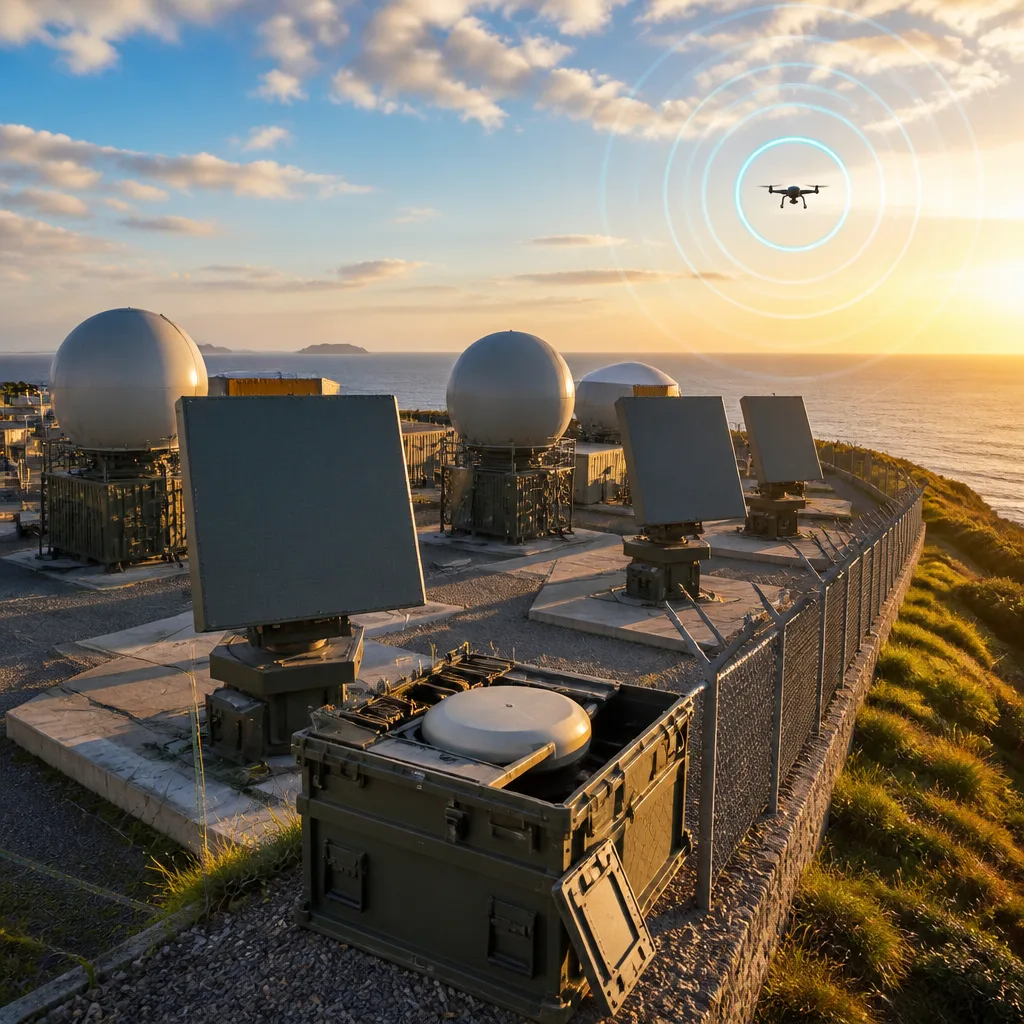
An official audit has concluded that Taiwan’s landmark fixed‑site counter‑drone programme contains technical weaknesses that leave military facilities vulnerable to some of the People’s Liberation Army’s newer unmanned aerial systems.
Key shortfalls identified
The Audit Office found that the system, developed by the National Chung‑Shan Institute of Science and Technology (NCSIST), is unable to detect or jam the 5.1GHz frequency reportedly used by newer Chinese drone models. It also does not provide full coverage of parts of the BeiDou‑3 satellite navigation signals and has only limited capability against emerging threats such as fibre‑optic and AI‑guided drones.
The programme has already been hit by schedule slippage and technical bottlenecks. Auditors reported construction delays and shortages of key components that left the delivery timeline six to 12 months behind plan, a gap that they warned could undermine protection for air bases and other sensitive sites.
Procurement problems and test failures
The audit’s findings came amid a separate procurement setback: the army’s intended acquisition of 26 fixed‑site systems from local contractor Tron Future Tech was cancelled after the equipment failed its third and final acceptance test. That failure, together with the audit’s technical criticisms, points to wider problems in converting a conceptual layered defence into an operational shield.
“The system struggled to combine information from search and passive radar systems when faced with multiple waves of drones, making it difficult for operators to identify targets accurately.”
That difficulty was flagged by Defence Minister Wellington Koo Li‑hsiung, according to the audit. The inability to fuse sensor inputs reliably under saturating attacks complicates operators’ task of discriminating hostile platforms from benign traffic — a vital function when small, low‑signature drones arrive in swarms.
Upgrades planned but timing uncertain
Defence officials said many of the problematic technologies were not prevalent when the programme began in 2021, and that upgrades are already under development. A ministry spokesman, Sun Li‑fang, told auditors that NCSIST had verified certain jamming capabilities. But analysts cited by the audit expressed concern that upgrades may not arrive swiftly enough to keep pace with the rapid evolution of drone capabilities.
- Programme value: $111 million
- Planned fixed‑site units: 26 (procurement terminated after failed tests)
- Frequency gap: inability to detect/jam 5.1GHz signals
- Schedule slippage: 6–12 months behind
| Issue | Finding |
|---|---|
| Detection/jamming | Does not cover 5.1GHz used by newer PLA drones |
| Navigation interference | Partial coverage of BeiDou‑3 signals |
| Sensor fusion | Problems combining search and passive radar under multi‑wave attacks |
| Procurement | 26‑system army purchase terminated after failed acceptance test |
Wider implications
The report underscores a recurring problem for modern militaries: procurement cycles that can take years to move from design to deployment, while adversary technology advances much faster. Drones and their countermeasures evolve in months, not years, and the audit suggests Taiwan’s approach to fixed‑site protection has struggled to keep up.
For Taiwan, which has placed growing emphasis on layered defences to deter or blunt an attack, gaps in detection, jamming and sensor integration present immediate operational concerns. Fixed installations such as airbases are high‑value targets; if counter‑drone systems cannot reliably identify, track and defeat hostile platforms across the radio‑frequency and navigation bands they use, commanders will face hard choices about force protection and redundancy.
Officials say work is under way to address the problems. But until upgraded capabilities are fielded and pass independent testing, the audit leaves a clear message: a programme billed as modernising fixed‑site defence requires faster iteration and better alignment between threat intelligence and system design to remain credible against a dynamic drone threat.