
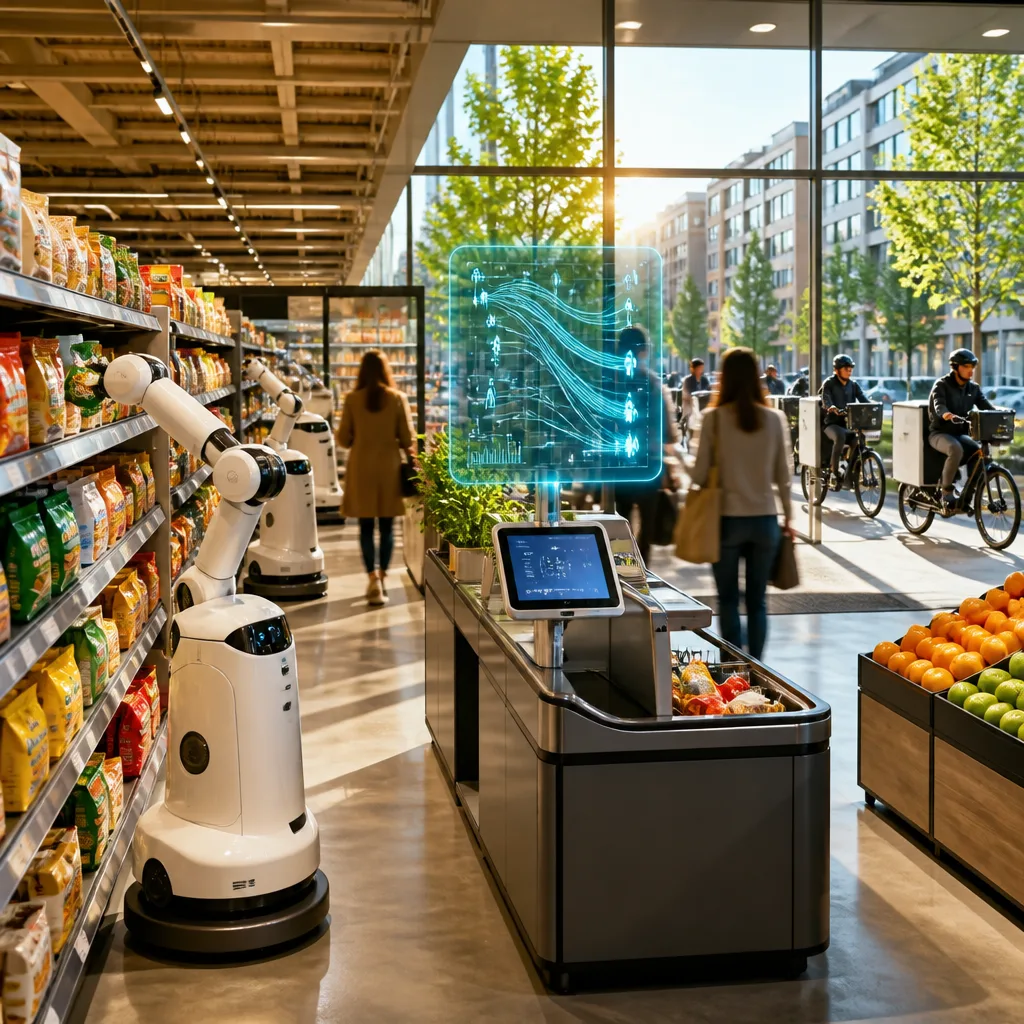
Agentic artificial intelligence, sub‑30‑minute delivery and shelf‑level robotics have ceased to be future promises and are now operational facts for large retailers in 2026. What started as pilots and product roadmaps has become embedded in the daily mechanics of store operations, logistics and customer interactions at chains including Amazon, Walmart and Kohl's, according to a mid‑year industry analysis.
From roadmap to routine
Industry observers say the pivot this year is not simply broader adoption but tighter integration. One notable development came in January when Google published the Universal Commerce Protocol (UCP) — an open standard intended to let agentic systems handle the full shopping journey, from discovery through checkout and after‑sales support. Retailers that connect to UCP can place search, basket and payment flows directly inside Google's agentic environment, shortening the technical effort required to run multiple bespoke integrations.
The practical effect is that agentic systems are now woven into diverse retail workflows: customer service, quality inspection, recruitment and onboarding, in‑store clienteling and dynamic pricing. Stores and fulfilment centres are coupling these software capabilities with hardware advances such as faster micro‑fulfilment and robotic shelf systems to deliver goods more quickly and reduce manual inventory tasks.
"Agentic AI would become a 'universal feature' of retail solutions this year,"
— an industry forecast that industry reporting says is now reflected in operational deployments.
What this means on the ground
- Faster fulfilment: Ultra‑fast delivery networks and local micro‑fulfilment are enabling retailers to offer sub‑30‑minute delivery windows in urban areas.
- Embedded agentic services: Search, checkout and post‑purchase assistance can be invoked within agentic environments without forcing retailers to maintain a tangle of custom APIs.
- Workforce augmentation: Robots and automated inspection tools are taking over repetitive tasks on shelves and in warehouses, changing the nature of in‑store and back‑room roles.
Retail technology vendors and in‑house teams are racing to close the gap with peers that moved early, making integration speed and data quality the primary competitive levers this year.
Winners, losers and the policy angle
Major chains that already invested in edge fulfilment and flexible pricing engines stand to preserve or extend market share. Smaller operators face a choice: invest in the same systems or become dependent as fulfilment and customer experience platforms consolidate around a few big providers.
Open standards such as Google's UCP reduce integration friction, but they also create new concentration risks if most retailers route commerce through a handful of agentic platforms. That matters for regulators watching platform power, and for CIOs who must balance dependency against speed to market.
| Trend | Operational impact |
|---|---|
| Agentic AI | Automates end‑to‑end interactions; embeds search and checkout in agent environments |
| Ultra‑fast delivery | Shortens fulfilment windows; increases reliance on micro‑fulfilment hubs |
| Shelf and warehouse robots | Reduces manual inventory tasks; shifts worker roles to oversight and exception handling |
Labour and consumer effects
Workforce augmentation is repositioning roles rather than simply eliminating them: retailers report concentrating human labour on exceptions, customer experience and tasks requiring judgement, while machines handle repetitive processes. For consumers, the immediate benefits are faster delivery, more personalised service and smoother post‑purchase support when agentic assistants are used correctly.
Yet the rapid roll‑out raises questions about transparency, data sharing and error management when autonomous agents are authorised to complete transactions or adjust prices. Integrations that reduce technical overhead also centralise control of shopping flows, and that centralisation will draw scrutiny from competition and consumer protection authorities.
For operations and technology leaders, the issue is no longer whether to adopt these capabilities but how quickly they can match peers that already have. The next phase for the sector will be testing resilience: how agentic systems behave under scale, how well micro‑fulfilment handles spikes, and whether robotic helpers reduce cost without degrading store experience.
These are practical problems for execs to solve now — and the retailers that succeed will be those that combine speed of deployment with clear rules about data governance and operational fallbacks.









