
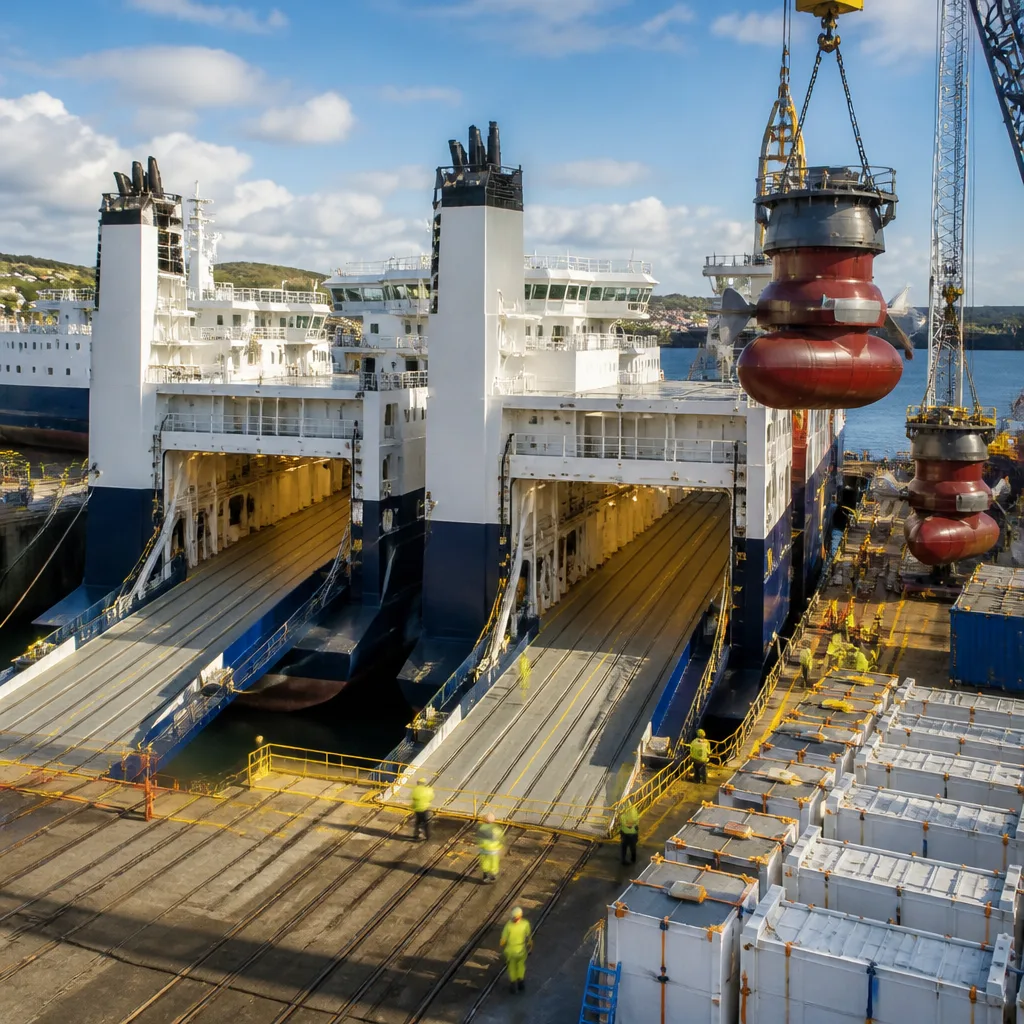
ABB has been contracted to provide the power, propulsion and automation package for two new rail-enabled ropax ferries, Kupe and Cook, being built for New Zealand’s Cook Strait Ferry Replacement Programme. The vessels are due to operate the 92-kilometre Wellington–Picton crossing and are scheduled for delivery in 2029.
What ABB will supply
The technology group will deliver a mix of electrical and digital systems designed to improve manoeuvrability, energy management and operational resilience. Key hardware and software items include:
- four main alternators;
- motors and drives for three bow thrusters;
- two Azipod propulsion units, enabling sideways "crab" movement;
- an onboard Power and Energy Management System (PEMS) to balance generation, battery storage, propulsion and auxiliary loads;
- the ABB Ability Remote Diagnostic System for continuous monitoring and access to ABB’s global experts.
The integration of these elements aims to reduce fuel consumption through automatic optimisation, allow harbour operations solely on battery power, and maintain power continuity during generator failures.
Capacity and operational changes
The new ferries measure approximately 200 metres by 28 metres. They will accommodate up to 1,530 passengers, representing a 63 per cent increase in passenger capacity, and offer 2,400 lane metres of freight space, a 44 per cent increase on the vessels they replace. Rail-enabled decks will allow train wagons to be loaded directly, cutting out intermediate cargo handling steps during inter-island transfers.
ABB highlights the Azipod units’ capability to move the vessels laterally—useful when berthing in challenging conditions. The company says the propulsion pods allow the ships to "crab" at 1 knot while facing winds of 40 knots from any direction, easing entries to the ports of Wellington and Picton.
"Growing up on the shores of Lyall Bay in Wellington, I watched the ferries push out into Cook Strait in all conditions, wind, swell and everything in between,"
Digital monitoring and maintenance
ABB’s remote diagnostic platform will provide real-time operational data and predictive-maintenance capabilities. The system connects the vessels to ABB’s global support network, which should enable faster troubleshooting and reduced downtime by identifying faults before they escalate. PEMS treats generators, batteries and drives as a single energy ecosystem, which the company says will automatically optimise power flow and lower fuel use.
Implications and context
The contract underlines a broader trend in maritime engineering: combining electric propulsion, energy storage and digital diagnostics to improve operational efficiency and resilience. For the Cook Strait route—exposed to strong winds and heavy swell—the ability to manage power dynamically and to manoeuvre precisely when berthing is especially valuable.
Rail-enabled ropax ferries are notable because they streamline freight logistics by allowing continuous rail movements between islands. That change could shorten turnaround times and reduce handling costs for freight operators, though final commercial benefits will depend on scheduling, port infrastructure and regulatory arrangements.
| Specification | Value |
|---|---|
| Length | 200 m |
| Beam | 28 m |
| Passenger capacity | 1,530 (up 63%) |
| Freight lane metres | 2,400 (up 44%) |
Delivery is pencilled in for 2029. Until the ferries enter service, claims about fuel savings, maintenance reductions and operational performance will remain projections rather than measured outcomes. Real-world benefits will be established only once the vessels operate across the Cook Strait and data from ABB’s monitoring systems can be analysed.
The project is an example of how modern ship designs fuse mechanical engineering with software-driven control systems. For passengers and freight customers, the most immediate changes to watch will be boarding efficiency for rail freight, port handling times and any changes to timetables driven by faster turnarounds or improved harbour manoeuvring.
As the vessels approach completion, further technical details and independent operational figures should become available, allowing operators and the public to assess whether the new technology meets its energy-efficiency and resilience goals.









