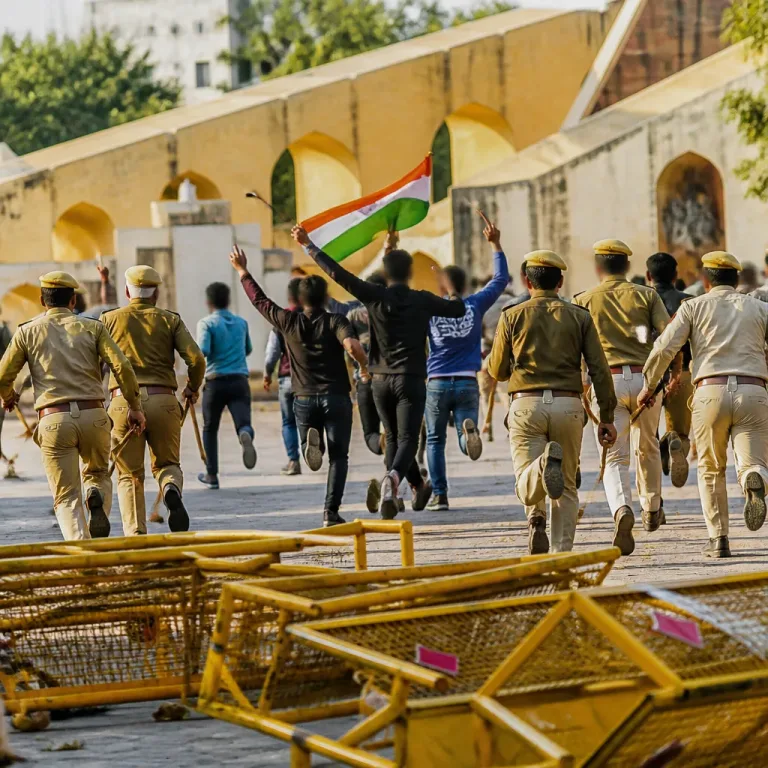
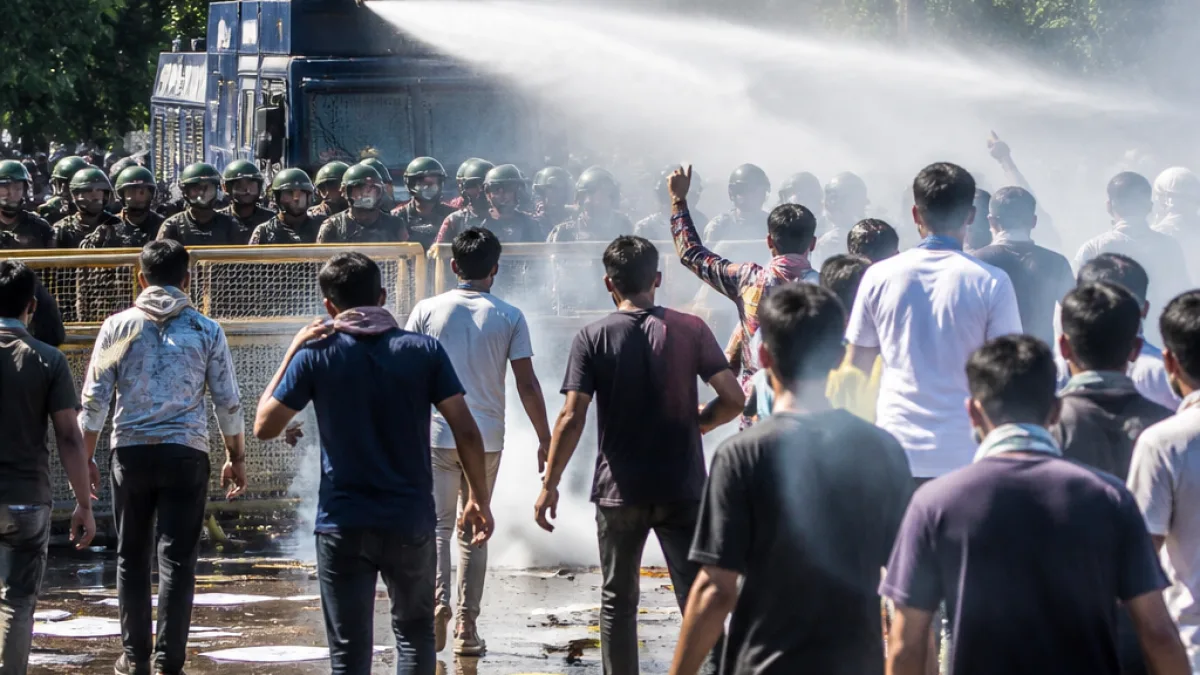
CHANDIGARH: Tension flared at the Chandigarh–Mohali border on Saturday when Chandigarh Police, backed by paramilitary personnel, used water cannon and fired tear‑gas shells to disperse hundreds of supporters of the Qaumi Insaaf Morcha attempting to enter the Union Territory from Mohali.
March towards Punjab Lok Bhawan, demands and police response
The protesters were marching towards Punjab Lok Bhawan to press demands for the release of Sikh prisoners — referred to by organisers as “Bandi Singhs” — and to seek a 10‑day parole for Jagtar Singh Hawara, convicted in the assassination of former Punjab chief minister Beant Singh. Police had erected barricades at multiple points along the Chandigarh–Mohali border, including the Yadavindra Public School (YPS) crossing, to prevent entry into Chandigarh.
According to police accounts reported from the scene, demonstrators tried to remove barricades placed behind tractors and to breach cordons. When protesters attempted to cross the barricades, officers used water cannon and fired tear‑gas shells to disperse the crowd. Police said some demonstrators resorted to stone‑pelting, turning the standoff violent.
Security deployment and claims of weapons
A large contingent of Chandigarh Police and paramilitary personnel were deployed along the route to maintain law and order. Police officials reported spotting some young protesters carrying weapons, and vehicles belonging to security agencies from nearby areas were also stationed to assist containment efforts.
“Police used water cannons and tear‑gas shells to prevent the protesters from entering Chandigarh,” reported officials at the scene.
There were media reports that Simranjit Singh Mann was detained after coming near Punjab Lok Bhawan disguised as a patient with bandages covering his face; senior police officials did not confirm the detention in the immediate aftermath.
Bandh call and further mobilisation
Following the confrontation, the Qaumi Insaaf Morcha announced a Punjab bandh on August 21 to press for the release of the Sikh prisoners. The organisers argued that some detainees had remained in custody for decades, “30 to 35 years”, despite allegedly becoming eligible for release or having completed sentences, as reported from the protest.
The bandh call escalates the dispute from a contained border standoff to a province‑wide mobilisation that could affect transport, public services and businesses across Punjab on the specified date.
What happened on the ground — quick summary
- Location: Chandigarh–Mohali border, Yadavindra Public School (YPS) crossing and other barricade points.
- Actors: Qaumi Insaaf Morcha supporters; Chandigarh Police and paramilitary units.
- Police action: Water cannon and tear‑gas shells used to disperse protesters.
- Aftermath: Morcha announced Punjab bandh on August 21.
| Issue | Reported detail |
|---|---|
| Primary demand | Release of Sikh prisoners and 10‑day parole for Jagtar Singh Hawara |
| Police tactic | Water cannon, tear‑gas; barricades reinforced |
| Reported violence | Stone‑pelting by protesters; claims some carried weapons |
Context and implications
The clash underscores persistent tensions surrounding long‑running prisoner cases linked to politically sensitive incidents in Punjab. Mass marches and bandh calls can rapidly affect daily life, particularly in border areas such as Mohali and Chandigarh where commuters and inter‑state traffic converge. Law‑and‑order responses that include non‑lethal force such as water cannon and tear gas are frequently used to prevent breach of civic perimeters, but they also risk escalation if crowds do not disperse.
For Chandigarh residents and commuters planning travel across the border in the coming days, the announced bandh on August 21 could mean disruptions to public transport, markets and administrative offices in parts of Punjab. Authorities have not issued a public advisory or curfew in Chandigarh as of the latest reports.
What officials have and have not confirmed
Police at the scene confirmed the use of crowd‑control measures and said personnel had observed individuals they believed were carrying weapons. Reports of the detention of a prominent figure near Punjab Lok Bhawan were circulated in media accounts, but senior police officials had not formally verified that arrest by the time of reporting.
The situation remains fluid. Further statements from Chandigarh Police, Punjab administration and the Qaumi Insaaf Morcha are expected in the coming days as organisers press the bandh call and authorities monitor public order.