
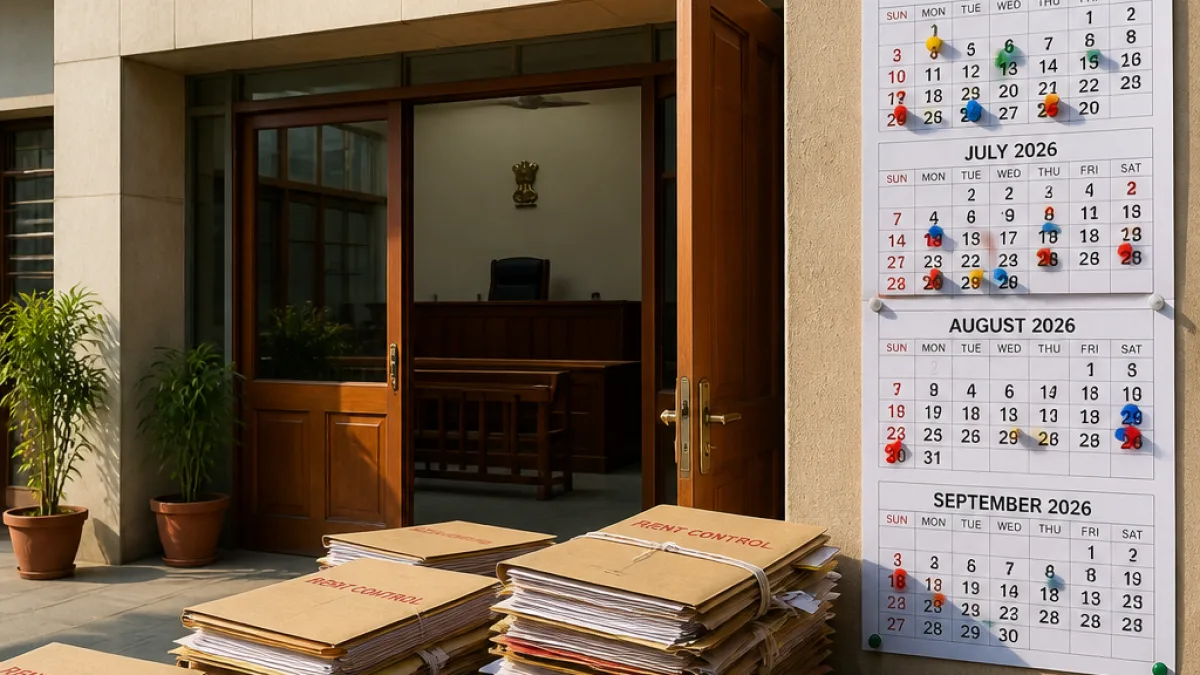
The district court in Chandigarh continued to record a substantial backlog of rent-related litigation as of September, with 206 Rent Control and Additional Rent Control cases pending and just 18 disposed in the same period, official figures show. The data underscore the challenge of clearing long-standing disputes even after the Union Territory adopted a new tenancy framework this year.
New law, old cases
The Assam Tenancy Act, 2021, was extended to Chandigarh on May 6, 2026, replacing the earlier rent-control regime. The statute establishes a dedicated three-tier mechanism — the rent authority, rent court and rent tribunal — and prescribes summary, affidavit-based proceedings with fixed timelines for replies, appeals and execution.
However, district court records indicate that cases instituted under the old framework remain before civil courts under transitional provisions, and the new mechanism does not automatically transfer or dispose of those matters.
Year-wise pendency and disposals
Court figures cited by legal practitioners show the following number of pending and disposed cases over recent years:
- 2026 (till September): 206 pending, 18 disposed
- 2025: 203 pending, 99 disposed
- 2024: 150 pending, 187 disposed
- 2023: 136 pending, 229 disposed
- 2022: 103 pending, 282 disposed
- 2021: 65 pending, 312 disposed
| Year | Pending cases | Disposed cases |
|---|---|---|
| 2026 (till Sept) | 206 | 18 |
| 2025 | 203 | 99 |
| 2024 | 150 | 187 |
| 2023 | 136 | 229 |
| 2022 | 103 | 282 |
| 2021 | 65 | 312 |
What the new framework changes
Legal experts say the Assam Tenancy Act replaces the older East Punjab Urban Rent Restriction Act, 1949 — a statute introduced in the immediate post‑Partition era when housing shortage and tenant protections shaped the law.
Under the new framework, landlords and tenants are expected to have access to a streamlined process with clearly prescribed timelines for different stages of dispute resolution, potentially reducing future delays that previously arose from repeated adjournments, multiple procedural stages and challenges before higher courts.
"The new framework could change the way landlord-tenant disputes are handled by replacing conventional civil court procedures with a dedicated mechanism," Advocate Amit Sharma said.
Sharma and other practitioners, however, cautioned that while the mechanism may prevent fresh cases from entering the civil court system, it cannot clear the existing backlog because those cases remain subject to transitional provisions under the law.
Practical implications for residents
For tenants and landlords in Chandigarh, the change means future disputes are likely to be processed under the rent authority, rent court and rent tribunal with summary proceedings and fixed timelines. But for those with ongoing litigation filed under the earlier statute, the path to resolution remains within the civil court system unless specific transitional rules transfer matters.
- Current litigants should check whether their case falls under the old Act and seek legal advice on transitional procedures.
- Landlords and tenants initiating fresh disputes will, in general, be routed through the new three‑tier mechanism.
- Observers say administrative capacity and staffing of the new rent bodies will determine the effectiveness of the expedited process.
Data in the district court record do not indicate the year in which the pending cases were instituted; they show only the number pending or disposed of in each year. That limits conclusions about the age profile of the backlog, though the steady rise in pending matters between 2021 and 2026 points to unresolved caseload pressures.
Stakeholders in Chandigarh’s housing sector — including lawyers, resident welfare associations and rental market participants — will be watching how quickly the new mechanism becomes operational and whether it eases pressure on the civil courts over the coming months.













