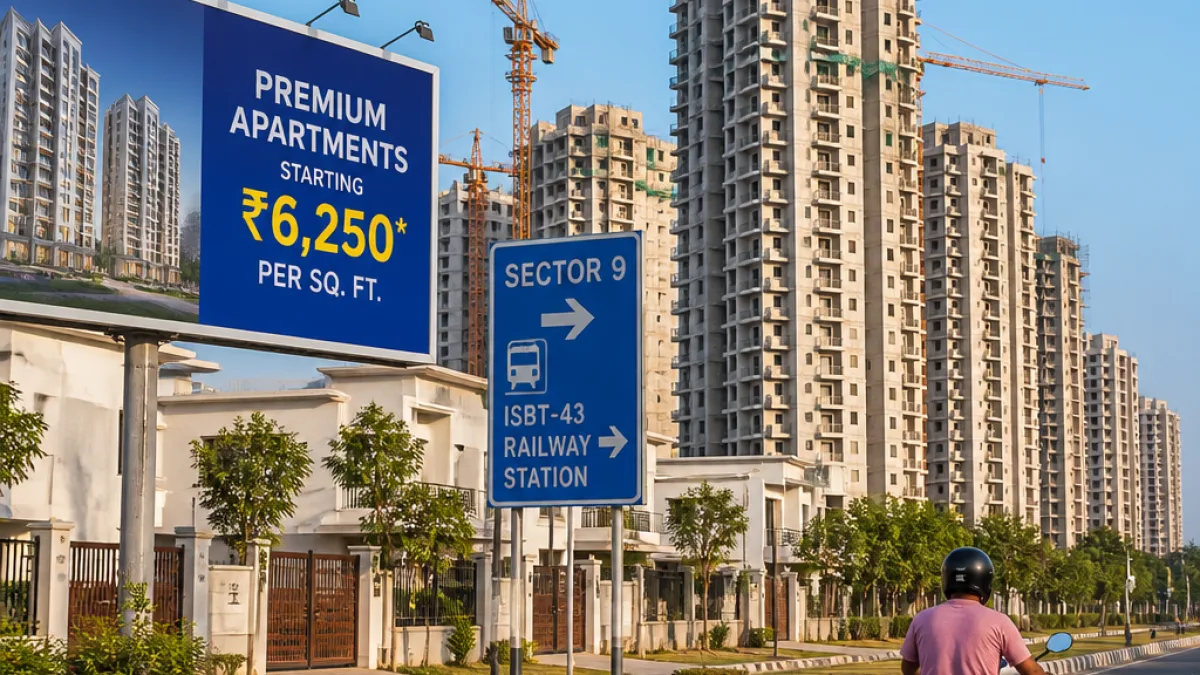
Report highlights rapid price growth, premium demand and transport links
The CII–Knight Frank report has identified Chandigarh Tricity as one of 11 emerging real estate markets likely to shape the next phase of property growth in India. The study, cited in media reporting on the report’s findings, notes that residential prices across these 11 markets rose 63 per cent between 2021 and 2026, compared with a 42 per cent rise across India’s top eight cities.
Between 2016 and 2026 the 11 emerging markets recorded an average residential price compound annual growth rate (CAGR) of 8 per cent, against 4 per cent for the top-eight cities, the report said.
- Chandigarh price band: ₹7,500–₹10,500 per sq ft — placed second only to Goa among the 11 markets on pricing.
- Driving factors: expanding connectivity and an established services economy including professional services, education and healthcare.
- Indicative transaction: a 4.1-kanal house in Sector 9 (2,489 sq yards) reportedly sold on May 13 for about ₹100 crore, signalling demand at the premium end.
“connectivity is expanding the reach of the Tricity, while its established services economy is creating the demand that can support further real estate development.”
The report frames Chandigarh’s case as a convergence of mobility improvements and a services-led economy. It specifically points to Airport Road and the regional road network as important mobility anchors. Education and healthcare, together with professional services, were identified as economic anchors that could sustain demand for both residential and commercial real estate, the report said.
What the numbers mean for buyers, sellers and local planning
For prospective homebuyers and investors in Chandigarh Tricity, the report’s figures imply accelerating price discovery and stronger interest in mid-premium and premium housing segments. A higher price band — ₹7,500–₹10,500 per sq ft — suggests that new developments in desirable pockets will command rates substantially above the typical city-average values seen a few years ago.
For developers and commercial landlords, the report highlights opportunity in mixed-use and office space that services the professional services, education and healthcare clusters. For local planners, the emphasis on connectivity underlines the need to align road and airport-linked infrastructure with land-use plans, to manage traffic and ensure last-mile access to new projects.
| Measure | 11 emerging markets | Top 8 cities |
|---|---|---|
| Price rise (2021–2026) | 63% | 42% |
| Residential price CAGR (2016–2026) | 8% | 4% |
The report’s use of comparable metrics is useful for household budgeting and investment decisions: a sustained CAGR of 8 per cent over a decade indicates compound appreciation that materially changes affordability and yields. At the same time, higher headline prices heighten the importance of transparent pricing, stamp duty and registration considerations for buyers and sellers.
Local market watchers point to isolated high-value transactions as signals rather than norms. The cited sale of a 4.1-kanal property in Sector 9 for about ₹100 crore is an example of the premium tier of the market; such transactions can influence perceptions of neighbourhood values but do not by themselves reflect average pricing across the Tricity.
In sum, the report positions Chandigarh Tricity among a set of Indian markets where infrastructure-led reach and a services-dominated economy are expected to spur demand for higher-end residential and commercial stock. For residents and decision-makers in Chandigarh, the findings underline the importance of coordinated infrastructure planning and proactive regulatory oversight as the local property market evolves.