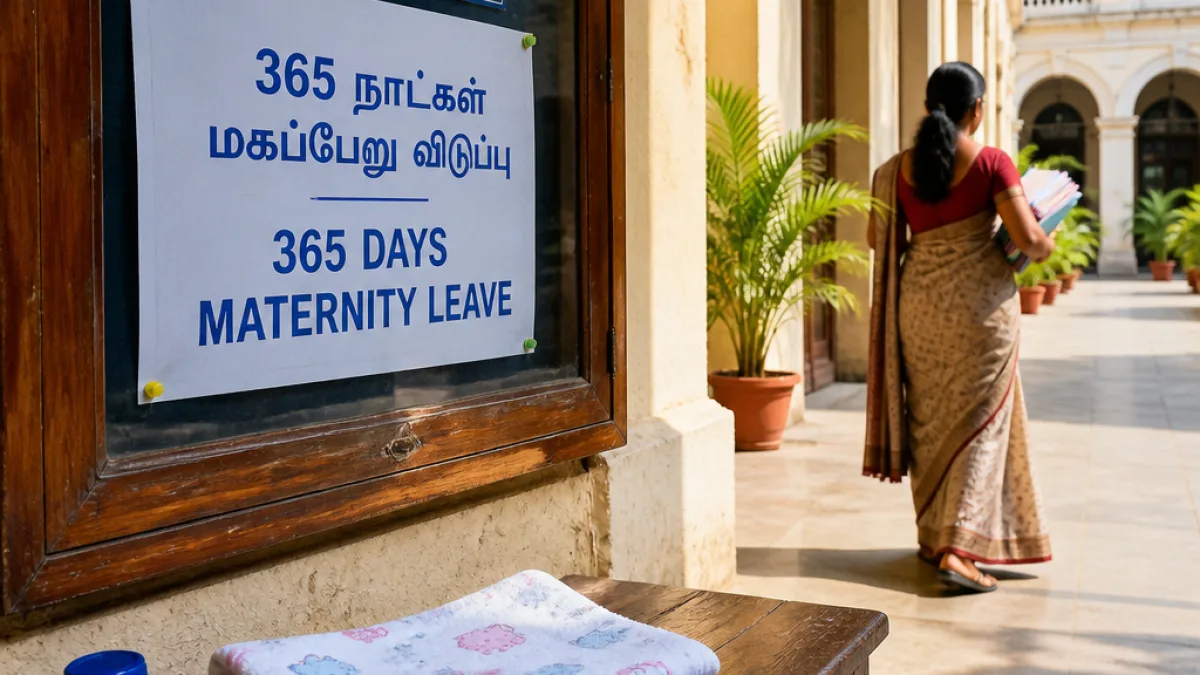
CHENNAI: The Tamil Nadu government on Tuesday announced the reinstatement of 365 days of maternity leave for women government employees on the birth of their third child, restoring the long-standing service benefit that had been curtailed earlier this year.
Decision announced in Assembly
Human Resources Management Minister Sarathkumar told the Assembly during the demand for grants discussion that the state would revert to providing one year of maternity leave for the third child. The benefit applies exclusively to women in state government service and is intended to cover childbirth, recovery and childcare.
Background: earlier amendment and court rulings
The move reverses an amendment to Fundamental Rule 101(A) made in March this year, which restricted maternity leave to 12 weeks for women government employees with two or more surviving children. That change had been introduced following a Supreme Court order and was later upheld by the Madras High Court in June in a petition filed by a woman government employee seeking 365 days of leave for her third child.
The Madras High Court had held that under the amended rules the employee was entitled only to 12 weeks. The state government’s announcement on Tuesday restores the earlier, more generous provision for a third child, effectively overriding the impact of the March amendment for that specific category of employees.
Context: demographic concerns cited
The restoration comes days after Health Minister K. G. Arunraj flagged concerns about the state’s demographic profile. Arunraj had pointed out that Tamil Nadu’s total fertility rate has fallen below 1.4, well under the replacement level of 2.1, and noted that nearly 16% of the population is aged above 60. He had also said the state could consider incentives to encourage larger families, and had referred to Andhra Pradesh’s financial incentives for a third child as a possible model.
Reaction from teachers’ federation
M. Manimekalai of the Tamil Nadu Primary School Teachers’ Federation welcomed the decision, saying the entitlement would help women who opt to have a third child but predicted the number of beneficiaries would be small. The elementary education department has among the highest proportions of women employees in the state service, with women accounting for more than 80% of its workforce.
- Benefit restored: 365 days paid maternity leave for third child.
- Previous position (since March): 12 weeks leave for employees with two or more surviving children.
- Demographic figures cited: total fertility rate below 1.4; nearly 16% population above 60.
Practical implications for employees and departments
The restoration will directly affect women in state departments who become eligible for maternity leave on the birth of a third child. Departments with high proportions of women employees — notably elementary education — may see the majority of potential claimants. The Teachers’ Federation representative suggested that while the benefit provides significant support for childcare and postpartum recovery, the actual uptake of the entitlement for a third child is likely to be limited by broader social trends towards smaller families.
Legal and administrative trajectory
Administratively, the March amendment had sought to align state leave rules with the Supreme Court’s directives; the Madras High Court had later upheld the amendment in a challenge. The present announcement reverses that administrative position for this specific category of leave. It is not yet clear whether the change will be implemented by a formal amendment to Fundamental Rule 101(A) or by a separate government order; the minister made the announcement in the Assembly but the exact schedule for issuing implementing orders was not specified in the statement recorded in the Assembly debates.
| Aspect | Previous (from March) | Restored |
|---|---|---|
| Maternity leave for third child | 12 weeks | 365 days |
| Applicability | Women employees with two or more surviving children | Women employees on birth of third child |
Wider policy debate
The announcement feeds into a larger policy conversation in Tamil Nadu about population ageing and fertility. Officials have been discussing whether targeted incentives or service benefits can influence family-size decisions. While Andhra Pradesh has explored direct financial incentives for third children, Tamil Nadu’s current measure is a service-related benefit limited to government employees rather than a universal cash incentive.
How the restoration will interact with court scrutiny and any pending litigation is likely to become clearer once the government issues formal orders to operationalise the decision. For now, the Assembly statement marks a policy shift that restores a lengthy maternity leave entitlement for a distinct group of state women employees.
Selvan Murugesan