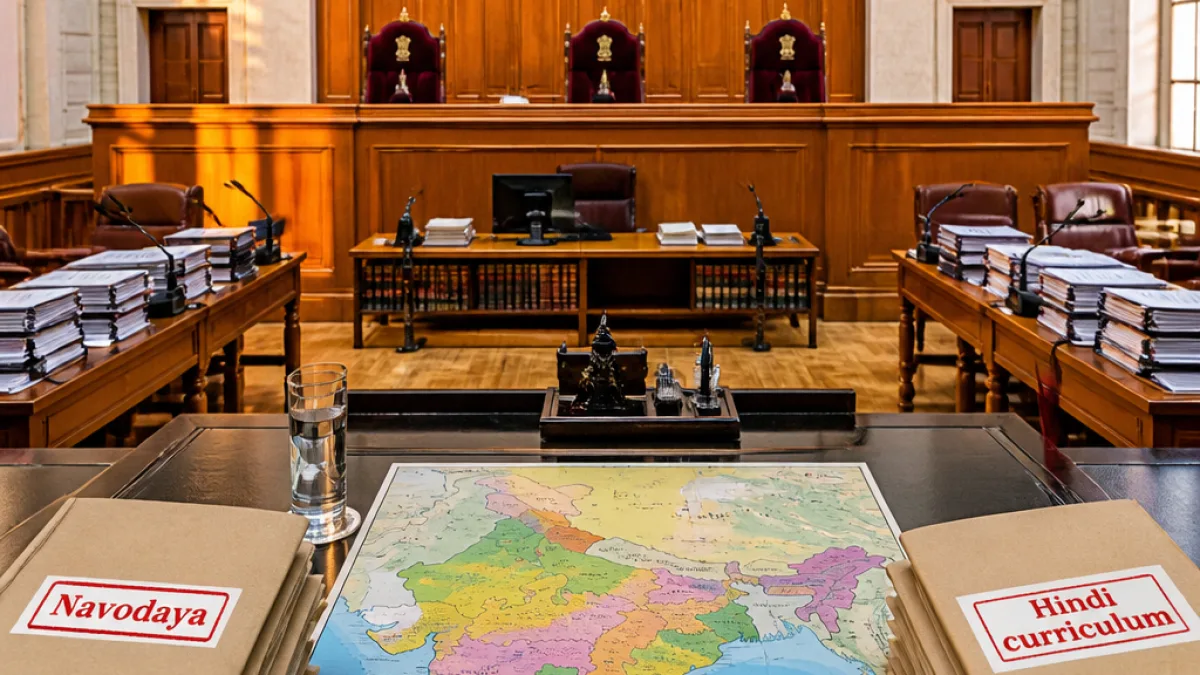
NEW DELHI: The Supreme Court on Thursday told the Tamil Nadu government that it must alter its stance towards the teaching of Hindi in schools and should engage in dialogue with the Centre on establishing Navodaya Vidyalayas in every district.
Bench urges change of mindset
A bench comprising Justices B V Nagarathna and A G Masih said individual states could not operate as separate countries and urged the state to "change your mindset" over the issue of Hindi instruction. "You have to change your mindset, it can't be that Hindi will not be taught on the soil of TN," the bench observed during the hearing.
The court noted that opposition by the state simply because a language is not part of the existing state policy was not acceptable in principle. "People in Chennai should not alienate Delhi and vice versa," the bench added, urging a spirit of cooperative federalism.
"You have to relax this rigidity in your mind," the bench told the state, pointing to the need for dialogue and warning that resisting a policy in education could set a precedent for refusal in other areas.
State counsel argues federal concerns
Senior advocate Jaideep Gupta, appearing for the Tamil Nadu government, countered that imposing the Centre's decision would undermine the federal structure and the state's language policy. Gupta argued that directing the state to accept a three-language policy that includes Hindi would "supersede Tamil" and that such unification was not the intent of the Constitution.
He also emphasised that Navodaya Vidyalayas were not central government schools but institutions run by a society and expressed concern that "there is an adamancy that Hindi must predominate." Gupta submitted that cooperative federalism should not function in only one direction and resisted judicial enforcement of the policy.
Background: Madras HC and earlier SC directions
The matter arises from a challenge by the Tamil Nadu government to a Madras High Court judgment which directed the state to permit Navodaya Vidyalayas in every district. The bench referred to an earlier Supreme Court direction from last December, which had instructed Tamil Nadu to identify land required for establishing Navodaya Vidyalayas in each district within six weeks.
The Supreme Court clarified that it was not asking the state to acquire land but merely to identify suitable sites for the schools. The case was posted for further hearing in December.
Implications and practical issues
The dispute touches on two core issues: language policy in schools and the Centre–state balance in education administration. Tamil Nadu has long maintained a two-language policy, prioritising Tamil and English, and has resisted central and national attempts to introduce or expand Hindi instruction.
Navodaya Vidyalayas follow a three-language formula that typically includes Hindi. The state's objection is that such a requirement would conflict with its statutory and policy commitments to promote Tamil as the primary language of instruction and cultural identity.
- Judicial direction (Dec, previous year): SC ordered TN to identify land for Navodaya Vidyalayas in each district within six weeks.
- State position: Tamil Nadu asserts the move contravenes its two-language policy and federal principles.
- Court position: Bench urged dialogue and said identification of land is not acquisition and can be done without overriding state policy.
| Event | Date / Status |
|---|---|
| Madras High Court judgment directing Navodaya Vidyalayas | Prior to current challenge (date not specified in court record) |
| Supreme Court direction to identify land | Last December; identification within six weeks |
| Current SC hearing and posting | Hearing on Thursday; matter posted for further hearing in December |
What the court asked and what remains
The bench stressed that the state was not being asked to acquire land or to immediately change its school language textbooks, but to identify suitable parcels should the Navodaya scheme proceed. The court emphasised the need for dialogue between the Centre and the state, saying a categorical refusal was not a sustainable position.
The case will return to the Supreme Court for further hearings in December. Until then, the immediate legal requirement from the last December direction—identifying land for Navodaya Vidyalayas—remains the focal point of the dispute.
The outcome will have wider bearing on Centre–state relations in education policy, the implementation of national-level schooling schemes in states with distinct language policies, and the role of the judiciary in mediating such disputes.
Reporting from New Delhi.