Salem, 25 August 2026
Uncertainty persists over the proposed textile park near Salem after renewed protests and a recent government order that restructured the project, leaving many residents unconvinced the contentious issue of dyeing units has been resolved.
Announced in 2021 as an ₹880-crore development, the project was originally conceived as the Salem Yarn Colouring Park (SYCP), planned to include dyeing units supported by a Common Effluent Treatment Plant (CETP) and a Zero Liquid Discharge (ZLD) system. Opposition from farmers and villagers over potential groundwater contamination and harm to agriculture led to large-scale protests in 2025 that halted work at the site.
Following a change in state government, a government order (G.O.) dated 22 July converted the scheme into Salem Integrated Textile Park Private Limited, and directed SIPCOT to identify an alternative site for any ZLD dyeing units. The Collector, K Elambahavath, announced the change on 24 July.
"The order mainly changes the name of the project and directs SIPCOT to identify another location for dyeing units."
Despite the administrative changes, opponents said the G.O. did not categorically rule out the establishment of dyeing units within the park at a future date. Residents and activists continued to demand a complete removal of dyeing operations from the scheme.
- Project announced: 2021
- Estimated investment: ₹880 crore
- Industrial plots: 110 earmarked for textile-related activities
- Key change: SYCP restructured to Salem Integrated Textile Park Private Limited (G.O. dated 22 July 2026)
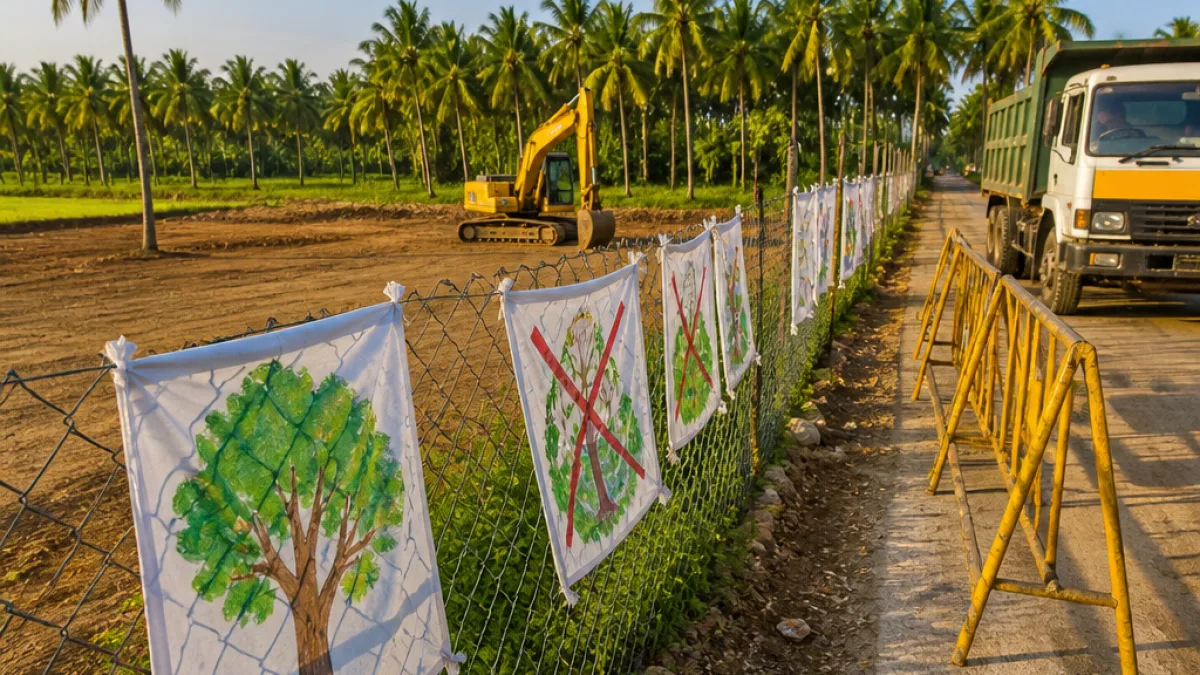
Protesters staged a large sit-in demonstration, citing fears that dyeing units would contaminate groundwater and damage agriculture in surrounding villages. The protests intensified in November 2025 and have kept major work at the site suspended since then.
Supporters of the project argued for its benefits, saying that the park — if implemented without dyeing units — could create substantial employment, boost exports and spur economic activity in Salem district. They urged authorities to proceed with implementation while ensuring environmental safeguards.
| Item | Detail |
|---|---|
| Original plan | Salem Yarn Colouring Park with dyeing units, CETP and ZLD |
| Revised plan | Salem Integrated Textile Park Private Limited; SIPCOT to find alternate location for ZLD dyeing units |
| Area of contention | Whether dyeing units will ever be allowed inside the park |
Residents opposing the park said the G.O. fails to provide a legally binding bar on dyeing units inside the integrated park. M Arun Kumar, secretary of the Salem Water Sources Protection Movement, told reporters that the order appeared to be largely nominal and did not give adequate assurance on the core environmental worry.
The government order states that the 110 industrial plots should be allotted exclusively to textile-related activities, but it also instructs SIPCOT to identify another suitable location for zero-liquid-discharge dyeing units. Critics said that instruction, while seemingly responsive, leaves open the possibility that dyeing operations could be introduced into the park at a later date by altering project scope or through future administrative decisions.
Local administration faces the challenge of balancing competing demands: placating environmental concerns of farmers and villagers, while addressing aspirations for jobs and industrial growth among youth and business groups. With major work stalled since late 2025, economic benefits promised by proponents have not materialised, even as uncertainty has chilled investor and local sentiment.
District officials have not announced a fresh timeline for implementation. SIPCOT has been tasked in the G.O. to locate alternate land for ZLD dyeing units, but officials have yet to publish options or a schedule for consultations with affected communities.
Until the administration provides a clear, enforceable assurance on whether dyeing units will be permanently excluded from the integrated park, opposition from residents and environmental groups is likely to continue, prolonging the stand-off and delaying any resurfacing of construction or allotment of plots.
Stakeholders in Salem now await further communication from the state government and SIPCOT, including details on site selection for dyeing units outside the park and specific measures to protect groundwater and agricultural livelihoods.