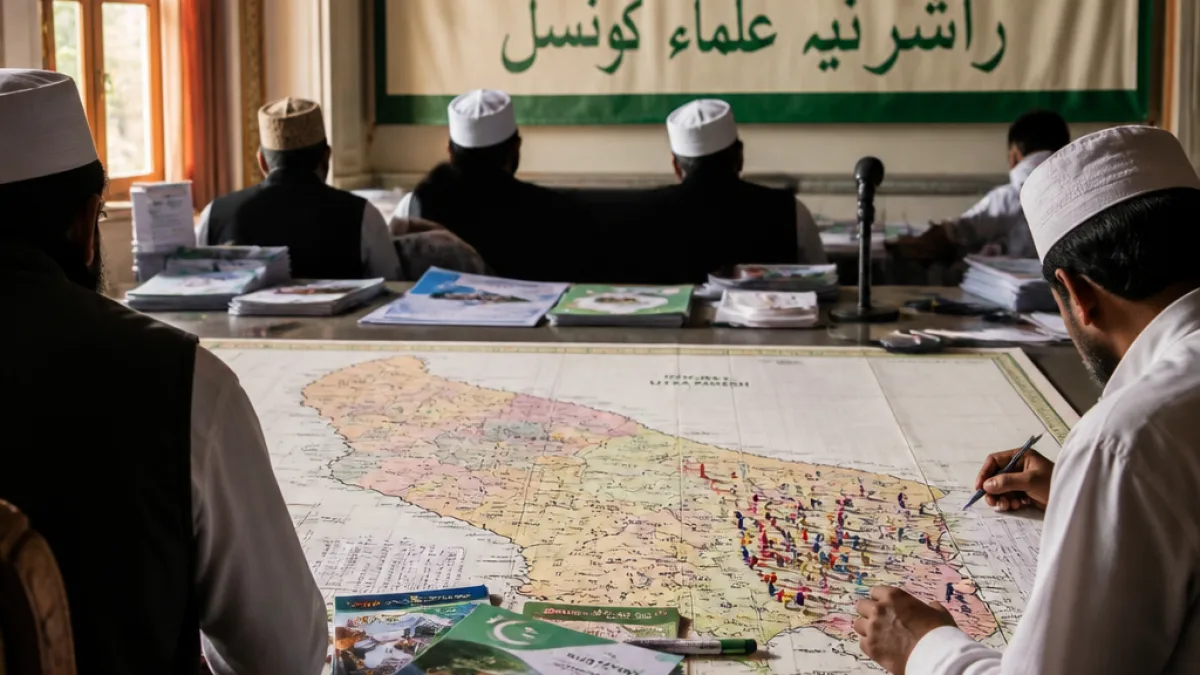
Lucknow: The Rashtriya Ulama Council (RUC) has begun preparing a renewed electoral push for the 2027 Uttar Pradesh Assembly elections, signalling plans for a broader candidate slate and strengthened organisation, RUC founder and national president Maulana Amir Rashadi said in an interview.
Origins and regional base
Formed in the aftermath of the 2008 Batla House encounter, the RUC has contested elections in Uttar Pradesh and other states including Assam, Karnataka and Maharashtra, but the party has not yet recorded an electoral victory, Rashadi said. The organisation continues to consider eastern Uttar Pradesh—particularly Azamgarh and neighbouring districts—as its strongest area of support.
Rashadi highlighted the importance of the Didarganj Assembly constituency in Azamgarh, noting that members of his family have contested the seat and that the district remains a key focus for the party’s activity and grassroots work.
Seat strategy and organisational plans
The RUC has not fixed the exact number of constituencies it will contest in 2027. Rashadi outlined a range of possibilities depending on organisational strength, local backing and the availability of candidates deemed strong locally.
- Base target: around 20–50 seats
- Ambitious scenario: potentially up to 200 seats, contingent on political circumstances
- Decision factors: district and state-level meetings, assessment of cadre strength and candidate readiness
On the process, Rashadi said district and state-level meetings are being held to evaluate prospects and firm up ticket distribution and organisational deployment.
| Scenario | Approximate seats | Key determinant |
|---|---|---|
| Conservative | 20–50 | Existing organisational reach and local candidates |
| Expansion | Up to 200 | Improved political conditions and alliances |
Past alliances and political memory
Rashadi recalled a past episode involving the Bahujan Samaj Party (BSP) and its then-leader, saying the RUC had withdrawn about 80 candidates in one election after being approached through Naseemuddin Siddiqui with the intention of helping the BSP. He said, according to his account, that BSP supremo Mayawati later acknowledged that more than two dozen candidates benefited from that move. Rashadi added that relations later cooled when the council sought political representation.
“The final decision will be based on the party’s organisational strength, local support and the availability of strong candidates,”
Those comments underline the party’s emphasis on both independent contestation and tactical calculation about where to deploy limited resources in a highly competitive state political landscape.
What RUC’s move means for UP politics
While the RUC remains a small player in terms of electoral success to date, its focus on eastern UP and willingness to expand candidature could affect vote dynamics in multi-cornered contests, particularly in constituencies with significant Muslim populations and where local issues and candidate profiles matter. The party’s stated willingness to contest more seats also raises questions about potential pre-poll arrangements or understandings with larger parties in the run-up to 2027.
For voters and observers, the RUC’s approach highlights two practical considerations ahead of the Assembly polls: the importance of local organisational presence in determining electoral outcomes, and the role of seat-sharing or withdrawals in shaping prospects for regional players.
Next steps and timeline
According to Rashadi, the RUC will take final decisions on the scale of its contestation after completing internal consultations at district and state levels. The party’s timetable and candidate list will therefore depend on the results of these meetings and on how political alignments evolve as the 2027 poll approaches.
As Uttar Pradesh moves into the election calendar, smaller parties such as the RUC will be watched for indications of alliance patterns and for signs that they may convert organisational work into electoral gains.
Reporting for UP political developments will continue as parties firm up strategies and announce candidates.