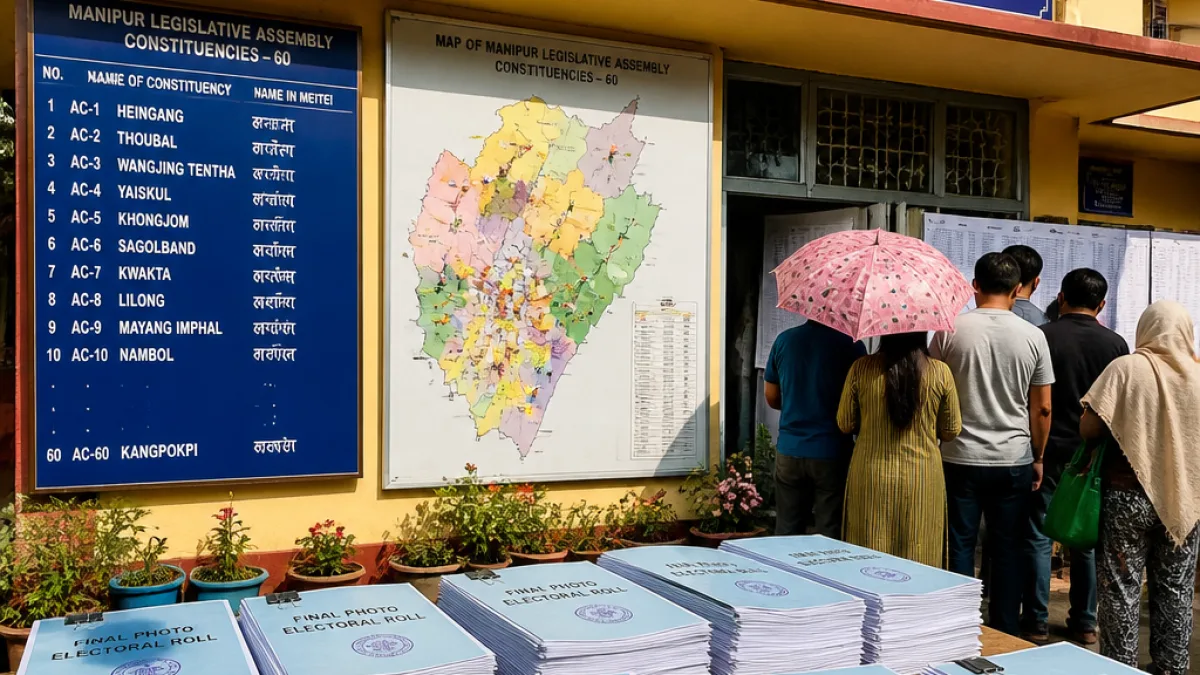
The Manipur administration on September 6 issued the final photo electoral rolls for all 60 Assembly constituencies, fixing the state’s total electorate at 19,60,620. The updated register records 9,53,350 male electors, 10,06,962 female electors and 308 electors listed as third gender, yielding a gender ratio of 1,056 females per 1,000 males.
What the final rolls contain
The published rolls also incorporate the service voters’ list prepared with the qualifying date of 1 July 2026. The number of enrolled service electors stands at 20,819. Officials said authorised representatives of recognised national and state parties received copies of the final photo electoral rolls for each Assembly segment at a meeting held on Sunday.
How the rolls were revised
The final publication follows a comprehensive revision exercise that began with a draft roll and included claims, objections and document verification. Before the draft was released on 18 May, the state’s electoral register showed 20,93,076 names — 10,10,317 men, 10,82,459 women and 300 third-gender electors.
During the enumeration stage 19,34,399 forms were received; officers reported 1,58,677 electors whose forms were not returned and who were accordingly excluded from the draft roll. These exclusions were recorded under categories such as absence, death, shifting and duplication.
Between the draft and final phases, a system of verification was carried out. Notices were issued to 91,178 unmapped electors and 11,30,655 electors flagged for logical discrepancies, bringing the total notices issued to 12,21,833. Following hearings and documentary checks, 26,362 persons were found ineligible for reasons that included insufficient documentation, death, shifting and duplication.
Claims, objections and net changes
The claims-and-objections window, which ran from 5 July to 4 August, generated 96,985 entries for processing. After scrutiny 56,871 electors were added to the rolls while 30,650 names were struck off, resulting in the final figure of 19,60,620.
| Category | Number |
|---|---|
| Total electorate | 19,60,620 |
| Male electors | 9,53,350 |
| Female electors | 10,06,962 |
| Third-gender electors | 308 |
| Service electors | 20,819 |
What electors should do next
Electors have been advised to confirm their inclusion and personal particulars in the final rolls. Verification points include the offices of the Electoral Registration Officer (ERO), the Assistant Electoral Registration Officer (AERO) and the Booth Level Officer (BLO). The Chief Electoral Officer, Manipur, has also made the rolls available for download on the office website.
- Check name, photograph and polling station details at ERO/AERO/BLO offices.
- Download and review constituency-wise rolls from the Chief Electoral Officer’s website.
- Contact local election officials promptly to correct errors or to seek clarifications.
Implications and context
The finalisation of electoral rolls is a procedural prerequisite for any upcoming assembly electoral activity, including candidate nominations, polling logistics and voter education drives. The marginal female majority in the rolls — reflected in the gender ratio of 1,056 — may influence campaigning priorities and outreach strategies of political parties.
Election authorities will use the final rolls to plan resource allocation at the booth level, arrange polling personnel and prepare voter information materials. Political parties received copies of the rolls to enable their local teams to verify booth-level strengths and identify any outstanding enrolment issues before formal poll notifications, if and when issued.
Local residents and party functionaries in Imphal and across hill districts will now have the opportunity to ensure that registrations reflect current residence and identity records, so that eligible citizens are not disenfranchised when voting processes are activated.
Copies of the final rolls for each Assembly constituency have been handed over to authorised representatives of recognised national and state parties, enabling stakeholders to begin constituency-level planning on the basis of the updated electorate data.