Higher turnout after delimitation; local wards decide civic control
The Jodhpur Municipal Corporation election held on 11 September 2026 has produced a closely contested outcome between the Indian National Congress and the Bharatiya Janata Party (BJP), with several wards captured by independent candidates, according to the list of ward-wise winners made public on Monday.
"A neck-and-neck political fight between the Indian National Congress and the Bharatiya Janata Party (BJP)"
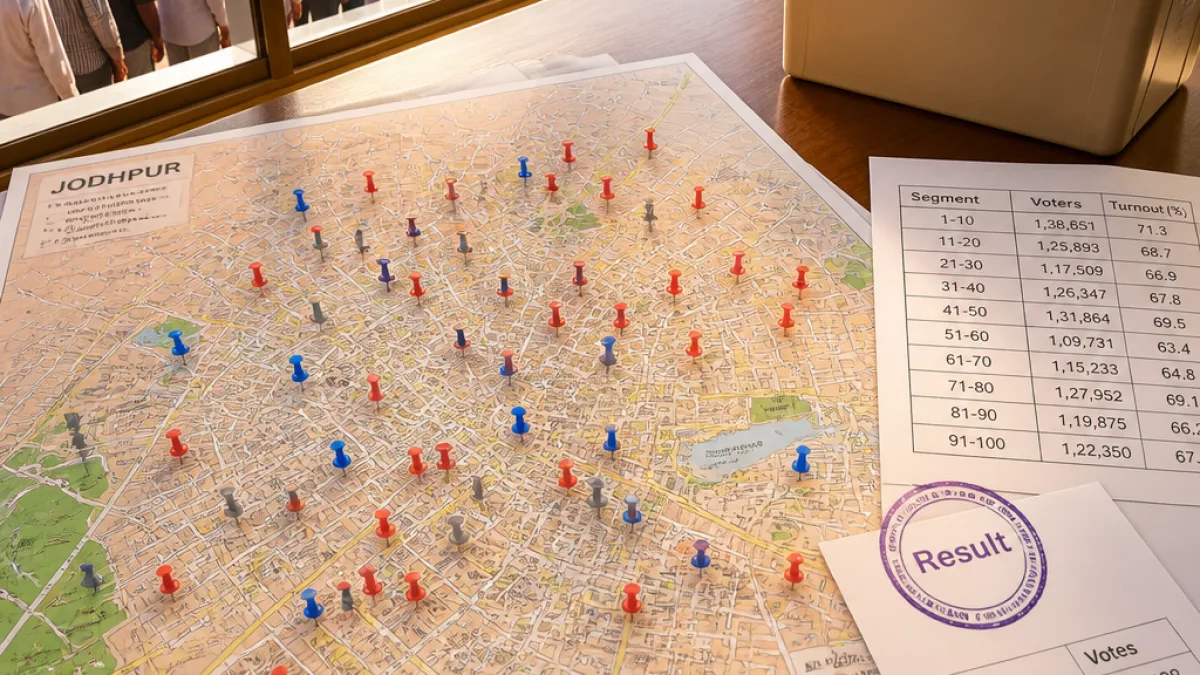
Jodhpur Municipal Corporation comprises 100 wards. Voter engagement increased this cycle: 5,12,410 electors cast votes out of 7,12,164 registered voters, giving a turnout of 71.95%. Local authorities and political observers attribute the rise in participation in part to the recent delimitation exercise that expanded and altered several wards, including incorporation of adjoining rural segments.
Ward results and notable winners
The currently available ward-wise list names winners across the city, with representation from the BJP, Congress and a handful of independents. The published results include victories in several prominent wards:
- Ward 1: Jagdish (Congress)
- Ward 3: Monica Vyas (BJP)
- Ward 9: Sanjay Bishnoi (BJP)
- Ward 11: Seema Kanwar (BJP)
- Ward 16: Vikram Singh Panwar (BJP)
- Ward 20: Chetan (Independent)
- Ward 21: Zakir Khan (Congress)
- Ward 23: Ashok Singh Chauhan (BJP)
- Ward 36: Gauri Shankar (Congress)
- Ward 41: Divya Prajapat (BJP)
- Ward 51: Saraswati Prajapati (Congress)
- Ward 52: Pinky Devi (BJP)
The published list continues with additional ward winners; several ward entries remain unfilled in the initial release and may be updated as counting and verification proceed.
What the results mean locally
Municipal corporation councillors determine delivery of basic urban services — water supply, sanitation, street lighting, local roads, health and primary-level infrastructure. Changes in ward boundaries from the delimitation process, which moved some urban wards into peri‑urban and rural areas, have altered the electoral mix and appear to have driven higher voter turnout.
Political strategists view the civic polls as a barometer for the two major parties ahead of the 2028 Assembly elections. The Jodhpur results will decide mayoral and deputy mayoral elections scheduled after councillor declaration; typically, the majority among elected councillors determines the mayoral outcome. Official mayoral and deputy mayoral elections will follow once the full set of councillor results is finalised.
Turnout and technical details
| Item | Figure |
|---|---|
| Total wards | 100 |
| Registered voters | 7,12,164 |
| Votes polled | 5,12,410 |
| Turnout | 71.95% |
Officials and party workers will await completion of counting in the remaining wards before declaring control of the corporation. Once all councillor seats are formally declared, the mayoral election for Jodhpur will be scheduled, followed by internal elections for deputy positions as per municipal rules.
For residents, the immediate implications are practical: shifts in ward representation may affect prioritisation of neighbourhood projects, water distribution schedules and municipal spending. The delimitation-driven inclusion of rural pockets in civic wards raises questions about alignment of urban services with peri-urban needs — an issue local councillors are expected to address in the corporation's first sittings following result finalisation.
Further updates, including the complete ward list and final party tallies, are expected as authorities complete verification of all returns.