Howrah has recorded a sudden rise in dengue cases at the tail end of the monsoon, with more than 150 infections reported across the municipal corporation and neighbouring areas between October 14 and October 20, health officials said. The surge — on top of about 350 cases logged over the preceding seven months — has placed renewed emphasis on mosquito control, drainage maintenance and waste management in the city and adjoining gram panchayats.
Health services strained, vector control stepped up
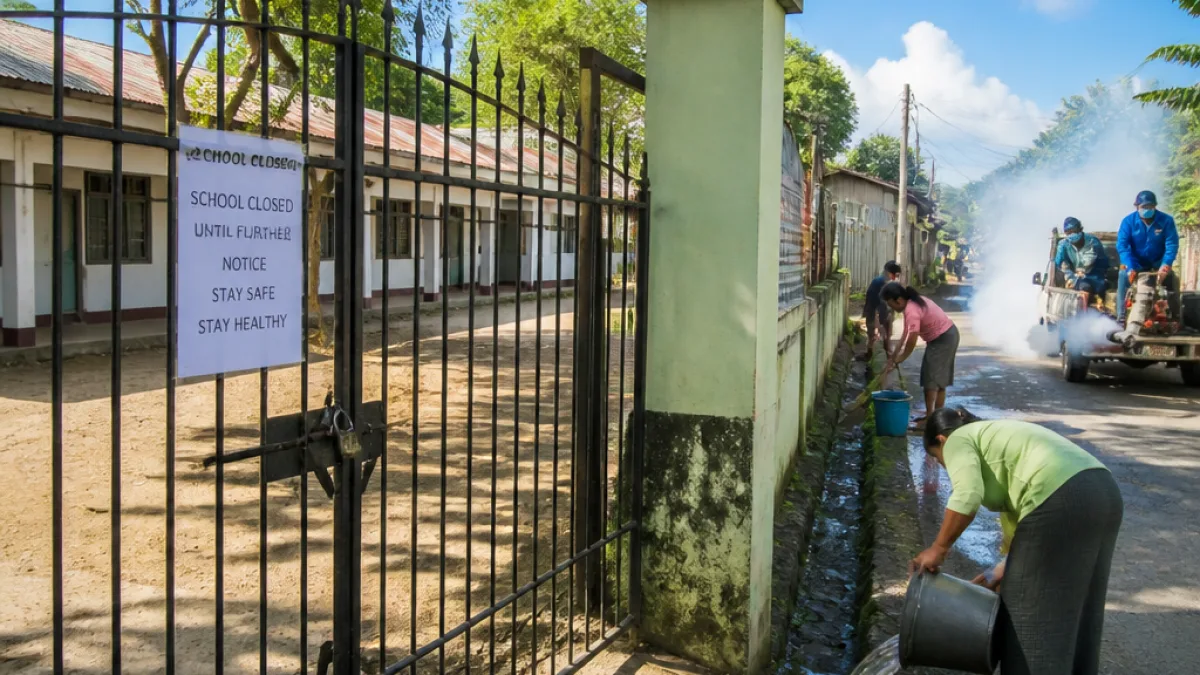
District authorities reported that 94 patients with various health complications were admitted to Howrah District Hospital during the recent spike. One critically ill patient was referred to RG Kar Medical College and Hospital in Kolkata, while other patients received care at local health facilities. The abrupt increase in case numbers has prompted intensified fogging, targeted spraying and cleaning of drains in affected pockets.
- Reported cases (Oct 14–20): more than 150 across Howrah Municipal Corporation and nearby areas.
- Earlier seven months: around 350 cases in Howrah.
- Municipal and panchayat spread: 47 cases within Howrah Municipal Corporation; at least 19 in Bankra Number 1 gram panchayat (Mondalpara, New Mondalpara and Uttarpara).
Health officials emphasised that the cluster of cases is not confined to a single administrative boundary. Local reports show infections in both municipal wards and panchayat areas, a pattern that can complicate sustained vector-control efforts when responsibility for drains, sanitation and waste collection crosses institutional lines.
"Dengue cases have risen suddenly in parts of the district," the chief medical officer of health, Kishalay Dutta, said in the report.
Drainage, waste management and jurisdictional gaps
Public-health analysts and municipal employees noted that dengue transmission often correlates with standing water and inadequate sanitation. The recent outbreak has drawn attention to persistent problems in drainage and sewerage in several Howrah localities, where clogged drains, uncollected waste and poor neighbourhood-level maintenance create breeding habitats for Aedes mosquitoes.
Bankra Number 1 gram panchayat was among the areas reporting new infections, with at least 19 cases from Mondalpara, New Mondalpara and Uttarpara. Because these neighbourhoods lie close to municipal boundaries, response activity requires coordination between Howrah Municipal Corporation, panchayat bodies, the district administration and state health agencies.
| Area | Reported cases (Oct 14–20) |
|---|---|
| Howrah Municipal Corporation | 47 |
| Bankra Number 1 gram panchayat (Mondalpara, New Mondalpara, Uttarpara) | 19+ |
| Other adjoining areas | Remaining portion of the >150 total |
The report does not establish that institutional overlap directly caused the surge, but it shows that multiple local authorities are now engaged in containment. Officials have focused on coordinated fogging operations, larval surveys and public awareness drives urging residents to remove stagnant water from containers, roof gutters and construction sites.
Implications for local healthcare and civic planning
Hospital admissions underscore that the outbreak is placing demand on district-level healthcare capacity as well as on primary health centres. Authorities are monitoring the situation to ensure timely referral of severe cases and adequate bed and laboratory capacity. Public-health experts say that beyond short-term vector control, longer-term improvements in urban drainage, waste disposal and inter‑agency coordination are essential to reduce recurring seasonal outbreaks.
As the city moves into the post-monsoon period, the immediate challenge for Howrah's civic agencies will be to sustain intensified anti‑mosquito measures while addressing the infrastructural deficits that recurring outbreaks repeatedly expose.