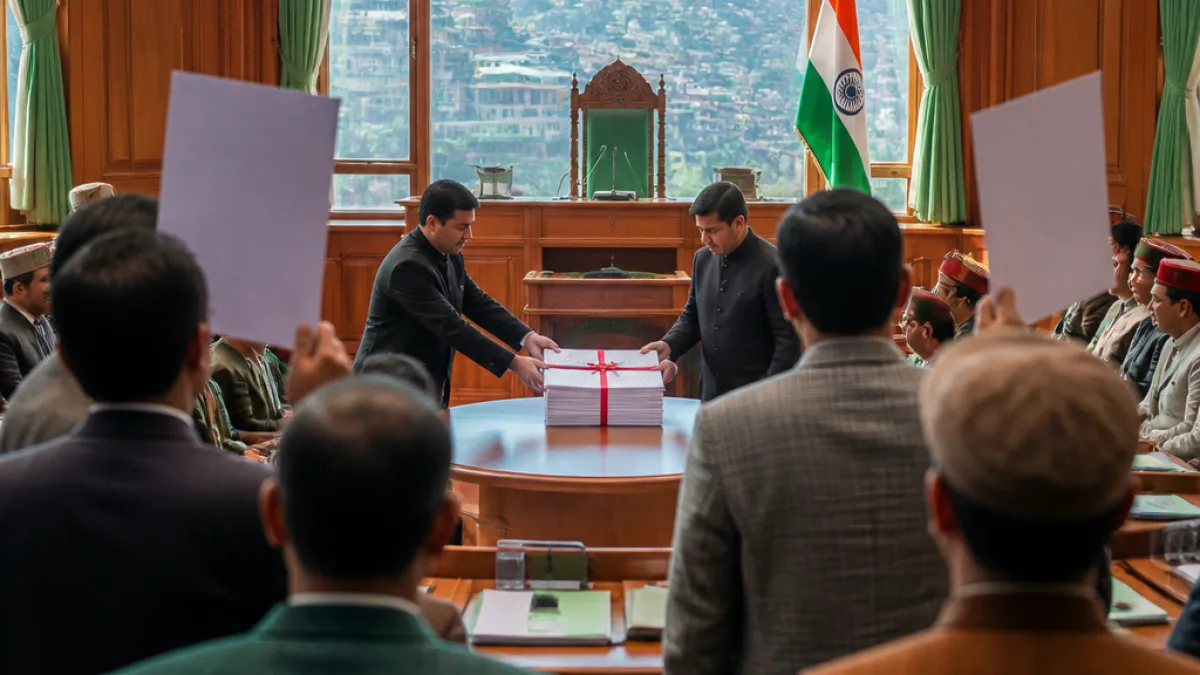
Shimla: The Himachal Pradesh Assembly on Wednesday passed the Himachal Pradesh State Universities (Amendment) Bill, 2026 despite sustained objections from BJP legislators who said the proposed changes would weaken the autonomy of state universities and bring greater government control over their functioning. The Bill will be forwarded to the Governor for assent.
Government frames Bill as protective reform
Chief Minister Sukhvinder Singh Sukhu, who moved the Bill, described it as a "historic" step intended to protect the interests of qualified youth and the people of Himachal Pradesh. He sought to reassure the House that academic independence would be preserved, saying the government would not interfere in syllabi, routine academic activities or student–teacher affairs.
Sukhu outlined that appointments to faculty posts such as Assistant Professor and Professor would continue to be made by the universities themselves and would not be affected by the amendment. He also said the Executive Committee, headed by the Vice-Chancellor, would remain the supreme administrative body in each university.
Opposition raises autonomy and judicial precedent concerns
Leader of Opposition Jairam Thakur strongly opposed the Bill, warning that it would curtail institutional autonomy. He referred to a recent High Court decision relating to amendments to the Himachal Pradesh Universities of Agriculture, Horticulture and Forestry Act, 1986, and suggested the present measures may face similar legal challenge. The High Court order referred to by Thakur struck down certain amended provisions on August 27, the Opposition noted.
"This amendment Bill will also meet the same fate which was meet to the amended provisions of Himachal Pradesh Universities of Agriculture, Horticulture and Forestry Act, 1986, in the Himachal High Court on August 27," Jairam Thakur said.
Key administrative features highlighted
The Bill, according to statements in the House, applies to the state's main public universities. The government said financial requirements of the universities will be examined by a Finance Committee led by the Finance Secretary, and that the Finance Committee will submit reports to the Executive Committee for final consideration. The Himachal Pradesh Public Service Commission (HPPSC) will be tasked with recruitment of class-III and class-IV staff and non-teaching faculty members.
| University | Year established |
|---|---|
| Himachal Pradesh University | 1970 |
| Sardar Patel University, Mandi | 2021 |
| Himachal Pradesh Technical University | 2014 |
| Himachal Pradesh Agriculture, Horticulture and Forestry University | 1986 |
| Atal Medical and Research University | 2017 |
Points of contention and likely next steps
Opposition members argued the changes would increase executive oversight in areas that should rest with university authorities. The government maintained that oversight structures are needed to ensure financial prudence and uniform standards across institutions. With the Assembly having passed the Bill, the immediate procedural step is submission to the Governor for assent; following that, the measure would become law and its provisions would be implemented as notified by the state government.
Implications for recruitment and university governance
Government speakers emphasised that direct recruitment of teaching posts would continue to be managed by the universities, while class-III and class-IV recruitment would be handled by the HPPSC. The introduction of a Finance Committee chaired by the Finance Secretary is intended, officials said, to bring an additional layer of fiscal review, including assessment of the need for new universities.
- Scope: The Bill covers five state universities established between 1970 and 2021.
- Administrative change: Creation of a Finance Committee led by the Finance Secretary to examine financial requirements.
- Recruitment: Universities to continue appointing faculty; HPPSC to recruit class-III/IV and non-teaching staff.
Legal observers and university representatives are likely to monitor the measure closely for any potential constitutional or statutory challenges. The Opposition's reference to a recent High Court invalidation suggests that litigation could be a possibility if parts of the amended law are perceived to impinge on academic autonomy.
For now, the Bill's passage marks a significant development in the state's higher education governance framework, with practical effects to be determined once the detailed rules of implementation are released and any judicial scrutiny plays out.