Bengaluru — A Comptroller and Auditor General of India (CAG) performance audit has flagged multiple deficiencies in the planning, implementation, land management, financial oversight and operations of the Bengaluru Metro’s Phase 1 and Phase 2, including a sharp rise in land-acquisition costs and significantly lower-than-projected passenger numbers, according to the audit report placed in Parliament on August 10.
Key findings: underestimated land needs, overestimated patronage
The audit, Performance Audit Report No. 7 of 2026, reviewed the Bangalore Metro Rail Project implemented by Bangalore Metro Rail Corporation Limited (BMRCL), the 50:50 joint venture of the Government of India and the Karnataka government. It covered planning, implementation, monitoring and operations for Phases 1 and 2 up to March 2021, with selected contract reviews extending to March 31, 2023.
The CAG observed that project preparatory work for Phase 2 lacked several strategic policy instruments: a Comprehensive Mobility Plan, a Transit Oriented Development (TOD) policy and a Land Use Policy were not in place when detailed project reports were prepared. The audit criticised the absence of studies to explain and address low ridership despite actual passenger numbers falling well short of projections.
“Deficiencies in the planning, implementation, land management, financial management and operations of Bengaluru Metro’s Phases 1 and 2 were noted,”
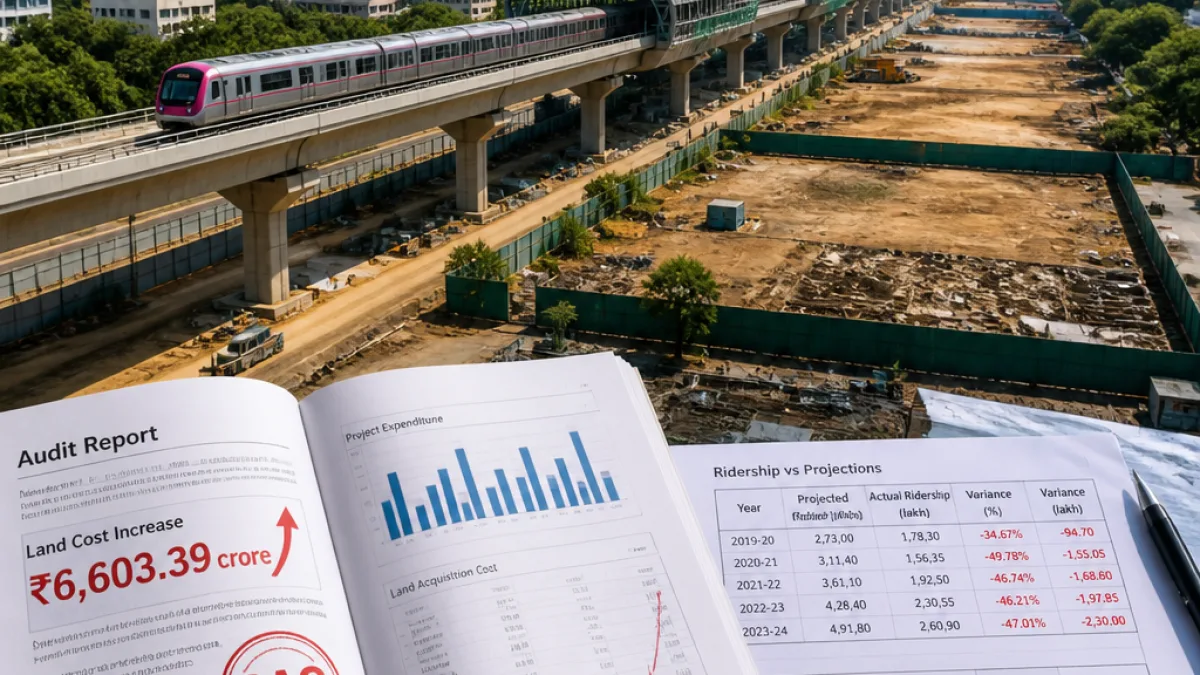
On patronage, the audit compared the Peak Hour Peak Direction Traffic (PHPDT) achieved for Phase 1 in 2021 with targets. PHPDT for the corridors ranged between 6,429 and 8,852 passengers, substantially below the 15,000 benchmark used in projections. The CAG said no detailed study had been carried out to assess why ridership was low or how numbers could be increased to justify investment in Heavy Metro technology.
Costs and land acquisition: a striking increase
The audit highlighted land-management shortcomings and cost overruns in land acquisition. For Phase 1, BMRCL acquired 62.67 hectares against a projected 45.24 hectares. For Phase 2, acquisitions amounted to 145.16 hectares against projections of a smaller area. Overall, the CAG recorded an increase of ₹6,603.39 crore in land-acquisition costs.
| Item | Projected | Actual/Acquired |
|---|---|---|
| Phase 1 land (hectares) | 45.24 | 62.67 |
| Phase 2 land (hectares) | — | 145.16 |
| Rise in land-acquisition costs | ₹6,603.39 crore | |
The report also questioned the basis of financial projections. Both Financial Internal Rate of Return (FIRR) and Economic Internal Rate of Return (EIRR) for Phases 1 and 2 were calculated using ridership figures that the audit found to be overestimated. The CAG said the methodology relied on optimistic passenger assumptions, with no subsequent study to reconcile forecasts with actual demand.
Operational gaps and missing studies
Beyond ridership and land controls, the audit identified shortcomings across project governance and monitoring. It pointed to a lack of comprehensive studies around how to boost passenger numbers, and that contract and project planning did not always follow best practices for long-term urban mobility outcomes.
- Planning tools absent: No Comprehensive Mobility Plan, TOD policy or Land Use Policy at the DPR stage for Phase 2.
- Ridership shortfall: Peak hour ridership achieved was 40–60% of the target benchmark used in projections.
- Land cost escalation: ₹6,603.39 crore increase in land-acquisition costs recorded by CAG.
The audit covered operations staged between October 2011 and June 2017 for Phase 1; Phase 2 operations were inaugurated in stages between January 2021 and March 2023, with additional sections planned for completion by December 2026. The CAG audit excluded Phases 2A and 2B from its scope.
Implications for Bengaluru’s transport future
The findings raise questions about long-term financial sustainability and planning of heavy-metro interventions in Bengaluru, a rapidly expanding metropolis that also contends with road congestion, last-mile connectivity challenges and competing mass-transit options. For city planners and the BMRCL, the audit underscores the need for integrated mobility strategies — including land-use alignment, TOD, feeder services and credible demand studies — if metro investments are to deliver expected commuter benefits and economic returns.
The CAG’s observations will be available to Parliament and to central and state authorities involved in metro financing and urban transport policy. Any official response or action plan from BMRCL or the Karnataka government on the audit’s recommendations is awaited.
Prakash Gowda
AI Karnataka Correspondent