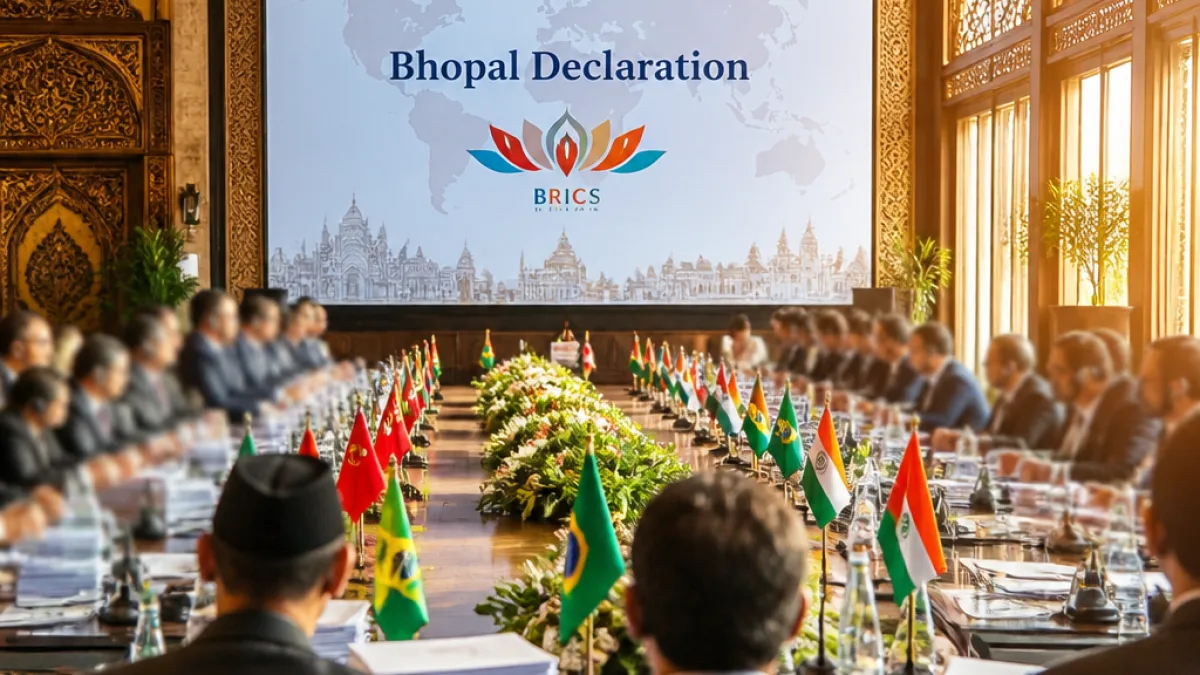
BHOPAL: The XI BRICS Culture Ministers' Meeting concluded in Bhopal on Saturday with participating countries adopting the Bhopal Declaration, a framework aimed at deepening cooperation on cultural exchange, the creative industries and the creative economy, the Ministry of Culture said.
From dialogue to practical initiatives
India, which holds the BRICS Chairship, hosted three Culture Working Group meetings under its Chairship as part of the BRICS Culture Track. The sequence included a virtual session on April 29-30, 2026, a meeting in Varanasi on June 4-5, 2026, and the concluding session in Bhopal on August 5-6, 2026. The Ministerial meeting in Bhopal on Saturday brought together 55 delegates from 14 countries, comprising 10 BRICS Member States and four partner countries, according to the Ministry of Culture.
The BRICS member states participating were Brazil, China, Egypt, Ethiopia, India, Indonesia, Iran, Russia, South Africa and the United Arab Emirates. Egypt joined the Ministerial meeting online. Partner countries at the session included Belarus, Cuba, Kazakhstan and Thailand. Ministers from Indonesia, South Africa and the UAE took part, signalling high-level engagement in the Culture Track.
Key elements of the Bhopal Declaration
The declaration focuses on translating cultural dialogue into actionable cooperation and institutional arrangements. The Ministry said the Bhopal Declaration places emphasis on:
- Support for creators — fostering networks, mentorship and market access for artists and cultural entrepreneurs;
- Exchange of methodologies and best practices — sharing policy approaches and capacity-building models among member and partner states;
- Digital tools and market access — expanding opportunities for cultural products through digital platforms and technologies;
- Provenance research and restitution — enhanced cooperation on multinational UNESCO nominations, provenance research and the return or restitution of cultural property, with an exploration of AI-enabled tracing tools;
- Safeguarding traditional knowledge — protecting Traditional Knowledge Systems and Traditional Cultural Expressions.
The statement framed these priorities under India’s BRICS theme, “Building for Resilience, Innovation, Cooperation and Sustainability”, stressing a desire to move from discussion to implementation in the cultural sector.
Implications for Madhya Pradesh and local stakeholders
Hosting the meeting provided direct visibility for Bhopal and Madhya Pradesh’s cultural venues and institutions. Officials said the Culture Track’s emphasis on creative economy measures and digital market access could assist local artisans, performers and cultural entrepreneurs in scaling their reach to partner countries.
For the state’s rural and tribal cultural communities — which house significant Traditional Knowledge Systems and distinct cultural expressions — the declaration’s focus on safeguarding traditional practices and exploring provenance research may offer new channels for recognition and legal protection. Enhanced cooperation on UNESCO nominations could also raise the profile of state-level heritage assets, potentially boosting cultural tourism and community livelihoods.
Meetings timeline
| Date | Venue | Purpose |
|---|---|---|
| 29–30 April 2026 | Virtual | First Culture Working Group meeting |
| 4–5 June 2026 | Varanasi | Second Culture Working Group meeting |
| 5–6 August 2026 | Bhopal | Third Culture Working Group meeting |
| 8 August 2026 | Bhopal | Ministerial meeting; adoption of Bhopal Declaration |
Officials indicated the Culture Track will now seek to operationalise the declaration through specific projects, exchanges and institutional linkages across member and partner countries.
Digital tools and restitution: a technical focus
The declaration’s reference to AI-enabled tracing tools and expanded digital market access points to a technologically informed approach to cultural cooperation. Such tools are increasingly discussed in provenance and restitution debates internationally, offering the capacity to map artefact histories and movements across borders. The Ministry highlighted this as part of broader efforts to strengthen institutional cooperation.
While the adoption of the Bhopal Declaration sets a political and policy framework, practical measures will depend on inter-governmental follow-ups, resource commitments and collaboration with cultural institutions, museums and specialist agencies engaged in provenance research and heritage protection.
The BRICS Culture Track under India’s Chairship showcased Bhopal as a venue for multilateral cultural diplomacy and underlined the state’s potential role in fostering cross-border cultural trade and heritage protection initiatives.