Five new AC e-buses arrive in Ajmer; operations to begin after Nosar depot completion
Ajmer has taken delivery of five air-conditioned electric buses under the Prime Minister's E-Bus Scheme, civic officials said, with services expected to begin once an e-charging facility in Nosar is completed in about a month. The low-floor, 9-metre buses incorporate accessibility and safety features being introduced in the city for the first time.
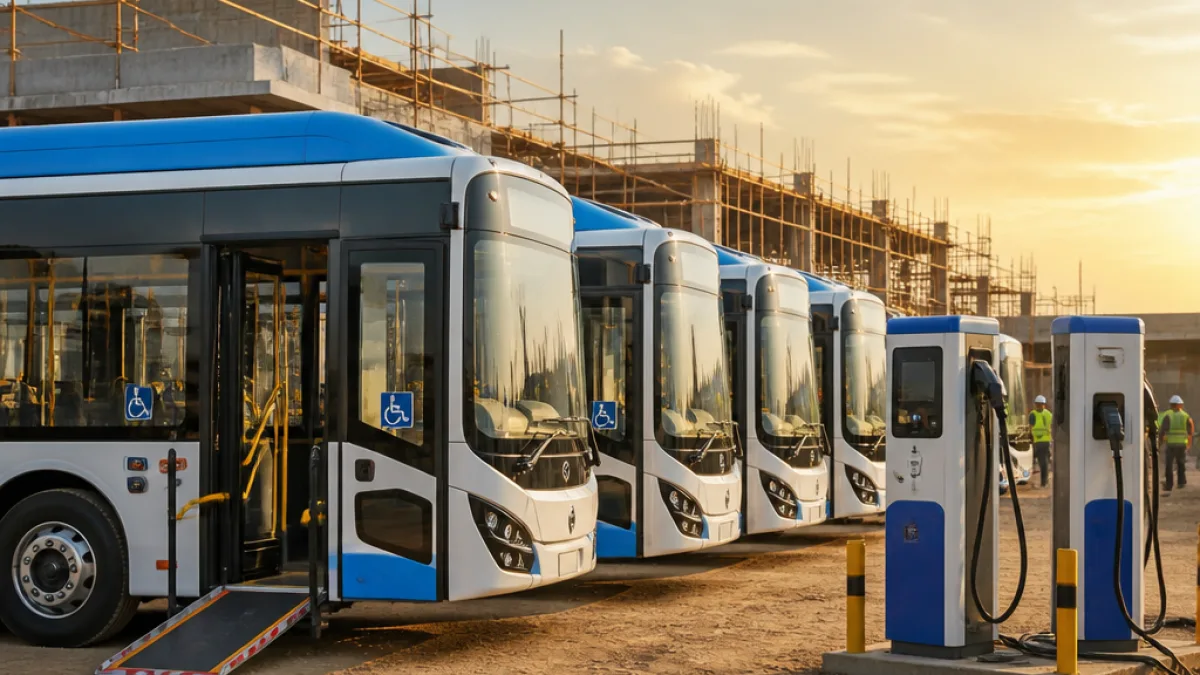
The buses are currently stationed at the construction site of the municipal e-charging station in Nosar. The charging complex is being built by the Municipal Corporation and, on completion, will have the capacity to charge 20 buses simultaneously. Two chargers have already been installed and more units will be added over the coming weeks.
- Charging time and range: Officials say a full charge takes about 1 hour 20 minutes, after which a bus can run for more than 200 kilometres.
- Seating and capacity: Each 9-metre bus has 25 seats and an overall capacity of roughly 36 passengers.
- Accessibility: The buses include automatic doors and, for the first time in Ajmer, a wheelchair lift to assist elderly and disabled passengers; two seats are specially designated for persons with disabilities.
- Safety and monitoring: CCTV cameras have been installed, with a CCTV display screen for the driver; buses also feature a fire safety system and an external emergency button.
Planned routes and operational details
The Municipal Corporation has finalised five routes for the e-buses; all have been registered with the Transport Department. The services are planned to operate from outside the Central Bus Stand. The routes listed by municipal officials are:
- Ajmer Bus Stand to Pushkar via Hokra
- Gandhi Bhawan to Tantoti
- Makadwali to Srinagar via Parbatpura Bypass
- Varun Sagar to Dorai
- Nosar to Kishangarh
Infrastructure and passenger amenities
The Nosar depot’s stated capacity to charge 20 buses at a time is intended to support a larger fleet in future phases. Presently two chargers are in place and additional charging units will be commissioned before services begin. Officials said the buses are fitted with passenger-counting sensors at the doors to monitor boarding and alighting.
| Specification | Details |
|---|---|
| Bus length | 9 metres |
| Seating | 25 seats |
| Total capacity | About 36 passengers |
| Charging time | ~1 hour 20 minutes |
| Range per charge | More than 200 km |
| Charging station capacity | 20 buses simultaneously |
Passenger conveniences include reserved seats for pregnant women and elderly commuters, automatic doors for safer boarding and an external emergency button for fire or other emergencies. CCTV systems aim to strengthen onboard security, with feeds accessible to the driver via a display screen.
Local context and expected impact
Ajmer’s municipal leadership is positioning the new e-buses as a move towards cleaner, more inclusive urban mobility. The combination of accessibility features — notably the wheelchair lift — and shorter charging times may improve last-mile connectivity between the city and nearby religious and commercial centres such as Pushkar and Kishangarh.
Officials said the buses will run from outside the Central Bus Stand and that the Nosar charging facility should be ready in about a month.
For residents, the project promises a quieter, air-conditioned alternative to existing diesel services, while the municipal charging infrastructure could permit scaling up the electric fleet over time. Municipal authorities will need to finalise schedules, fares and frequency before day-to-day operations begin, and ensure the Nosar depot’s phased commissioning keeps service rollout timely.
The arrival of these five e-buses marks the first tranche of the city’s planned transition to electric public transport under the national scheme. Officials say operations will commence once the Nosar depot’s additional chargers are installed and tested.