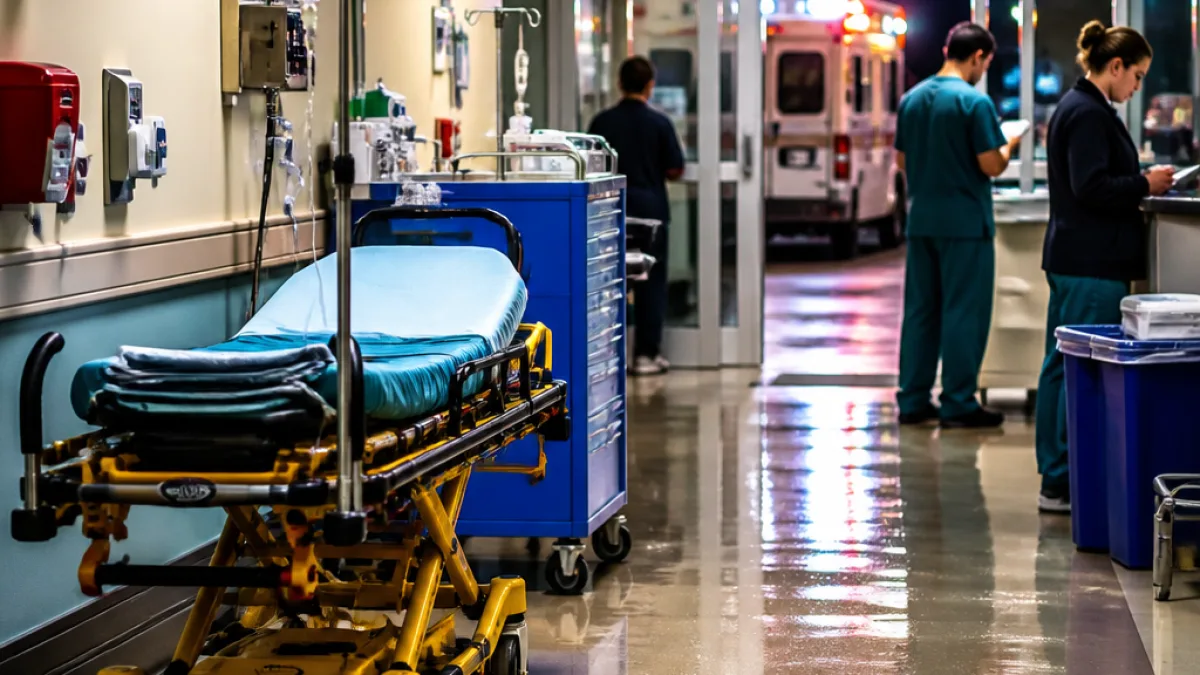
A Winnipeg woman who spent nearly 26 hours waiting for treatment in an emergency department last year says she is disappointed that little appears to have changed to reduce prolonged waits for care.
Patient recounts long hold in crowded corridors
The patient, a 73-year-old woman who received cancer treatment for years, said she first contacted cancer-care staff after suspecting a recurrence of a deep vein thrombosis (DVT). She said she was told she could not present to the urgent-care clinic and instead had to go to a hospital emergency department by ambulance.
Once at the hospital, she said the wait stretched to almost 26 hours before she saw a doctor. For the first part of that time she was not actually inside the main emergency room but positioned on a stretcher in a narrow corridor between the ambulance bay and the ER entrance, she said.
“HSC wouldn’t let me come into the urgent care. They advised I had to go by ambulance to HSC emergency. And that’s when things went downhill dramatically.”
She described other patients on stretchers sharing the same cramped space. With no access to proper amenities, she said she had to use a bedpan in what she thought was a janitorial closet. Eventually she received a 15-minute ultrasound and blood-thinning medication — the same treatment she had previously received at another Winnipeg hospital.
What the timeline looked like
| Event | Approximate time |
|---|---|
| Arrival by ambulance | Day 0 |
| First 14 hours spent outside ER (on stretcher in corridor) | First 14 hours |
| Ultrasound and blood-thinner treatment | After prolonged wait |
| Total time waiting to see a doctor | Almost 26 hours |
Patient frustration echoes wider wait-time concerns
The woman’s experience underscores ongoing worries among patients and advocates who say emergency departments remain under strain, with hallway care becoming routine in some situations. She told reporters she was discouraged by what she sees as little progress since her ordeal.
Her case also highlights the interaction between cancer-care services and emergency departments. In her situation, the temporary shutdown of a cancer-care ward at another Winnipeg hospital had previously led her to seek care at the Health Sciences Centre, where she ultimately sought help for suspected DVT.
- Nearly 26 hours: the total time she waited to see a doctor.
- First 14 hours: spent on a stretcher in a corridor outside the main emergency room.
- Treatment: a 15-minute ultrasound followed by blood thinners.
Long waits in emergency departments have consequences for patient comfort and safety, and they can signal broader capacity shortfalls, including limited urgent-care access and bed availability. For patients with complex conditions — such as those undergoing cancer treatment or with a history of blood clots — timely assessment and intervention are particularly important.
Community impact and questions for planners
Winnipeg residents rely on a network of acute-care services that includes urgent-care clinics and tertiary centres. When pathways between those services are disrupted — whether by temporary clinic closures or other factors — pressure shifts to emergency departments, which can result in experiences like the one reported.
Health-system planners and hospital administrators routinely measure and report wait times and patient flow, and the public expects action when bottlenecks are identified. For people who have endured long waits, the issue is personal: it affects trust in the system and the willingness to seek care when needed.
The patient said she remains concerned about the prospects for meaningful change but hopes that publicity around such experiences will prompt officials to address the systemic issues behind prolonged emergency waits.
Authorities and hospital leaders have not been quoted in this report; the account is based on the patient’s description of her experience and treatment.