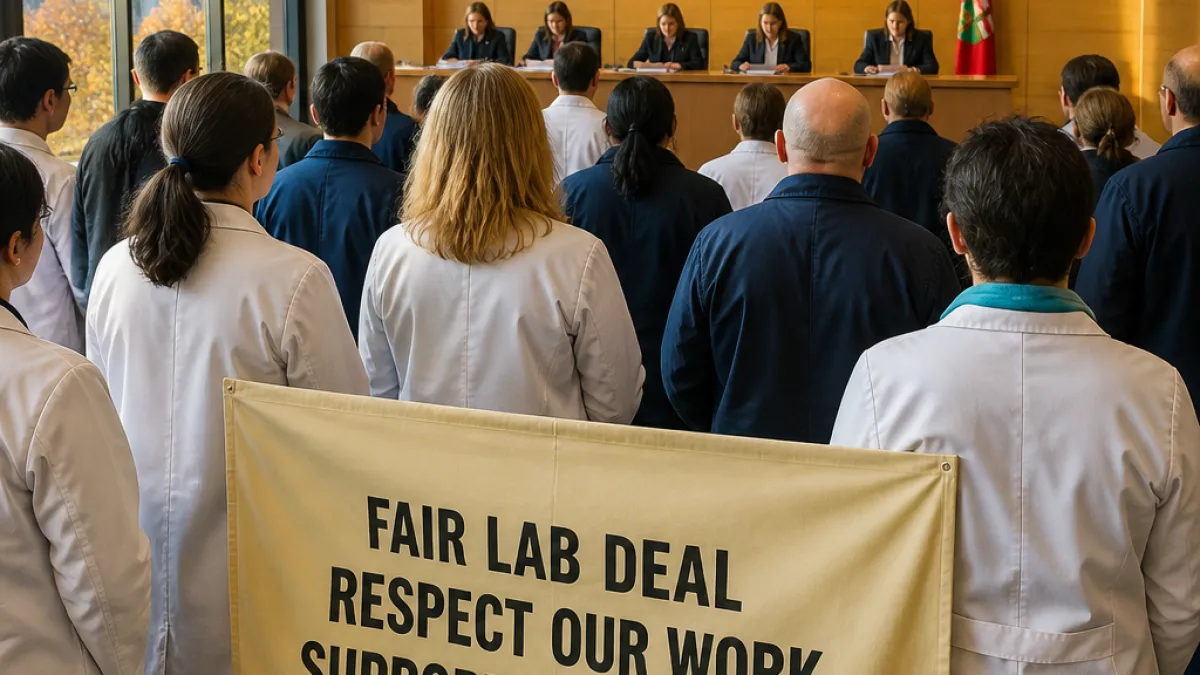
The Manitoba Labour Board is hearing arguments over whether hundreds of laboratory workers at Dynacare should be designated "essential" after the provincial labour minister intervened to halt a planned strike and ordered employees back to work.
What has happened
Dynacare, a private laboratory services company, and the union representing the workers reached an agreement in March that classified the employees as non‑essential, allowing normal strike and bargaining processes to proceed under that arrangement.
Under labour legislation introduced in 2024, however, the province's labour minister has the authority to call a hearing and set aside such agreements if the minister disagrees with the parties’ designation of essential services. Labour Minister Malaya Marcelino used that authority to request the Manitoba Labour Board review the status of the workers and to order them back to work while the board considers the matter.
Union alarm
Jason Linklater, president of the Manitoba Association of Health Care Professionals (MAHCP), said while the government's action is technically within the law, it raises serious concerns for the labour movement and could be open to constitutional challenge.
"This is truly the first test of this new legislation, and clearly it's problematic. The entire labour community should be very concerned, not only that it exists, but that it was used this way. This is really a red flag."
Linklater expressed concern that the ministerial power to intervene in agreements reached voluntarily between employers and employees undermines established collective‑bargaining processes and could chill negotiations in other sectors.
Shared Health involvement and public‑service concerns
Shared Health, Manitoba's health authority, advocated for Dynacare workers to be considered essential. The authority's position reflects concerns about maintaining lab services that support hospitals and other health-care providers across the province.
Health‑system partners often stress uninterrupted laboratory services for patient care, but labour advocates say continuity of services should be balanced against workers' rights to collective bargaining and to strike as a last resort.
Legal and constitutional questions
Labour law scholars have flagged the 2024 provisions that empower the minister as novel and potentially contentious. Critics argue the statute effectively allows the government to override agreements that were negotiated and accepted by both sides.
Union representatives say the move may infringe on Charter protections related to freedom of association and collective bargaining. While courts in Canada have not always treated collective bargaining as a Charter right in the same way as other freedoms, recent jurisprudence has been evolving — and union leaders say the Dynacare case could form the basis for a constitutional challenge if the board upholds the minister's intervention.
What the hearing will decide
The Manitoba Labour Board is being asked to determine whether the Dynacare employees perform services the province deems essential and, if so, what minimum services must be maintained during a labour stoppage. The board's decision will also clarify how the 2024 law operates in practice and whether ministerial intervention is constrained by the terms of agreements reached by employers and workers.
Timeline of key events
| When | Event |
|---|---|
| March (year not specified) | Dynacare and the union agreed the workers were non‑essential |
| 2024 | Province introduced labour‑law provisions allowing ministerial review of essential‑service agreements |
| September (current month) | Labour Minister Malaya Marcelino called a hearing and ordered workers back to work; Manitoba Labour Board is hearing arguments |
Implications for Manitoba workplaces
Labour observers say the outcome could have broad consequences beyond Dynacare. If the board upholds ministerial authority to substitute its view of essential services for an agreement reached by the parties, other negotiated arrangements across health care and public‑adjacent services could be vulnerable to similar intervention.
Unions warn this could deter frank bargaining, knowing that an agreement might be reopened by government fiat. Employers and public‑sector planners, by contrast, may argue that the state must retain the ability to act when services critical to public health and safety are at risk.
What comes next
The Manitoba Labour Board will continue to hear submissions from the province, Shared Health, Dynacare and the union. Its ruling will be closely watched by labour organisations, health‑care administrators and legal observers across the province, and it could prompt further legal challenges depending on the outcome.
- Key parties: Dynacare, Manitoba Association of Health Care Professionals, Shared Health, Manitoba Labour Board, Labour Minister Malaya Marcelino.
- Core issue: Whether ministerial power to intervene undermines negotiated essential‑service agreements and raises Charter concerns.
- Why it matters: Decision could reshape collective bargaining and essential‑service determinations in Manitoba.
The hearing represents a practical and legal test of how new provincial labour rules interact with long‑standing principles of collective bargaining and workers' rights in Manitoba.