
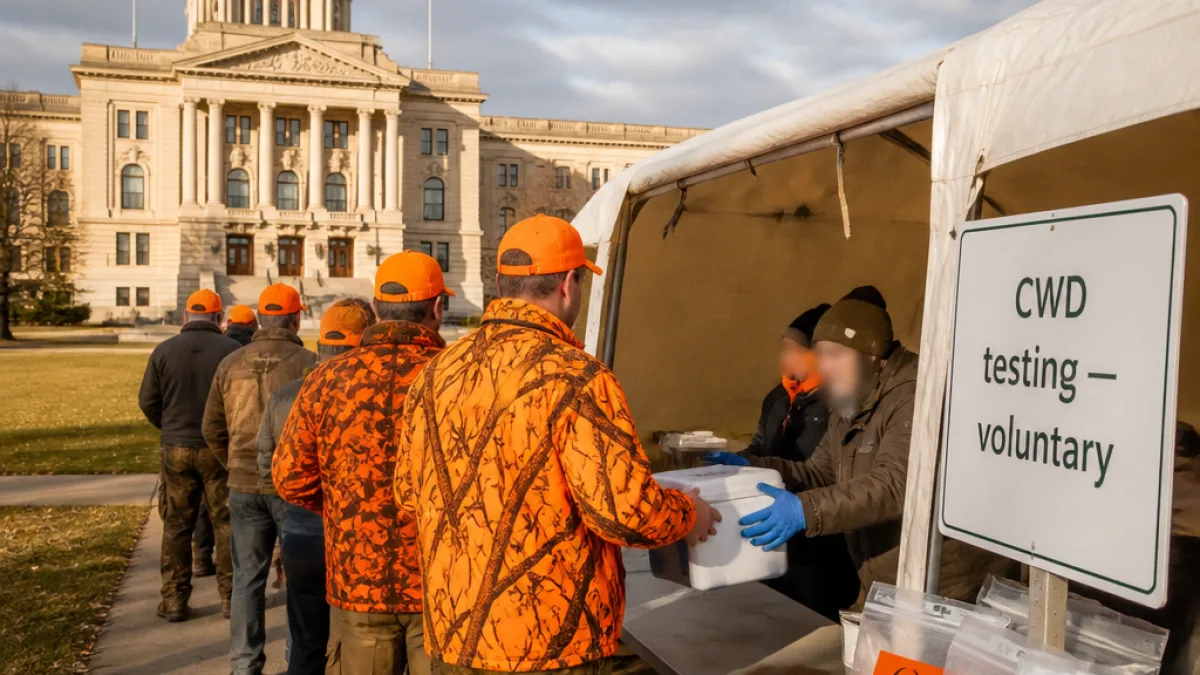
REGINA — Saskatchewan will continue its chronic wasting disease (CWD) testing program for the coming season after reversing an earlier decision to end testing of hunter-submitted samples, the province announced this week.
Decision reversed amid pressure from hunters and stakeholders
The provincial government said it will restore the testing approach used last year, allowing hunters to submit samples to the environment ministry on a voluntary basis while maintaining mandatory testing in designated wildlife management zones.
Environment Minister Darlene Rowden acknowledged the initial decision was made without sufficient consultation and apologised, saying the government had "made a mistake." She told reporters at the Legislature that the change was prompted by immediate and widespread concern from hunters, conservation officers, the Saskatchewan Wildlife Federation and rural MLAs.
"We recognize we made a mistake and we are sorry,"
The decision to roll back the change means the ministry will also test samples it had previously accepted from hunters in voluntary testing areas and will continue collecting information on the prevalence and distribution of CWD.
What CWD is and why testing matters
Chronic wasting disease is a prion disease that affects the brains and nervous systems of deer, elk and moose. It is fatal in infected animals and is monitored closely because of its impact on wildlife health and hunting communities.
Health Canada currently recommends against consuming meat from animals known to be infected, though there are no recorded cases of CWD transmission to humans.
Testing gives hunters information about whether meat from a harvested animal is known to be infected and supports provincial surveillance that informs wildlife management decisions.
Timeline and program background
The province first detected CWD in a farmed elk in 1996 and later in wild deer in 2000. Surveillance and testing began on game farms in 2001 before expanding to wild animals, with hunters historically submitting heads or samples for laboratory testing.
| Year | Event |
|---|---|
| 1996 | First CWD detection in a farmed elk in Saskatchewan |
| 2000 | First detection in wild deer |
| 2001 | Surveillance/testing begins on game farms |
Government cites budget and uptake; critics disagree
Premier Scott Moe had earlier said the move was a budgetary decision. Officials also noted low participation in voluntary testing as a factor when the program was initially slated for cancellation.
Critics said removing a low-cost program that offered hunters reassurance about meat safety was short-sighted. Concern was particularly sharp because the announcement came in mid-October, during hunting season, leaving little time for hunters to adapt.
What hunters need to know
For now, hunters can submit samples to the Ministry of Environment in the same manner as last year. The ministry said it will post testing and sample-submission information on the provincial website and notify hunters of updated requirements by the end of the month.
- Voluntary testing: available to hunters provincewide, as it was last season.
- Mandatory testing: remains in effect in certain wildlife management zones.
- Notifications and guidance: the ministry will provide detailed instructions and locations online and via direct communication by month-end.
The ministry said the revised approach will allow it to continue collecting surveillance data and to provide individual hunters with the status of submitted samples.
Looking ahead
Rowden said the voluntary program will continue this year but that its future beyond the coming seasons depends on further conversations with hunters and stakeholder groups. The government did not provide a timetable for consultations or detail what changes, if any, might follow.
In the meantime, officials will resume testing previously accepted samples from voluntary areas and maintain mandatory testing where required. Hunters and other interested parties are being asked to watch the provincial website for updates and instructions on sample submission.
This reversal underscores the political sensitivity of wildlife-health programs in Saskatchewan, where hunting is both a traditional pastime and an economic activity for many rural communities.