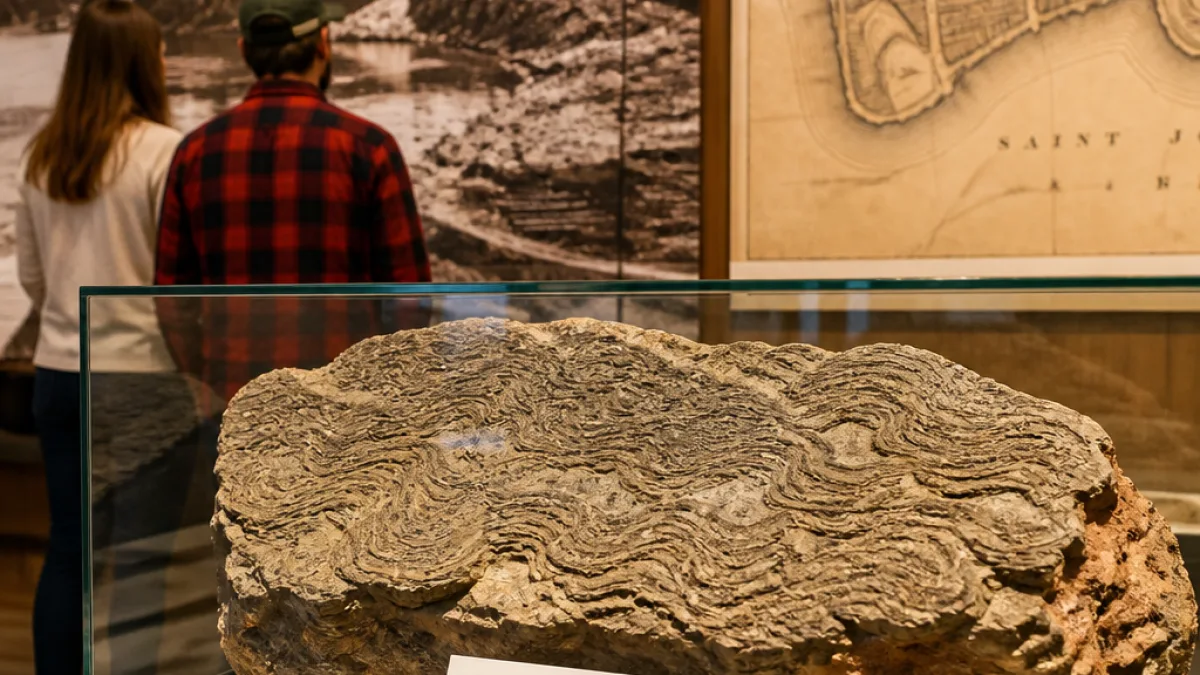
Saint John’s shoreline now known as Dominion Park holds a quiet, deep-time claim to fame: a slab of rock preserving stromatolites, some of the oldest fossil evidence yet identified in Atlantic Canada. The specimen — first recognised in the mid-19th century by a local customs clerk and amateur naturalist — links the city to biological activity more than 650 million years ago.
Local curiosity led to scientific recognition
George Matthew, born in Saint John in 1837, worked at the city’s customs office but pursued natural history in his spare time. Contemporary accounts and later scholarship describe how Matthew explored nearby shores and, along with peers, formed an interest in the region’s complex geology. According to the New Brunswick Museum and subsequent writers, he helped found the Steinhammer Club in 1857 at age 20, a small group of young men fascinated by local rocks and fossils.
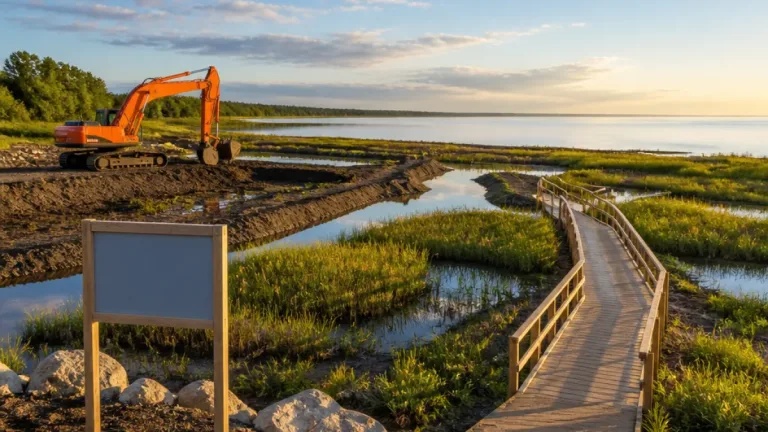
The fossil-bearing rock, reported from what sources variously describe as Red Head Cove and Green Head Cove in the present-day Dominion Park area, contains stromatolites — layered structures formed by colonies of microscopic organisms such as algae. These structures are widely recognised by geologists as some of the earliest evidence of life on Earth.
"Although the American geologist Charles Doolittle Walcott is viewed as the founder of Precambrian paleobiology, Matthew deserves acknowledgement for his early recognition of Precambrian life," wrote Randall Miller, formerly of the New Brunswick Museum and author on the subject.
Why the find matters to Saint John and science
For residents, the discovery underlines Saint John’s place in a much older geological story: during the Precambrian era the area that is now New Brunswick lay far to the south of its present latitude and supported primitive life forms long before complex animals or plants evolved. The fossil slab now held by the New Brunswick Museum is a tangible connection between city residents and that deep past.
Recognising Matthew’s role also matters for how local scientific contributions are remembered. The history of paleontology often highlights major figures who worked in larger institutions, but Matthew’s work as a self-taught observer in Saint John is an example of meaningful, place-based scientific contribution from outside university settings.
- Find site: reported as Red Head Cove / Green Head Cove in present-day Dominion Park
- Discoverer: George Matthew (born 1837), customs office employee and amateur geologist
- Fossil type: stromatolites (microbial mats, algae-related structures)
- Age: about 650 million years (Precambrian)
Preservation and public access
The specimen’s presence in the New Brunswick Museum means it is curated and available for study and interpretation, giving local residents and visitors an opportunity to see an object that ties Saint John to global questions about early life. Museum staff and regional geologists can use the slab for education, connecting classroom lessons to a nearby shoreline that many residents walk or drive past without realising its deep-time significance.
Local history groups and museums often rely on the work of amateur collectors and curious observers. Matthew’s example — a city clerk who combined a day job with sustained study of the natural world — is a reminder of the contributions that can come from outside formal institutions.
| Year | Event |
|---|---|
| ca. 650 million years ago | Stromatolite formation (Precambrian) |
| 1837 | George Matthew born in Saint John |
| 1857 | Founding of the Steinhammer Club (Matthew, age 20) |
For Saint Johners, the discovery is more than a scientific footnote: it is a civic story. The cove where the rock was first noticed is part of the city’s shorelines, used today for recreation and contemplation. That same shore preserves a record of microscopic life from a time long before humans, animals or trees existed. The preserved rock and the story of its discoverer invite residents to take a longer view of the land they live on and to see local landscapes as chapters in the planet’s deep history.
As museums and researchers continue to study and interpret such finds, Saint John’s place in the narrative of early life remains a point of local pride and scientific interest.