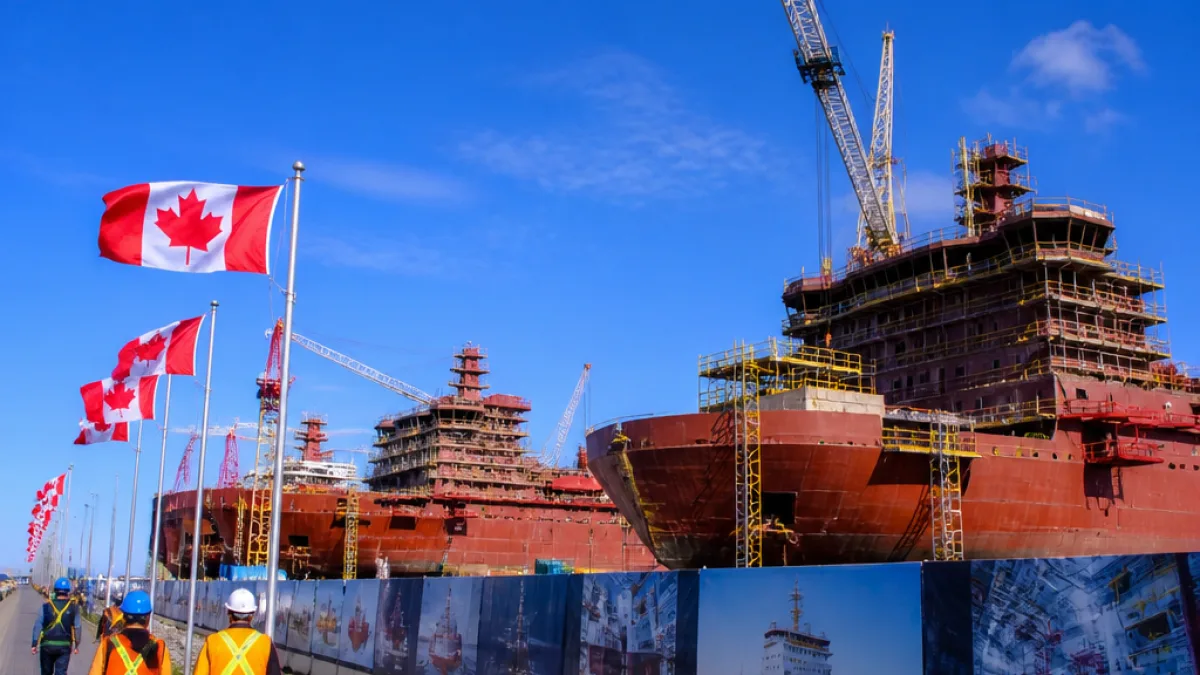
LEVIS — The federal government is promising a major boost to Quebec’s maritime industry with a contract worth $11.3 billion to build six new icebreakers at the Chantier Davie yard in Lévis, Prime Minister Mark Carney announced Monday.
Scope and schedule
Ottawa said the project — described by the prime minister as the province’s largest shipbuilding contract in generations — will see the first plate of steel cut next fall. Officials expect the first vessel to be delivered about five years after construction begins, with the entire six-ship fleet entering service five years following that first delivery.
| Milestone | Timing (as announced) |
|---|---|
| First steel cut | Next fall |
| First vessel delivered | About 5 years after steel cutting |
| Full fleet in service | About 10 years after steel cutting |
Jobs, suppliers and procurement
Carney said the contract will sustain roughly 5,000 jobs during construction and involve more than 1,500 suppliers from across Canada. The federal announcement highlighted the project’s alignment with a "Buy Canadian" procurement approach and confirmed the vessels will be built with Canadian steel.
- Construction site: Chantier Davie, Lévis, Que.
- Expected jobs during construction: 5,000.
- Number of suppliers involved: more than 1,500.
The government named several Ontario steel producers it expects to supply material for the builds, including facilities in Sault Ste. Marie, Brampton and Hamilton, underscoring the project’s national supply chain reach.
Political context at the announcement
Premier Christine Fréchette joined the prime minister at the Davie yard. The provincial leader — speaking in French and appearing ahead of a provincial campaign — said the contract will protect Quebec’s economic autonomy and create skilled careers such as welding and technical trades.
“Some people might want to rule over us,” Fréchette said in French, adding that the province “will not yield to any kind of threat.”
Her remarks came days after bilateral trade talks with the United States collapsed and amid new tariff threats from President Donald Trump, according to the federal announcement. The timing framed the deal as also being about national industrial resilience and sovereignty.
Industry significance and local impact
Chantier Davie will construct all six vessels, a win for the Lévis yard and for Quebec’s shipbuilding cluster. Officials billed the plan as the largest shipbuilding agreement the province has seen in decades, signalling a long-term programme of heavy marine construction that could anchor local skilled-labour markets and subcontractor networks.
Beyond direct employment at the yard, the project is likely to sustain jobs in steel manufacturing, transportation and specialized marine suppliers across several provinces — a point Ottawa emphasised in naming specific Ontario suppliers expected to participate.
Reactions and next steps
While federal and provincial officials celebrated the announcement, opposition voices signalled scrutiny. A Conservative defence critic said the timeline to renew coast guard icebreaking capacity had been slow, according to a social media post noted at the press event.
Carney reiterated the government’s intent to move quickly on the programme. Contractual arrangements, detailed procurement milestones and the names of specific contractors beyond Chantier Davie were not released at the announcement. Those details and tendering processes will shape the coming months as the programme transitions from announcement to active construction.
Why icebreakers matter
The new fleet is intended to replace aging heavy and medium icebreakers in the Coast Guard’s inventory and to operate year-round in key Canadian waterways. Officials said the vessels will operate in Atlantic Canada and the St. Lawrence River during winter months and in the Arctic during summer, ensuring navigation, supply and safety services in ice-prone regions.
For Lévis and the Quebec shipbuilding sector, the contract offers a decade-long horizon of work and investment that industry leaders hope will translate into apprenticeship opportunities, higher-skilled employment and strengthened local supply chains.
As the programme moves forward, attention will shift to the procurement schedules, the composition of the Canadian supply chain, and how the work will be phased at Chantier Davie — questions that will determine the full economic effect on Lévis and the surrounding region.