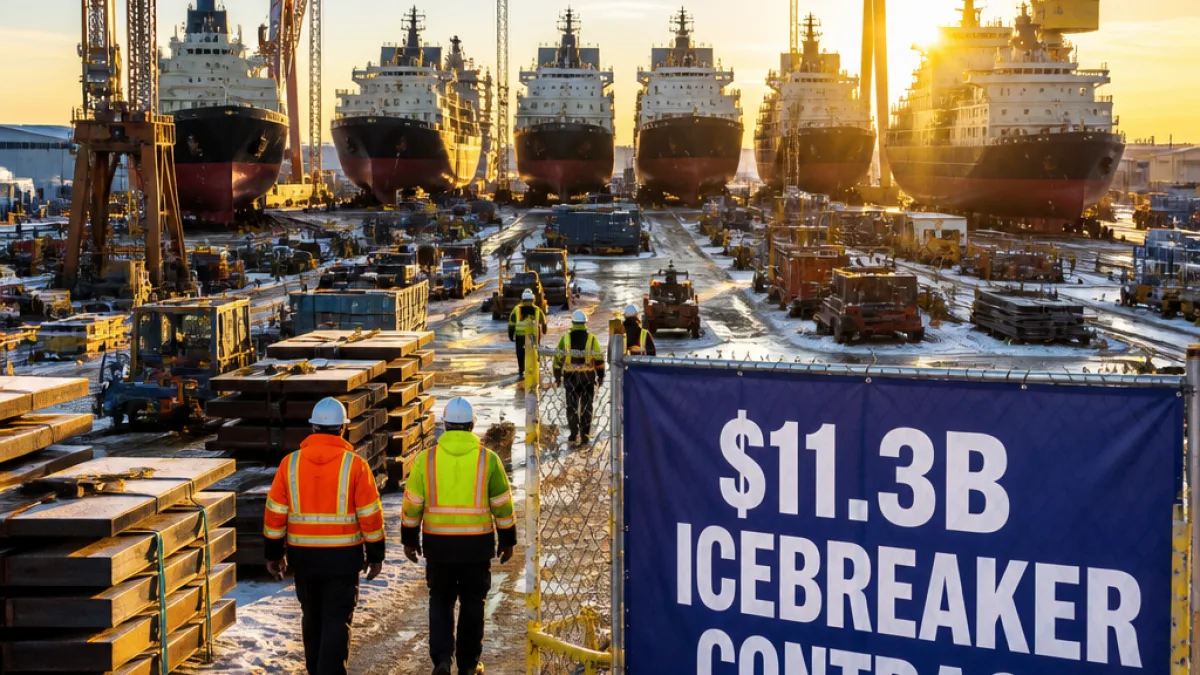
OTTAWA — The federal government will invest $11.3 billion to commission six new heavy and medium icebreakers to be built at the Chantier Davie shipyard in Lévis, Quebec, Prime Minister Mark Carney announced on Monday.
Commitment aims to renew ageing Coast Guard fleet
The vessels are intended to replace existing heavy and medium icebreakers and are described by the government as an essential upgrade to Canada’s capacity to operate in the St. Lawrence River during winter months and in Arctic waters during summer. The project was presented as the largest shipbuilding contract in Quebec’s history.
"We will move fast. The first steel will be cut next fall, the first ship will be delivered five years later, and the full fleet will be in service five years after that," Carney said.
The announcement was made at the Lévis yard where construction of all six icebreakers will take place. Quebec Premier Christine Fréchette joined the prime minister on site and framed the contract as a major win for the local economy ahead of the province’s pending election campaign.
"This is a great day for Lévis," Fréchette said, noting the contract will protect economic sovereignty and create skilled careers such as welders and technicians.
Jobs, procurement and timing
The federal office estimates the program will support roughly 5,000 jobs during the construction phase. The vessels will be built under the government's Buy Canadian procurement rules and will use Canadian steel, the office said.
- Construction site: Chantier Davie, Lévis, Quebec
- Number of ships: 6 icebreakers (Polar Class 3 design)
- Cost: $11.3 billion
- Estimated employment support during construction: 5,000 jobs
Project schedule
The government released a phased timeline for the program. Key dates cited at the announcement include the start of steel cutting, the initial delivery and the full fleet in service.
| Milestone | Timing |
|---|---|
| First steel cut | Next fall |
| Delivery of first ship | Five years after steel cutting |
| Entire fleet in service | Five years after first delivery |
Context within national shipbuilding strategy
The icebreaker contract builds on an earlier design award: in 2024 Ottawa provided a $19.6-million contract to Davie under the national shipbuilding strategy to design the six Polar Class 3 vessels. The coast guard’s renewal forms part of a broader plan under the strategy to deliver 88 new vessels by 2045.
Analysts and stakeholders widely view the plan as an attempt to modernize ageing assets that are increasingly strained by longer seasons of navigability and rising Arctic interest.
Political and economic implications
The announcement comes amid renewed trade tensions with the United States and just days after bilateral talks failed to reach agreement. Ottawa framed the procurement as both an economic stimulus for Quebec and a reaffirmation of Canada’s domestic industrial policy in the face of external tariff pressures.
For Lévis and the surrounding region on the south shore of Quebec City, the contract will represent a sustained period of activity for the yard, with implications for supply chains and trades training. Premier Fréchette emphasised the potential for long-term careers in skilled trades.
What remains to be seen
Details still to be clarified include delivery schedules for each hull, the exact composition of the workforce at peak construction, and the procurement breakdown for subcontracts and steel suppliers. The federal office has said the work falls squarely under Buy Canadian provisions and that Canadian steel will be used, but further procurement documents will provide specifics.
Davie’s yard, which has expanded yard capacity in recent years, will be under close observation as the nation watches how quickly the project moves from design to production.
The icebreaker program is a high-profile element of Canada's effort to strengthen maritime infrastructure and industrial capability in Quebec — a province where shipbuilding has long been intertwined with regional economies and political debates over manufacturing and sovereignty.
— Reporting from Lévis and Ottawa