
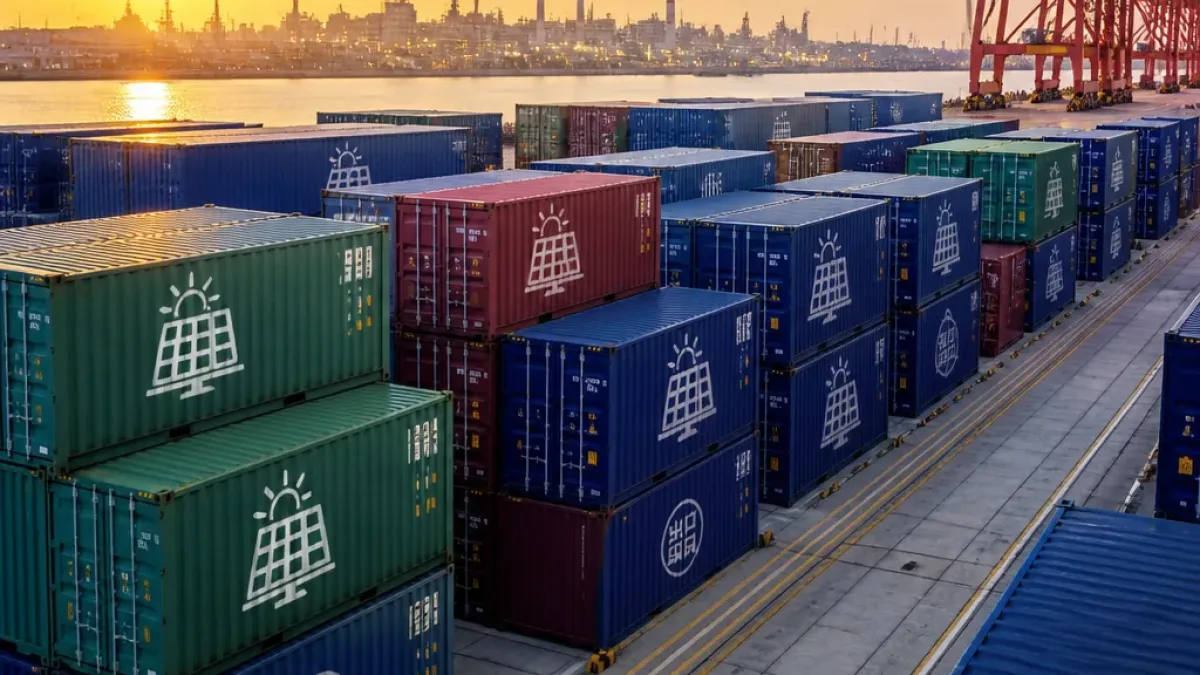
China has proposed export restrictions on 12 solar manufacturing technologies, a regulatory move framed as a matter of national security that could reshape global photovoltaic supply chains and complicate efforts by overseas producers to scale up domestic solar manufacturing.
What Beijing is proposing
The Ministry of Commerce announced the plan as part of a broader revision of its technology export-control catalogue, which also covers artificial intelligence and biotechnology. Officials said more oversight was needed because some photovoltaic technologies are increasingly used in sensitive sectors, including aerospace and national defence.
Under the proposal, China would prohibit exports of technologies used to manufacture thin silicon wafers, perovskite and tandem solar cells, and large-scale fluidised-bed polysilicon production systems. The move would, in effect, make those capabilities inaccessible to overseas buyers without a licence.
The draft rules would also restrict — rather than ban outright — advanced solar cell manufacturing technologies such as TOPCon, heterojunction technology (HJT) and XBC.
Why these technologies matter
The technologies singled out in the proposal are tied to higher-efficiency or lower-cost pathways in solar production:
- Perovskite and tandem cells promise greater sunlight conversion by combining materials to capture a broader spectrum of light.
- Thin silicon wafers reduce material use and cost while supporting modern cell designs.
- Fluidised-bed polysilicon production is a method that can be more energy-efficient and cheaper than the conventional Siemens process.
Restricting access to these processes could slow technology transfer to foreign manufacturers trying to build non-Chinese supply chains or domestic plants.
Potential impacts on global manufacturing and policy
Industry watchers say the proposal could complicate expansion plans by overseas manufacturers and firms that rely on Chinese equipment and know-how. The source material notes previous discussions between Chinese officials and manufacturers and specifically mentions U.S. companies, including Tesla, whose solar ambitions have included overseas manufacturing initiatives.
India, which has pushed to develop domestic solar manufacturing to reduce reliance on Chinese suppliers, has also faced tighter access to Chinese solar manufacturing technology according to the same report.
Those dynamics fit a broader pattern in which governments treat advanced clean-energy manufacturing as a strategic industry and seek to retain competitive advantage through export controls and industrial policy.
Proposed controls at a glance
| Action | Technologies |
|---|---|
| Prohibit exports | Thin silicon wafers; perovskite cells; tandem solar cells; large-scale fluidised-bed polysilicon production systems |
| Restrict exports | TOPCon; heterojunction technology (HJT); XBC |
Implications for Canada and the clean-energy transition
For Canadian policymakers and industrial planners, the proposal underscores a persistent risk: supply of critical clean-energy hardware and the advanced manufacturing technology behind it can be concentrated in a handful of countries and may be subject to political restrictions. That has consequences for procurement, industrial policy and plans to scale up domestic manufacturing.
Even where Canadian firms are not directly affected, the change could ripple through global component markets. Equipment, process licences and technical expertise often flow across borders; tighter controls could raise costs, delay projects or alter where firms choose to build factories.
China frames the shift as a national-security measure linked to dual-use applications. Whether other governments respond with their own export or investment controls, or with incentives to build alternative supply chains, will determine how durable the proposal's effects become.
At this stage the measures are a proposal. The Ministry of Commerce published the revision to the export-control catalogue as part of a consultation process; details on the timing and implementation mechanisms were not provided in the source material. Observers will be watching for final language, licensing procedures and any carve-outs for international partners or joint ventures.
Regardless of the final form, Beijing's move signals that advanced solar manufacturing is now squarely in the realm of strategic technology policy — and that access to the next generation of solar production know-how may become a matter of geopolitics as much as engineering.