
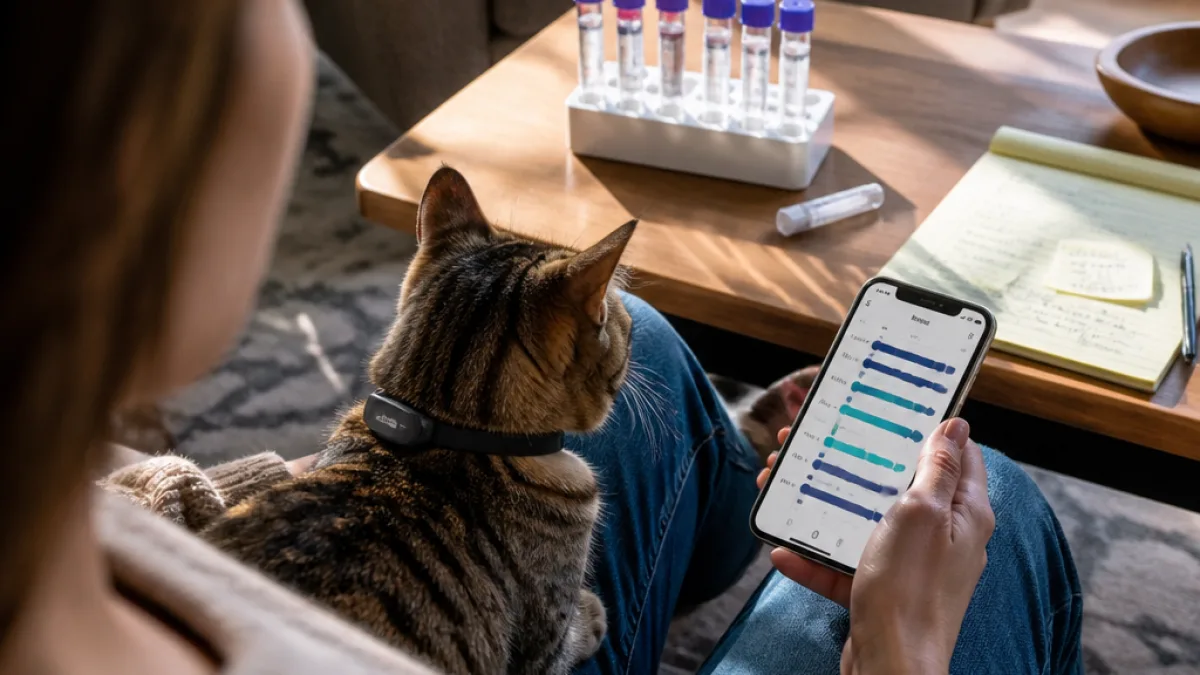
Everyday closeness with a cat — rather than how long you’ve owned it — may be the key to the emotional perks many owners report, according to a small observational study from Kyoto University that tracked the daily lives and biology of cat–owner pairs for one month.
Study design and core findings
The research team followed 29 cats and their 19 owners for 30 days, recruiting participants via flyers and social media. To monitor routine contact, researchers attached small Bluetooth Low Energy (BLE) beacons to cats’ collars. They also collected urine samples from both cats and humans to measure concentrations of two hormones linked to social bonding and stress: oxytocin and cortisol.
Key patterns emerged:
- Owners who spent more time physically close to their cats reported more positive feelings.
- How long the owner had the cat was not associated with those positive mood reports.
- Higher oxytocin levels in cats’ urine were associated with higher oxytocin in their owners’ urine.
- Cats with higher oxytocin tended to have owners with lower cortisol levels and fewer reported negative moods.
| Measure | Value |
|---|---|
| Number of cats | 29 |
| Number of owners | 19 |
| Monitoring period | One month |
| Tracking method | BLE beacons on collars; urine samples |
What the results suggest — and what they do not
The study adds a biological dimension to the idea that companion animals can affect human well-being. The associations between a cat’s oxytocin and an owner’s lower cortisol and fewer negative moods point to a possible bidirectional social connection: when cats show hormonal signs of bonding, owners may experience less stress.
However, the authors and reporting underline important caveats. The sample size is small, and the design is observational. The relationships identified are correlations, not proof of cause and effect. In other words, the study cannot show that a cat’s oxytocin directly reduces an owner’s stress — only that the measures moved together in this group over the month studied.
How this fits with existing research
Past research on companion animals has been mixed. Several studies have found lasting health benefits associated with dogs, while evidence for cats has been inconsistent. Researchers at Kyoto University framed this work to test whether the quality and frequency of everyday interactions, rather than the mere fact of ownership or the length of the relationship, might explain some of those inconsistent findings.
The study’s approach — combining proximity tracking with physiological sampling — aims to capture the texture of daily life that traditional surveys can miss. It suggests that routine, close contact may be the mechanism by which some owners experience emotional benefits.
Implications and next steps
For clinicians, pet-therapy programmes and public-health observers, the study offers a hypothesis worth testing at scale: interventions that encourage safe, positive day-to-day interactions between people and their pets might produce measurable benefits. But larger, controlled studies are needed to determine causation, to explore the directionality of the hormonal links and to assess variability across different households and cat temperaments.
Until then, the research provides a cautious reassurance for cat owners: the small moments of proximity — sitting together on a couch, stroking a purring coat, sharing quiet space — may be where the measurable emotional value of the relationship resides, even if ownership alone isn’t a guaranteed mood booster.