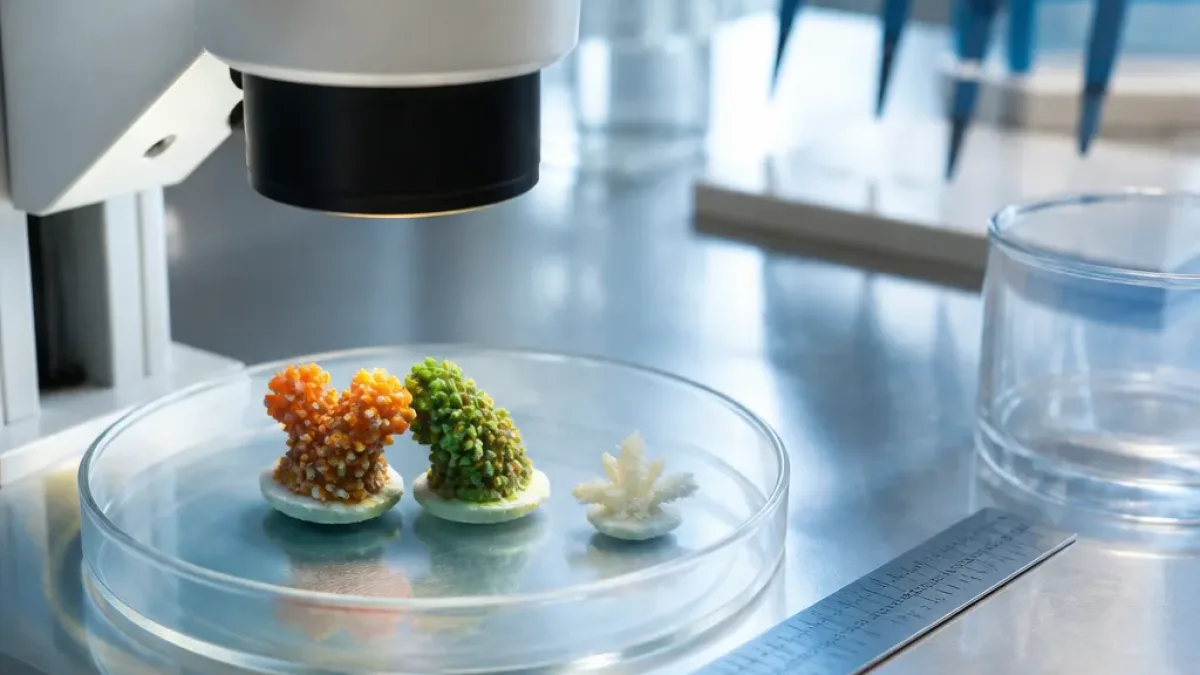
Laboratory work published in Science Advances suggests a startlingly simple route to help some corals recover from bleaching: a touch. In experiments led by researchers at Stanford, bleached coral fragments that were placed in direct contact with genetically identical, healthy fragments regained colour within seven weeks, while bleached pieces positioned only a few millimetres away but not touching did not recover and eventually died.
Direct contact appears to transfer life-sustaining algae
The new findings hinge on the intimate partnership corals share with colourful microscopic algae that live inside their tissues and supply most of their energy. When seawater temperatures rise, corals commonly expel these algal symbionts, a response known as bleaching that leaves the animals pale, starved and vulnerable. Recovery traditionally can be slow, taking months to years if it occurs at all.
In the Stanford experiments, researchers used fragments cut from the same parent colony — genetically identical pieces often called clones in coral work — and observed that where a healthy fragment touched a bleached one, colour began to return. By contrast, fragments set just millimetres apart but not in physical contact failed to regain their symbionts.
"While bleached corals may be dying, they are not dead yet," said lead author Danny Collins, an oceans Ph.D. student at the Stanford Doerr School of Sustainability.
The team’s discovery grew from an accidental observation in 2025, when Stanford marine biologist Steve Palumbi noticed two fragments from the same colony had toppled in a tank and made contact. Colour was returning at the point of contact on the bleached piece — a clear sign that the microscopic algae were moving back into the coral tissue.
Implications for reef conservation and future research
The results point to a potentially pragmatic pathway for accelerating recovery in some bleaching events, though the work so far is laboratory-based and limited to genetically identical pairs. The researchers caution that proximity alone — without actual physical contact — did not produce recovery in their trials.
- Recovery timeline: Bleached fragments regained colour within seven weeks when touching healthy clones.
- No contact, no recovery: Bleached fragments a few millimetres away from healthy partners failed to recover and ultimately died.
- Origin of discovery: An accidental tank collision observed in 2025 prompted systematic experiments.
These findings sharpen questions about how symbionts move between host animals — whether by direct tissue transfer, surface migration, or other mechanisms — and under what circumstances such transfers might be feasible in natural reef settings. The requirement for genetic identity between donor and recipient fragments in the experiments also raises important limits: wild reefs are genetically diverse and corals are subject to additional stressors such as disease, pollution and ongoing warming.
Marine heat waves are becoming both more frequent and intense, increasing the number of bleaching events globally. Any method that plausibly speeds recovery warrants close attention from researchers and reef managers, yet the jump from controlled tanks to complex reef ecosystems is non-trivial. Questions remain about scalability, risks of moving tissue between colonies, and whether contact-mediated transfer could work across different coral species or between non-clonal individuals.
The study offers a clear experimental signal that bleached corals can be revived rapidly under specific conditions, and it provides a fresh avenue for both laboratory research and cautious field trials. If further work confirms the mechanism and safety of contact-mediated symbiont transfer, it could inform targeted interventions as part of broader restoration strategies — though not as a substitute for the primary need to address climate-driven warming that causes mass bleaching in the first place.
| Condition | Outcome |
|---|---|
| Bleached fragment touching healthy clone | Colour regained within seven weeks |
| Bleached fragment a few millimetres away (no contact) | No recovery; eventual death |
The work underscores a simple scientific truth: sometimes subtle observations — a tipped fragment in a tank — open doors to new understanding. Translating that understanding to the open ocean will require careful, evidence-driven steps rooted in both ecological science and conservation ethics.