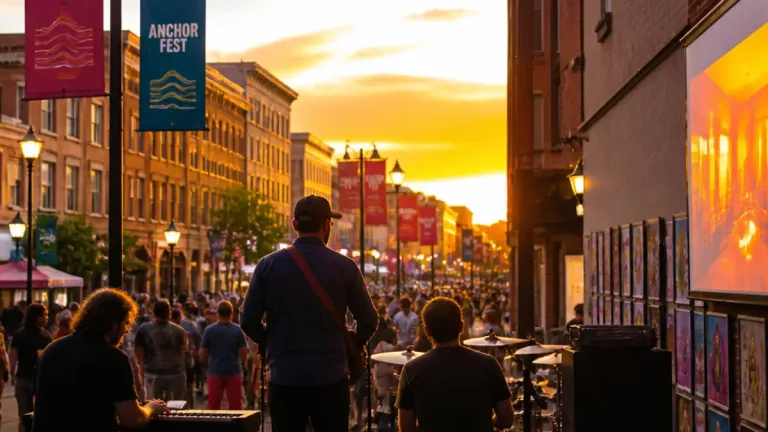

A traditional Innu tent and a spoken-word performance drew a crowd on Water Street this past Saturday as part of the Hold Fast Contemporary Art Festival, using St. John’s most trafficked pedestrian mall to make a pointed statement about how Innu history is being represented in the province.
Taking up space on Water Street
The installation was presented by artist Melissa Tremblett of Sheshatshiu, Labrador. It combined a temporary tent structure with a spoken-word piece titled "300 years," placing Indigenous presence squarely in the heart of St. John’s commercial district.
Tremblett said the work is a response to a public disagreement that began in June when Innu Nation publicly criticised a provincial exhibit that they say limited Innu history in Labrador to about 300 years. That exhibit had been planned for the Labrador Interpretation Centre in North West River and was pulled before its scheduled unveiling on National Indigenous Peoples Day.
“I feel when I'm on Water Street, in the middle of the pedestrian mall on a Saturday with an Innu tent which, you know, doesn't belong there, you know, in a way it's taking land back, it's taking space. It's putting ourselves in a place to be seen,” Tremblett said.
Artist’s intent and public reaction
The display was framed as an act of visibility: bringing an object associated with Labrador’s Indigenous people into an urban setting where daily commerce and tourism normally dominate. Tremblett told CBC she wanted to "take space" and compel passersby to confront the contested history.
Organisers placed the installation in the pedestrian corridor intentionally during a busy Saturday to ensure maximum exposure. Observers included festival-goers, shoppers and tourists who paused to listen, photograph and ask questions. The work sat within the Hold Fast Contemporary Art Festival’s broader programming, which has a history of using public spaces to provoke conversation.
Where the dispute stands
The controversy centres on competing accounts of how long the Innu have lived in Labrador. Innu Nation maintains a timeline extending back millennia in the territory they call Nitassinan; the provincial exhibit was criticised by Innu leaders for portraying a much shorter presence.
Following the dispute, the province’s Indigenous Relations and Reconciliation Minister, Lela Evans, said in July the government would review the Innu timeline used in the exhibit. Beyond that announcement, public details on the review’s timeline and scope have been limited.
| Month | Event |
|---|---|
| June | Innu Nation objects to exhibit timeline |
| June | Exhibit pulled before National Indigenous Peoples Day unveiling |
| July | Province says it will review Innu timeline |
| August | Artist installs Innu tent on Water Street during Hold Fast festival |
Local implications
Putting the installation on Water Street transformed a corridor known for souvenir shops and seafood restaurants into a site of cultural contestation. For many St. John’s residents and visitors, it was an unmissable reminder that disputes over historical narrative are not confined to government offices or museums — they can spill into the public square.
While the provincial review was announced in July, the artist’s intervention suggests that, in the eyes of some Labradorians and local Indigenous artists, there remains work to be done to ensure history is told in a way that honours community knowledge and continuity. The action also raises questions about how urban centres like St. John’s can accommodate and reflect Indigenous voices from Labrador.
- Artist Melissa Tremblett staged the display on Water Street during the Hold Fast Contemporary Art Festival.
- The installation responds to a dispute over an exhibit that Innu Nation said limited Innu history in Labrador to 300 years.
- The province announced a review of the timeline in July; further details on that review remain limited.
As conversations continue between Innu Nation and the provincial government, the tent on Water Street served as a reminder that history, representation and public space remain intertwined — and that for many, those conversations are not abstract, but lived and visible in communities from Labrador to St. John’s.
Coverage for this story included reporting by CBC and statements from the artist and provincial officials; no new findings were introduced beyond those sources.