
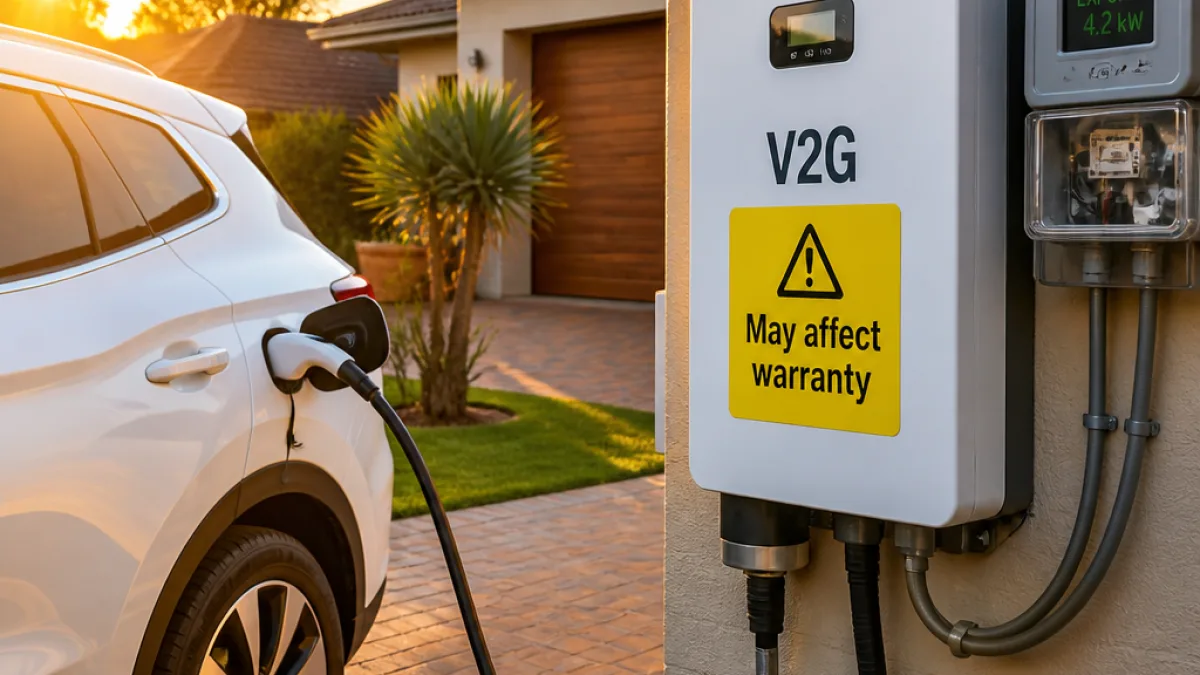
South African EV owners should take note of an emerging international warning: using vehicle‑to‑grid (V2G) systems that allow a car battery to feed power back into the grid can risk voiding manufacturer warranties. The issue was highlighted in recent reporting on Australian markets and echoes concerns manufacturers and industry representatives have raised globally about safety, battery degradation and unauthorised modifications to vehicle systems.
What V2G does and why manufacturers are cautious
Vehicle‑to‑grid technology enables an electric vehicle battery to discharge electricity back to the grid at times of high demand, potentially allowing owners to earn income or offset household bills. But industry voices warn most current warranties were not written with V2G in mind. The Electric Vehicle Council’s head of energy, infrastructure and commercial affairs, Alina Dini, told reporting that "current warranties generally weren't designed to account for undertaking V2G" unless expressly permitted in the warranty terms and conditions.
"Unless it has been stipulated in those terms and conditions that vehicle to grid is allowed, it's generally not,"
Those concerns centre on two practical risks: accelerated battery deterioration from increased cycling and safety problems where third‑party bidirectional chargers override vehicle controls. Hyundai Australia, for example, said none of its vehicles support V2G in Australia and warned unapproved bidirectional charging "introduces safety risks, potential vehicle damage and warranty implications for your vehicle." Their senior manager for future mobility and government relations, Scott Nargar, noted that third‑party set‑ups may not allow the car to control the energy transfer, which could lead to overheating or other faults that would not be covered by warranty.
Which brands are warning and who offers support
Most mainstream brands referenced in the reporting — BYD, Hyundai, Kia, Tesla and Zeekr — caution against unauthorised V2G set‑ups because of potential safety and warranty consequences. Mitsubishi was identified as one of the few manufacturers actively supporting V2G in a limited form: its Outlander plug‑in hybrid SUV has warranty provisions that accommodate V2G, although the company still cautions about repeated fast charging reducing battery capacity.
| Manufacturer | Position on V2G (per reporting) |
|---|---|
| BYD | Warns against unapproved V2G set‑ups |
| Hyundai | No vehicles in Australia support V2G; warns of safety and warranty risks |
| Kia | Warns against unapproved V2G set‑ups |
| Tesla | Warns against unapproved V2G set‑ups |
| Zeekr | Warns against unapproved V2G set‑ups |
| Mitsubishi (Outlander PHEV) | Offers limited support in warranty for V2G, with caveats |
What this means for owners and prospective buyers
For owners considering V2G, the immediate implication is to check warranty documents and consult manufacturers before installing third‑party bidirectional chargers. Unapproved hardware that circumvents vehicle software or control logic may create heat, stress batteries and trigger faults that manufacturers will not cover. That leaves owners exposed to repair bills and possible safety hazards.
- Read warranty terms carefully to see if V2G or bidirectional charging is permitted.
- Contact your vehicle manufacturer or dealer for written guidance before installing third‑party V2G equipment.
- Avoid aftermarket set‑ups that require software workarounds or remove vehicle control over charging cycles.
- Consider the battery implications: more frequent deep cycling can reduce usable capacity over time.
Manufacturers and regulators will need to clarify standards and acceptable hardware if V2G is to scale without undermining consumer protections. In the interim, owners should weigh the potential financial benefit of exporting electricity against the risk of accelerated battery wear and the possibility of voided warranty cover.
Local relevance and practical steps
In South Africa, where grid reliability and Eskom load‑shedding are ongoing issues, V2G is an attractive concept because it promises flexibility and potential revenue for vehicle owners. But the same manufacturer cautions apply: unless a vehicle's warranty and software explicitly allow bidirectional charging and the charging equipment is approved by the maker, owners could face denied claims for battery and electrical system failures.
Owners should keep records of any advice received from manufacturers, insist on written confirmation if a V2G arrangement is supported, and prioritise approved solutions. For now, the most secure route is to use manufacturer‑approved chargers and to avoid retrofit systems that bypass vehicle protections.
The debate over V2G highlights a wider tension between emerging energy services and legacy vehicle warranties: technology can outpace contracts and standards, and consumers often bear the immediate risk. Clearer manufacturer policies and industry standards will be essential if bidirectional charging is to become mainstream without creating new liabilities for owners.











