
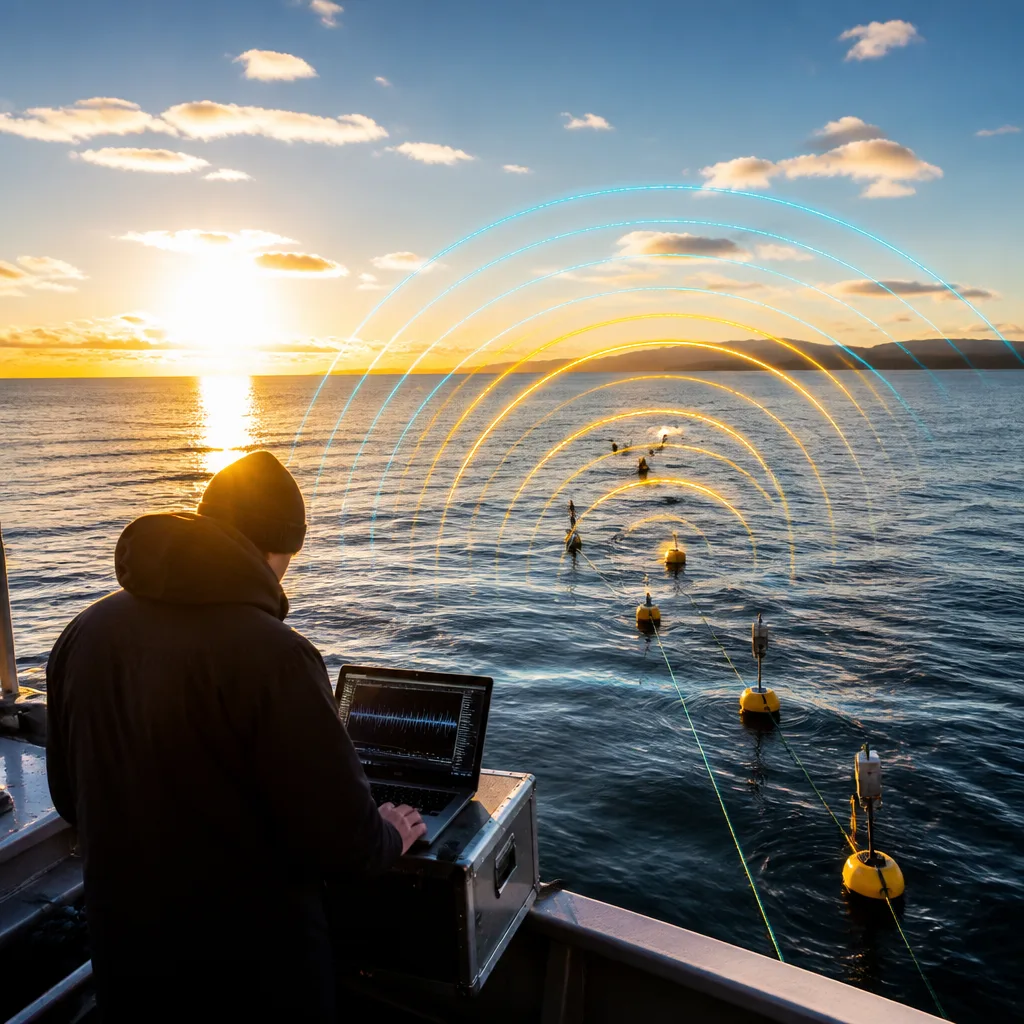
Interference between two wave paths can make a combined signal peak appear earlier than the direct arrival, according to a paper accepted for publication in Physical Review E. The work, arising from studies of underwater sound, shows how overlapping direct and reflected pulses can shift the time of a peak forward — an effect that can look like a signal travelling faster than light but does not violate the speed limit set by special relativity.
From whale calls to a surprising theoretical result
The study began with practical problems in ocean acoustics. Scientists use multiple hydrophones to locate calling whales by comparing when the sound reaches each sensor. Earlier research by the same group showed that reflections off the water surface can combine with direct sound to change the apparent arrival time, producing errors in localisation.
Building on that work, acoustician John L. Spiesberger of the University of Pennsylvania and oceanographer Eugene Terray of the Woods Hole Oceanographic Institution explored how a range of realistic pulse shapes behave when a direct path and a reflected path interfere at a receiver. They found that under certain conditions the interference can shift the moment of peak energy so it appears earlier than the direct-wave peak alone would arrive.
"We prove the speed of information is less than or equal to the speed of light in a vacuum, so the effect does not violate special relativity," the authors wrote.
How the effect works — and why it isn’t faster-than-light communication
Waves add together; where two partial waves arrive close in time their superposition can change the shape of the combined pulse. If the reflected component is delayed and has a particular phase and amplitude relative to the direct component, the interference can move the highest-energy point of the summed signal earlier or later than the direct component’s peak.
Crucially, the authors emphasise that the information contained in the wave cannot be transmitted faster than light. The apparent early peak is a property of the pulse shape created by interference, not a carrier of new information that outruns causal limits. In other words: the observed peak time is a feature of how energies combine, not a violation of relativistic causality.
Potential implications and limits
The work has two clear strands of consequence. First, for underwater acoustics it identifies a mechanism that can bias time-of-arrival measurements and therefore degrade position estimates if it is not accounted for. Second, because waves obey similar mathematics across domains, the mechanism could in principle apply to electromagnetic waves, including light, though the paper presents the idea as theoretical rather than experimentally established for optics.
The authors caution that demonstrating the effect with light would require careful experimental design; materials, dispersion and the available pulse shapes in optics differ from ocean acoustics. They also stress that the fundamental bound on information speed remains intact — which is why the result is better read as a subtlety in wave dynamics rather than a route to faster-than-light signalling.
- Domain tested: underwater sound, motivated by whale localisation studies.
- Mechanism: interference between direct and reflected wave components can shift combined pulse peak times.
- Relativity: information speed remains ≤ speed of light; effect does not transmit information superluminally.
- Broader relevance: may affect acoustic ranging and, in principle, optical pulse behaviour — but optical demonstration is not yet shown.
| Path | Effect on received pulse |
|---|---|
| Direct path only | Gives the baseline arrival time of the pulse peak |
| Direct + reflected (interfering) | Combined waveform can have peak shifted earlier or later, depending on phase and shape |
Where next for experiments and applications
For engineers and field scientists the practical takeaway is clear: when precise timing is used for localisation or synchronisation, complex multipath interference can bias results in unexpected directions. Modelling and measurement strategies that account for pulse shape and multipath geometry will be needed to mitigate errors.
For physicists the finding opens a conceptual door. The mathematics suggests analogous behaviour could exist for other wave types, including light in vacuum, but the paper stops short of claiming that optical experiments have observed the phenomenon. Laboratory tests with controlled pulse shapes and well-characterised reflective geometries would be the logical next step.
Overall, the result is a reminder that wave behaviour can produce counterintuitive appearances without overturning fundamental limits. It highlights the importance of distinguishing the motion of an identifiable feature of a waveform from the transmission of new information — a distinction at the heart of why relativity survives even when peaks seem to race ahead.


