
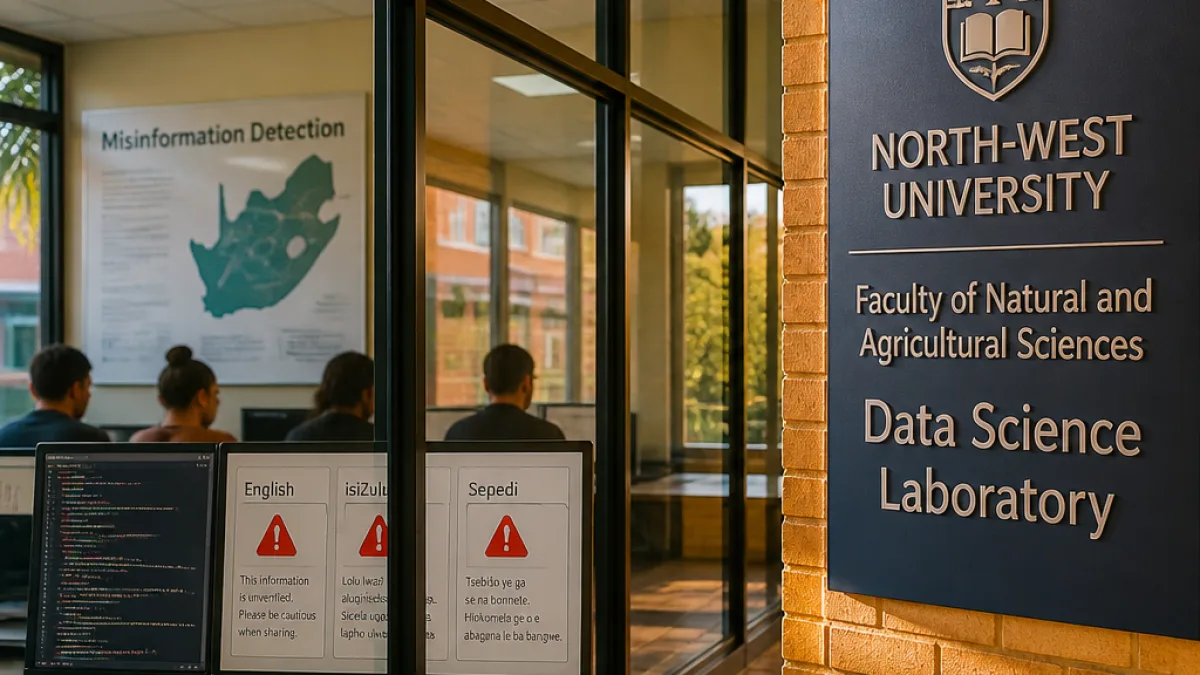
Researchers at North-West University (NWU) have developed a multilingual artificial intelligence framework designed to detect misinformation across English, isiZulu and Sepedi. The work aims to strengthen protection for speakers of South Africa’s indigenous languages in digital spaces where most fact‑checking tools remain English‑centric.
Why language matters in fighting false information
The NWU study used misinformation circulated during the Covid‑19 pandemic as a pilot case to test whether a single system could identify misleading claims in multiple languages. The researchers found that building multilingual tools is feasible but depends heavily on the quality of machine translation for so‑called low‑resource African languages.
Speed is critical when misinformation spreads during elections, public emergencies or health crises. The NWU framework could enable earlier detection of false content and improve access to credible information for speakers who are less likely to find reliable content in their home languages.
Potential users and practical impact
The researchers say the framework could support a range of actors, including government departments, fact‑checking organisations, social media platforms and community groups. Improved multilingual detection promises practical benefits:
- Earlier identification of high‑risk or viral falsehoods in multiple languages;
- Better reach of public health and safety messages to non‑English speakers;
- Support for community‑level decision‑making during emergencies and elections.
By centring language diversity in system design, the work attempts to prevent speakers of indigenous languages from being left behind as AI tools play a greater role in moderating online content.
Technical challenges and next steps
The research highlights that translation quality remains a limiting factor. When machine translation is poor, downstream AI performance in identifying misleading claims falls away. To be effective at scale, the researchers argue, systems must improve how they process and translate low‑resource languages.
Planned next steps include expanding the framework to cover more South African languages and testing it on misinformation spread during elections and other high‑impact events. The team will also examine emerging threats such as AI‑generated deepfakes, hate speech and other harmful online content.
What this means locally
For communities across the North West and the broader central interior, the research offers the prospect of more reliable monitoring of harmful online claims in languages used every day at home and in workplaces. Health workers, local government communicators and community organisations could be better equipped to counter false claims before they influence behaviour.
Fact‑checking organisations and social media teams may find the framework helpful when prioritising resources, while government departments responsible for public communication could integrate multilingual detection to improve outreach during crises.
| Aspect | What NWU tested |
|---|---|
| Languages | English, isiZulu, Sepedi |
| Pilot domain | Covid‑19 misinformation |
| Key limitation | Quality of machine translation for low‑resource languages |
Researchers say the framework could also be a foundation for trustworthy multilingual systems such as large language models, retrieval‑augmented generation systems and knowledge graphs applicable in healthcare, education, agriculture and governance.
While the study does not claim a finished product ready for nationwide deployment, it marks a decisive step towards inclusive digital safety tools. The focus on indigenous languages recognises the practical reality that many South Africans consume and share information in languages other than English — and that misinformation can be harmful wherever it takes hold.
As the NWU work expands to more languages and new forms of online manipulation, collaboration with civil society, media, government communicators and tech platforms will be crucial to turning research into operational tools that protect communities across the province and country.











